
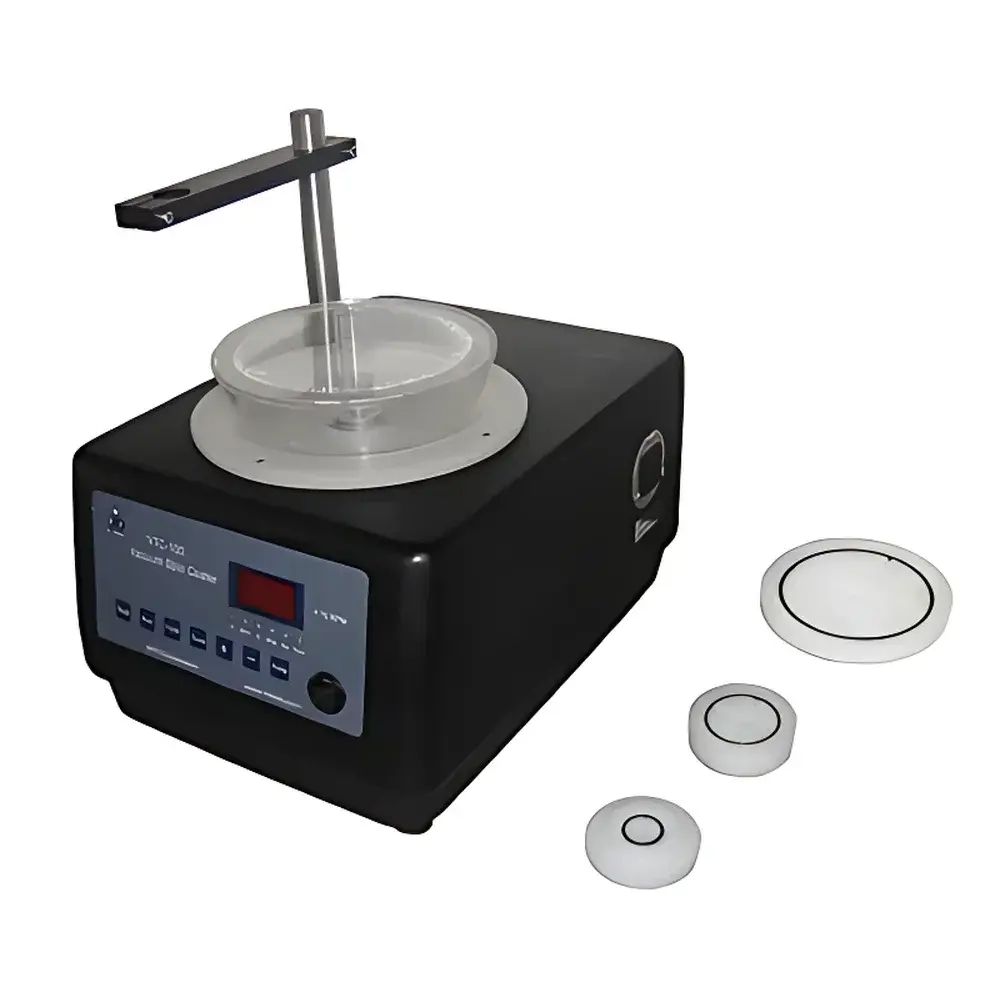
KJ GROUP VTC-100 Vacuum Spin Coater
| Brand | KJ GROUP |
|---|---|
| Origin | Liaoning, China |
| Manufacturer Type | Authorized Distributor |
| Country of Origin | China |
| Model | VTC-100 |
| Pricing | Upon Request |
| Power Supply | AC 220 V / 50 Hz (fixed), 10 A |
| Total Power Consumption | ≤150 W |
| Dimensions (W×D×H) | 380 × 260 × 330 mm |
| Weight | 20 kg |
| Vacuum Pump | Oil-free dual-piston, ≥70 L/min flow rate |
| Sample Holders | Three polypropylene vacuum chucks (Ø25 mm, Ø50 mm, Ø100 mm) |
| Rotation Direction | Counter-clockwise |
| Speed Range | 500–8000 rpm (SPD1 & SPD2, both fully programmable) |
| Speed Stability | ±1% |
| Spin Time Range | 1–600 s per stage |
| Control System | Microcontroller-based PCB with tactile keypad and LED 7-segment display |
| Vacuum Requirement | Negative pressure only (no compressed air or gas supply needed) |
| Operating Environment | 0–45 °C, 10–85% RH (non-condensing) |
| Structural Frame | Cast aluminum housing |
Overview
The KJ GROUP VTC-100 Vacuum Spin Coater is a precision-engineered laboratory instrument designed for reproducible thin-film deposition via centrifugal force-driven solution spreading. It operates on the principle of rotational fluid dynamics: a precisely metered volume of viscous precursor (e.g., polymer solutions, sol-gel precursors, photoresists, or nanomaterial dispersions) is dispensed onto a substrate mounted on a vacuum-chuck rotating disk; subsequent acceleration to high angular velocity induces radial thinning governed by viscous, inertial, and evaporative forces—yielding uniform films with thicknesses tunable from ~10 nm to several micrometers depending on solution rheology, concentration, and spin parameters. Engineered for academic and R&D environments, the VTC-100 delivers deterministic process control without requiring cleanroom integration, making it ideal for rapid prototyping of optical coatings, perovskite photovoltaic layers, graphene oxide films, and microelectronic resist patterning.
Key Features
- Two-stage programmable spin protocol: Low-speed dispensing (SPD1, 500–8000 rpm) followed by high-speed uniformity optimization (SPD2, independently adjustable 500–8000 rpm), enabling precise decoupling of solution delivery and film leveling.
- Vacuum fixation using three interchangeable polypropylene chucks (Ø25 mm, Ø50 mm, Ø100 mm), ensuring secure, non-damaging substrate clamping across diverse wafer and slide geometries without mechanical clamps or adhesives.
- Cast aluminum structural frame with vibration-damped mounting—minimizes mechanical resonance and ensures rotational stability at all speeds up to 8000 rpm (±1% speed consistency).
- Dedicated isolated power supplies for motor drive and control electronics, eliminating electromagnetic interference between actuation and signal processing circuits.
- Microcontroller-based digital control system with tactile membrane keypad and real-time LED countdown display—supports intuitive parameter entry and repeatable recipe recall without external software dependency.
- Integrated oil-free dual-piston vacuum pump (≥70 L/min free-air displacement) with low maintenance requirements, zero hydrocarbon emission, and compliance with ISO 8573-1 Class 0 air purity standards for vacuum lines.
Sample Compatibility & Compliance
The VTC-100 accommodates rigid, flat substrates including silicon wafers (up to 100 mm diameter), glass slides, quartz plates, ITO-coated substrates, and metal foils. Substrate thickness range: 0.1–5 mm. Vacuum chuck compatibility extends to standard SEM stubs and custom-machined fixtures (optional PTFE or aluminum chucks available). The system complies with general electrical safety requirements per IEC 61010-1:2010 (Equipment for Laboratory Use), and its oil-free vacuum architecture eliminates risk of sample contamination—critical for semiconductor-grade processes and GLP-compliant material synthesis. While not certified for GMP manufacturing, its deterministic two-stage timing logic and stable speed control support audit-ready documentation when paired with external logging tools.
Software & Data Management
The VTC-100 operates as a standalone benchtop instrument with no embedded operating system or network interface. All process parameters—including SPD1/SPD2 rpm values, T1/T2 durations, and vacuum activation sequence—are stored in non-volatile memory across power cycles. For traceability in regulated environments, users may integrate external USB data loggers or machine vision systems to record start/stop timestamps, motor current signatures, and vacuum pressure profiles. Though native software is not provided, the device’s fixed I/O architecture (24 V DC control signals, relay-triggered vacuum valve output) enables seamless integration into LabVIEW, Python (PySerial), or PLC-controlled workflows under ASTM E2500-13 guidelines for equipment qualification.
Applications
- Preparation of uniform photoresist films for maskless lithography and microfabrication training.
- Deposition of perovskite precursor layers in solar cell R&D, where solvent evaporation kinetics must be synchronized with spin acceleration profiles.
- Coating of antireflective and hydrophobic silica sol-gel films on optical substrates.
- Formation of conductive polymer thin films (e.g., PEDOT:PSS) for flexible electronics characterization.
- Controlled drying of colloidal nanoparticle suspensions (e.g., quantum dots, metal oxides) for self-assembled monolayer studies.
- Teaching laboratory demonstrations of Newtonian/non-Newtonian fluid behavior under centrifugal shear fields.
FAQ
What vacuum level does the integrated pump achieve?
The oil-free dual-piston pump delivers a base pressure of ≤5 × 10⁻² mbar (50 Pa) under standard conditions, sufficient for reliable chuck adhesion across all supported substrate sizes.
Can the VTC-100 accommodate non-circular substrates?
Yes—flat, rigid samples with minimum lateral dimension ≥25 mm can be secured using appropriate vacuum chuck selection and edge-sealing techniques (e.g., vacuum grease or optional gasket kits).
Is speed calibration traceable to national standards?
The unit includes factory-calibrated tachometric feedback; users may perform periodic verification using an external optical tachometer per ISO 16063-31 guidelines.
Does the device support external trigger input for synchronized dispensing?
No native TTL trigger input is provided; however, the dispensing step (T1) is manually initiated or timed via internal countdown—automation requires third-party solenoid valve integration.
What maintenance intervals are recommended for the vacuum pump?
The pump requires no scheduled oil changes; filter replacement every 6 months (or after 2000 operating hours) is advised per manufacturer specifications to maintain ≥95% rated flow capacity.



