
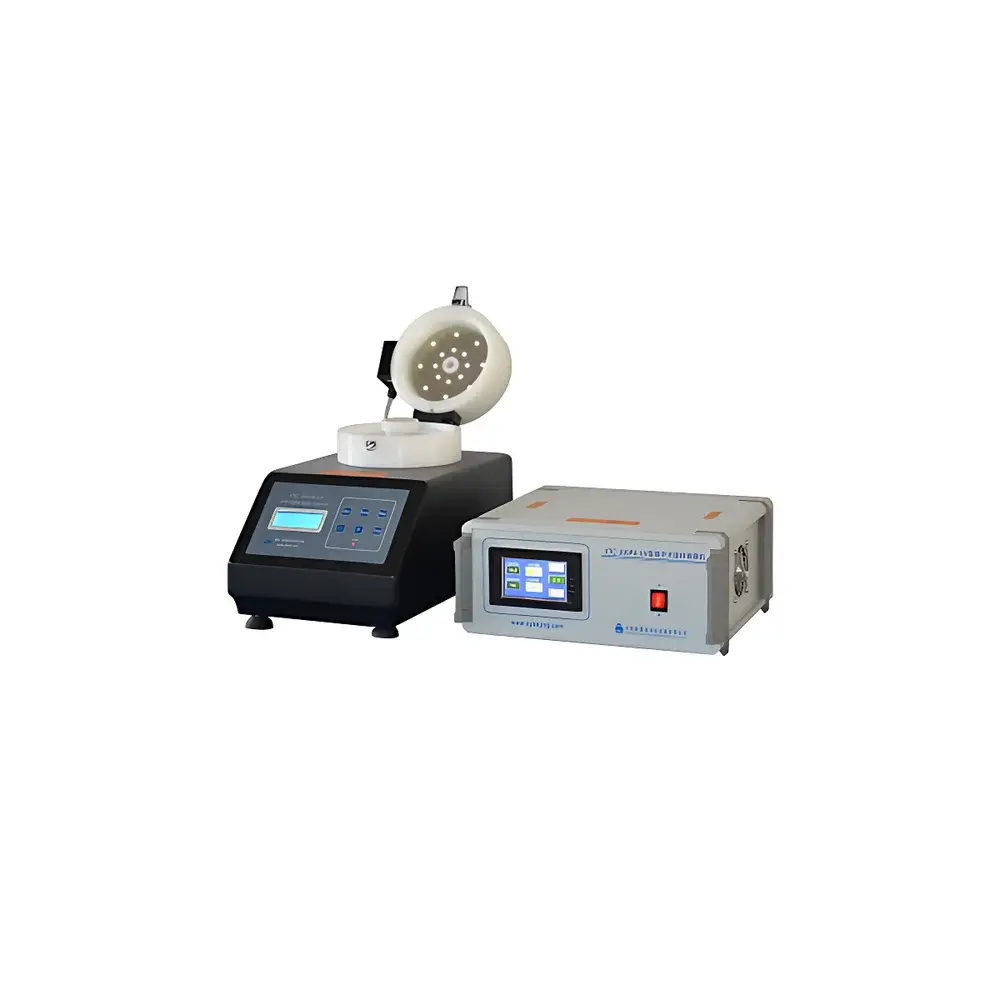
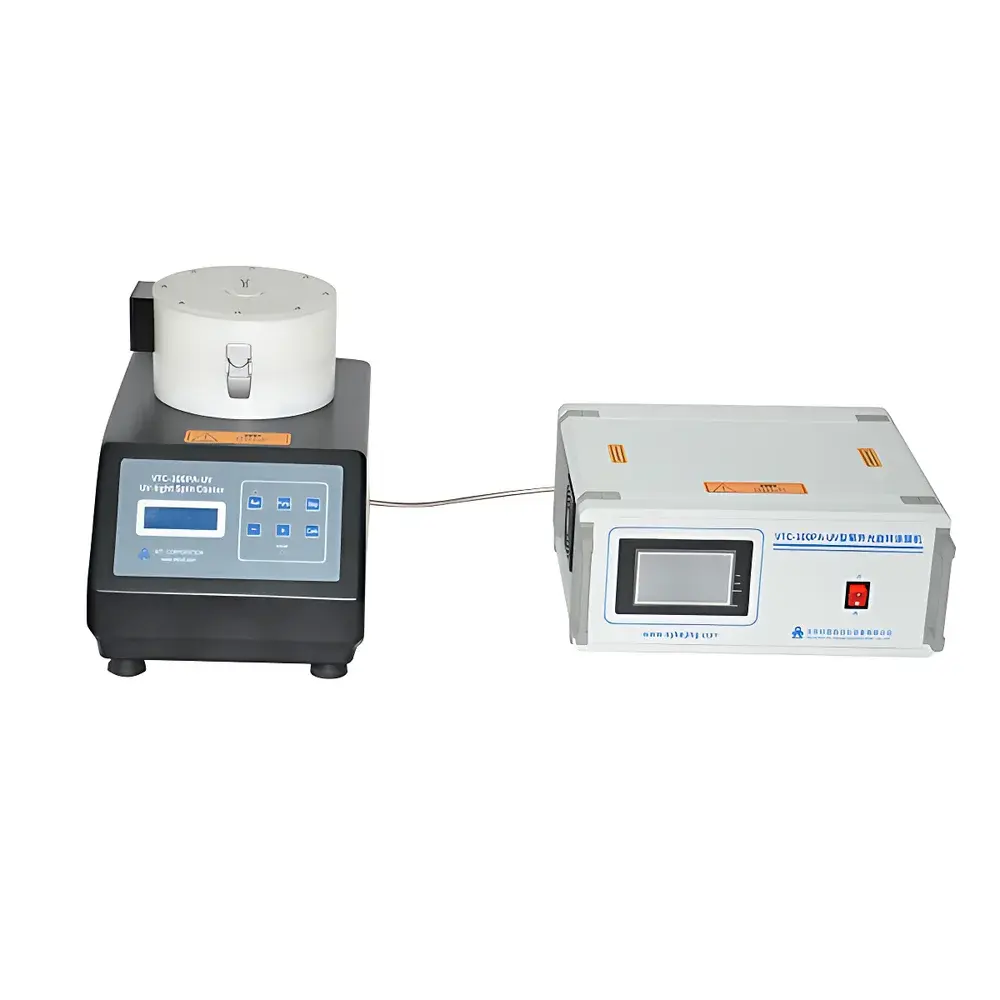
KJ GROUP VTC-100PA-UV UV-Curable Precision Spin Coater
| Brand | KJ GROUP |
|---|---|
| Origin | Liaoning, China |
| Manufacturer Type | Authorized Distributor |
| Origin Category | Domestic (China) |
| Model | VTC-100PA-UV |
| Quotation | Upon Request |
| Chamber Material | Polypropylene (PP) |
| Sample Fixation | Vacuum Chuck (Φ19 mm & Φ60 mm standard) |
| Speed Range | 500–10,000 rpm |
| Speed Stability | ±1% |
| Acceleration/Deceleration Rate | 100–2,000 rpm/s per stage |
| Program Storage | 12 multi-stage programs (6 stages each) |
| Spin Duration per Stage | 0–60 s |
| UV Source | 16 high-intensity LED UV lamps (365 nm typical peak) |
| UV Power Adjustment | 5–30 W |
| UV Exposure Time | 1–800 s |
| UV Control | Independent touchscreen interface |
| Vacuum Requirement | ≥70 L/min (external oil-free pump required) |
| Input Power | AC 220 V, 50 Hz / Optional AC 110 V, 50/60 Hz |
| Max. Power Consumption | ≤180 W (excl. vacuum pump) |
| Dimensions (W×D×H) | 450 × 280 × 340 mm |
| Weight | 18 kg |
| Operating Environment | 0–45 °C, 10–85% RH (non-condensing) |
| Structural Frame | Cast aluminum chassis with vibration-damping mounts |
| Gas Inlet | Dedicated inert gas port (N₂ or Ar compatible) |
| Compliance | Designed for ISO/IEC 17025-aligned lab environments |
Overview
The KJ GROUP VTC-100PA-UV UV-Curable Precision Spin Coater is an engineered solution for reproducible thin-film deposition and in-situ photopolymerization in microfabrication, optoelectronics, and advanced materials research. It operates on the principle of centrifugal spin coating—where viscous precursor solutions are dispensed onto a rotating substrate, and radial acceleration governs solvent evaporation and film thickness via the Meyerhofer and Gaskell models. Integrated 365 nm UV-LED irradiation enables real-time photochemical crosslinking during or immediately after rotation, eliminating post-process thermal curing and minimizing interfacial stress-induced delamination. The system’s polypropylene (PP) chamber resists aggressive chemistries—including concentrated H₂SO₄, HF, and KOH—ensuring compatibility with semiconductor-grade resist processing, sol-gel metal oxide deposition, and perovskite precursor formulations. Its cast aluminum frame, vibration-isolated motor mount, and precision DC brushless motor deliver rotational stability within ±1% across the full 500–10,000 rpm range—critical for achieving sub-5 nm thickness repeatability in R&D-scale coating.
Key Features
- Vacuum chuck system with interchangeable PP chucks (standard Φ19 mm and Φ60 mm); optional custom diameters available for wafer, glass slide, or flexible substrate handling.
- Independent dual-control architecture: PCB-based microcontroller with LCD interface manages spin parameters (speed, time, acceleration), while a dedicated PLC-driven touchscreen regulates UV intensity (5–30 W) and exposure duration (1–800 s).
- Multi-stage programmability—12 user-storable protocols, each supporting up to six sequential phases with individually defined rpm, ramp rate (100–2,000 rpm/s), and dwell time (0–60 s)—enables gradient-thickness films and controlled edge-bead suppression.
- Chemically inert PP chamber with sealed injection port (silicone stopper included) and regulated inert gas inlet (N₂/Ar) for oxygen-sensitive processes such as conductive polymer or quantum dot ink deposition.
- Integrated mechanical damping and low-noise motor design reduce operational sound pressure to <55 dB(A) at 1 m—suitable for shared cleanroom or teaching laboratory environments.
- Modular electrical isolation: separate power supplies for motor drive and UV subsystem minimize electromagnetic interference, ensuring signal integrity in adjacent metrology equipment.
Sample Compatibility & Compliance
The VTC-100PA-UV accommodates rigid and semi-rigid substrates up to 60 mm in diameter, including silicon wafers (up to 4″), fused silica, ITO-coated glass, stainless steel coupons, and flexible PET or PI foils. Substrate flatness tolerance: ≤10 µm over 50 mm span. Vacuum chucking achieves >60 kPa holding force under standard pump conditions (≥70 L/min flow). The PP chamber complies with ASTM D5229/D5229M for chemical resistance classification and meets ISO 14644-1 Class 8 (100,000) cleanroom compatibility when operated with filtered inert gas purge. While not certified to UL/CE for CE-marked markets, its electrical design adheres to IEC 61010-1 safety requirements for laboratory equipment. For regulated environments (e.g., ISO 13485 medical device R&D or USP pharmaceutical coating development), audit-ready operation logs can be exported manually; future firmware updates will support 21 CFR Part 11-compliant electronic signatures and audit trails.
Software & Data Management
The VTC-100PA-UV operates without proprietary PC software—parameters are configured locally via front-panel controls and retained in non-volatile memory. All 12 program sets persist through power cycles. Each program includes timestamped execution history (date, start time, total runtime, final rpm), accessible via scroll navigation on the LCD. For traceability, users may manually record program IDs alongside process batch numbers in laboratory notebooks or LIMS. Optional RS-232 or USB-to-serial adapters (not included) enable ASCII command-line integration with custom Python or LabVIEW scripts for automated sequence triggering and log aggregation. Exported data conforms to CSV-compatible plain-text format, facilitating import into MATLAB, OriginLab, or JMP for statistical process control (SPC) analysis of thickness uniformity (e.g., %CV across 5-point radial mapping).
Applications
- Semiconductor lithography: Spin-coating of positive/negative photoresists (e.g., AZ® series, SU-8) with immediate UV crosslinking to prevent standing-wave defects and improve line-edge roughness (LER).
- Perovskite solar cell fabrication: Sequential deposition of PbI₂ and organic cation solutions followed by in-situ UV-assisted crystallization to suppress δ-phase formation.
- Antireflective and hydrophobic coatings: Sol-gel-derived SiO₂/TiO₂ nanocomposites cured under N₂ blanket to inhibit premature condensation and ensure monolayer continuity.
- Microfluidic device prototyping: PDMS pre-polymer spin-casting with controlled viscosity ramping to achieve uniform 50–200 µm elastomer layers prior to thermal cure.
- Academic thin-film research: Teaching labs use the system to demonstrate Reynolds number effects on film thickness, Marangoni flow during drying, and UV dose–conversion relationships in acrylate monomers.
FAQ
What vacuum pump specifications are required?
An oil-free diaphragm pump delivering ≥70 L/min at ≤−80 kPa is mandatory. Recommended models include KNF NMP 830 or Vacuubrand MD 1 VARIO.
Can the UV wavelength be changed?
No—the 16-LED array is fixed at 365 nm (±5 nm FWHM), optimized for common photoinitiators (e.g., Irgacure 651, Darocur 1173). Custom 315 nm or 405 nm modules are available under OEM agreement.
Is the system compatible with corrosive solvents like chlorobenzene or DMF?
Yes—the PP chamber and silicone seals resist prolonged exposure to aromatic hydrocarbons, amides, and halogenated solvents. Avoid acetone and chloroform, which cause PP swelling.
How is film thickness calibrated?
Thickness is inferred from empirical models (e.g., Landau-Levich-Derjaguin) using known solution viscosity, density, and spin parameters. Users must validate with profilometry (e.g., Bruker Dektak) or ellipsometry for material-specific calibration curves.
Does the unit support remote monitoring or Ethernet connectivity?
Not natively. However, the RS-232 interface allows integration with building management systems (BMS) or SCADA platforms via Modbus RTU protocol conversion (third-party gateway required).



