
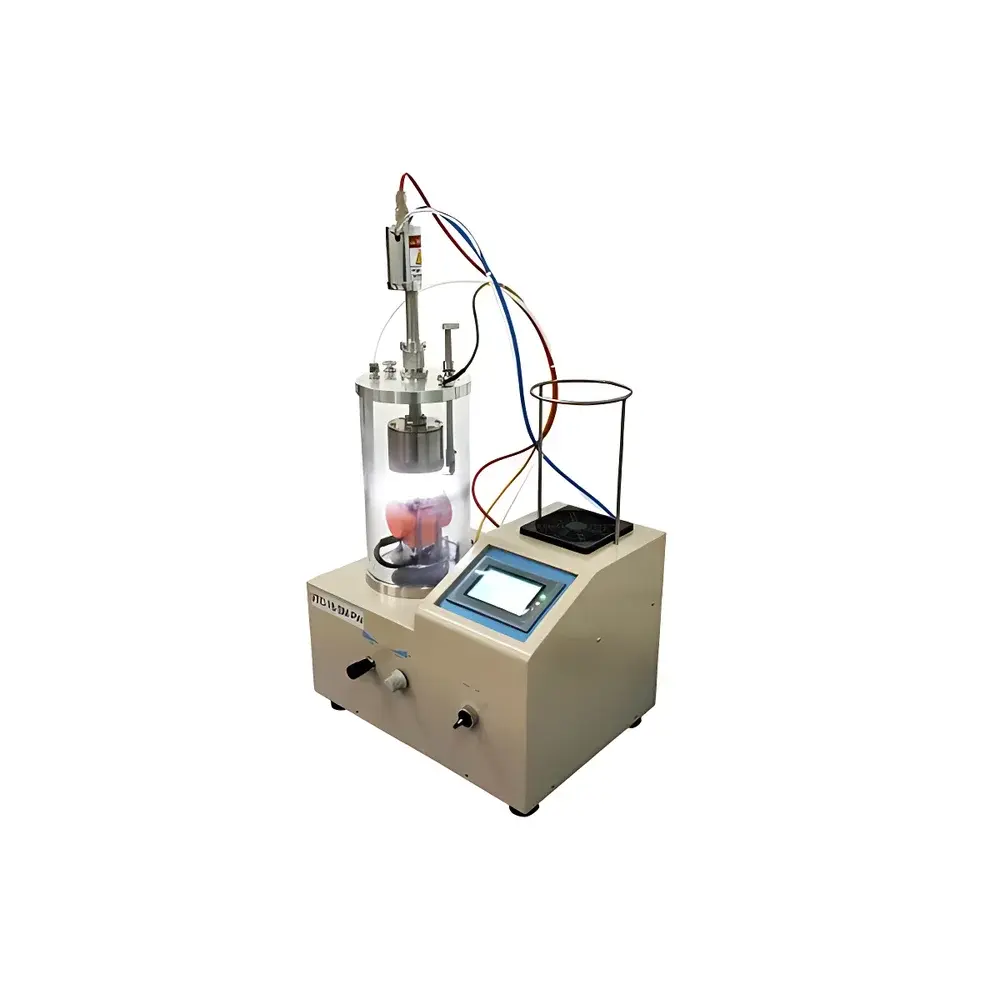
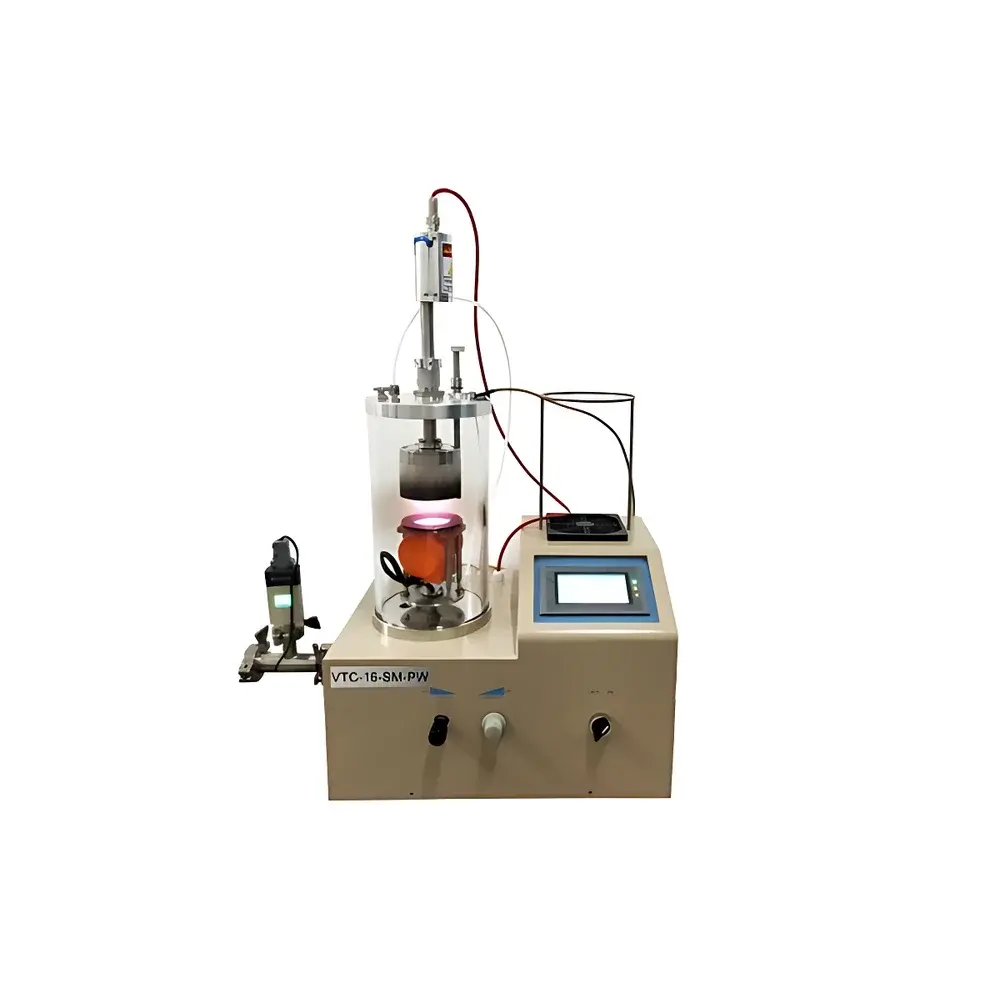
KJ GROUP VTC-16PW Benchtop Powder PVD Coating System
| Brand | KJ GROUP |
|---|---|
| Origin | Liaoning, China |
| Manufacturer Type | Authorized Distributor |
| Origin Category | Domestic (China) |
| Model | VTC-16PW |
| Pricing | Upon Request |
| Input Voltage | 220 VAC, 50/60 Hz |
| DC Power Output | 1600 VDC, 250 W |
| Max Current | 150 mA |
| Sputter Head | 2-inch adjustable-angle magnetron |
| Vibrating Sample Stage | Frequency adjustable from 6–33 Hz, Ø50 mm, max sample mass < 500 mg, recommended particle size 1–1000 µm |
| Chamber | Fused quartz, OD 165 mm × ID 150 mm × H 250 mm |
| Base Pressure | ≤1.0×10⁻² Torr (mechanical pump only) |
| Dimensions (L×W×H) | 460 × 330 × 810 mm |
| Net Weight | 20 kg |
Overview
The KJ GROUP VTC-16PW is a compact, benchtop-scale physical vapor deposition (PVD) system engineered specifically for uniform surface coating of fine particulate materials via magnetron sputtering. Unlike conventional planar or bulk-substrate PVD tools, the VTC-16PW integrates a dynamically vibrating sample stage within a fused quartz vacuum chamber—enabling continuous tumbling and reorientation of powder particles during sputter deposition. This motion ensures isotropic exposure of all particle surfaces to the plasma plume, mitigating shadowing effects and enabling conformal nanoscale coatings on irregular, high-surface-area powders. The system operates under controlled low-pressure environments (down to <4.0×10⁻⁶ Torr), supporting both noble metal (Au, Ag, Pt, Cu, Mo) and reactive metal (Al, Mg, Ti, Zn, Li) target sputtering—provided appropriate vacuum integrity and pre-deposition cleaning protocols are followed. Its footprint (460 × 330 × 810 mm) and modular design allow safe integration inside inert-atmosphere gloveboxes (O₂/H₂O < 0.1 ppm), making it suitable for air-sensitive battery cathode precursors, pyrophoric catalysts, and lithiated intercalation compounds.
Key Features
- Adjustable-angle 2-inch magnetron sputter head with precise angular alignment capability for optimized plasma flux distribution onto the vibrating bed.
- Vibrating sample stage with digitally tunable frequency (6–33 Hz) and fixed 50 mm diameter—engineered to induce gentle, non-destructive tumbling without particle attrition or agglomeration.
- Fused quartz vacuum chamber (OD 165 mm × ID 150 mm × H 250 mm) offering optical transparency for in situ process observation and compatibility with reactive or corrosive chemistries.
- Dual-pumping architecture: integrated two-stage rotary vane pump for rough vacuum (≤1.0×10⁻² Torr) and optional turbomolecular pump for high-vacuum operation (≤1.0×10⁻⁵ Torr), with baked-out ultimate pressure <4.0×10⁻⁶ Torr.
- CE-certified 1600 VDC, 250 W power supply with current-limiting protection (max 150 mA) and interlocked high-voltage safety circuitry requiring insulated gloves during maintenance.
- Glovebox-compatible form factor (20 kg net weight) with rear-panel feedthroughs designed for seamless integration into argon- or nitrogen-purged enclosures.
Sample Compatibility & Compliance
The VTC-16PW accommodates dry, free-flowing powders with particle sizes ranging from 1 µm to 1000 µm and total masses up to 500 mg per run. Successful coating requires prior drying (e.g., vacuum desiccation at 60 °C for 12 h) and mechanical dispersion (e.g., light sieving or sonication in low-polarity solvent followed by full evaporation). Target compatibility follows standard PVD reactivity guidelines: Au, Ag, Pt, Cu, and Mo targets operate reliably at base pressures ≥1.0×10⁻² Torr; Al, Mg, Ti, Zn, and Li require ≤1.0×10⁻⁵ Torr to suppress native oxide formation. All sputter components—including targets, shields, and stage surfaces—must be cleaned with spectroscopic-grade ethanol and fine-grit alumina sandpaper before each use. The system complies with EU Machinery Directive 2006/42/EC and carries CE marking for electromagnetic compatibility (EMC Directive 2014/30/EU) and low-voltage safety (LVD Directive 2014/35/EU). It supports GLP-aligned documentation when paired with external loggers for vacuum history, power parameters, and vibration settings.
Software & Data Management
The VTC-16PW operates via front-panel analog controls with calibrated potentiometers for voltage, current, and vibration frequency—deliberately omitting embedded microprocessors to minimize EMI interference in sensitive lab environments. Process parameters are recorded manually or via external data acquisition systems (e.g., National Instruments USB-TC01 thermocouple logger or Keysight U1282A multimeter). For audit-ready traceability, users are advised to maintain a bound logbook documenting batch IDs, target lot numbers, vacuum pump oil change dates, chamber bakeout cycles, and post-coating SEM/EDS verification results. While no proprietary software is bundled, the system’s analog interface ensures compatibility with third-party LabVIEW or Python-based automation scripts using RS-232 or USB-to-serial adapters (not included).
Applications
- Core–shell electrode material synthesis: Al₂O₃ or LiNbO₃ coatings on NMC811, LFP, or silicon anode powders to enhance interfacial stability in solid-state batteries.
- Catalyst functionalization: Pt or Pd nanocoatings on carbon black or CeO₂ supports to improve dispersion and reduce sintering in PEM fuel cell applications.
- Pharmaceutical excipient modification: thin SiO₂ or MgO barriers on hygroscopic APIs to control dissolution kinetics and improve shelf-life.
- Quantum dot passivation: ZnS or AlN shells on CdSe or CsPbBr₃ nanocrystals to suppress non-radiative recombination pathways.
- Standard reference material preparation: certified thickness calibration layers (e.g., 5 nm Au on SiO₂ spheres) for TEM cross-section analysis.
FAQ
Can the VTC-16PW deposit insulating oxides like Al₂O₃ or SiO₂?
Yes—but requires RF sputtering capability, which is not natively supported. Users must integrate an external 13.56 MHz RF generator and impedance-matching network; the existing DC power supply is incompatible with dielectric targets.
Is the quartz chamber resistant to HF or chlorine-based etchants?
No. Fused quartz is highly susceptible to hydrofluoric acid and hot chlorine gas. Avoid exposure to any fluorinated or halogenated precursors unless using dedicated corrosion-resistant chamber liners.
What is the typical coating uniformity across a 500 mg powder batch?
Measured via XPS depth profiling on representative subsamples, typical thickness variation is ±12% RSD for 10–50 nm metallic films under optimized vibration (22 Hz) and 30-min sputter time at 1.0×10⁻⁴ Torr.
Does the system include vacuum gauges with digital readout?
It includes an analog Pirani gauge for rough vacuum and a cold-cathode gauge for high vacuum—both with analog needle displays. Digital readouts require optional upgrades (e.g., MKS 925 series controllers).
Can I perform in situ heating of the powder bed during sputtering?
No. The standard vibrating stage is unheated. Resistive or radiative heating modules are not available as factory options and would compromise vibration integrity and vacuum sealing.



