
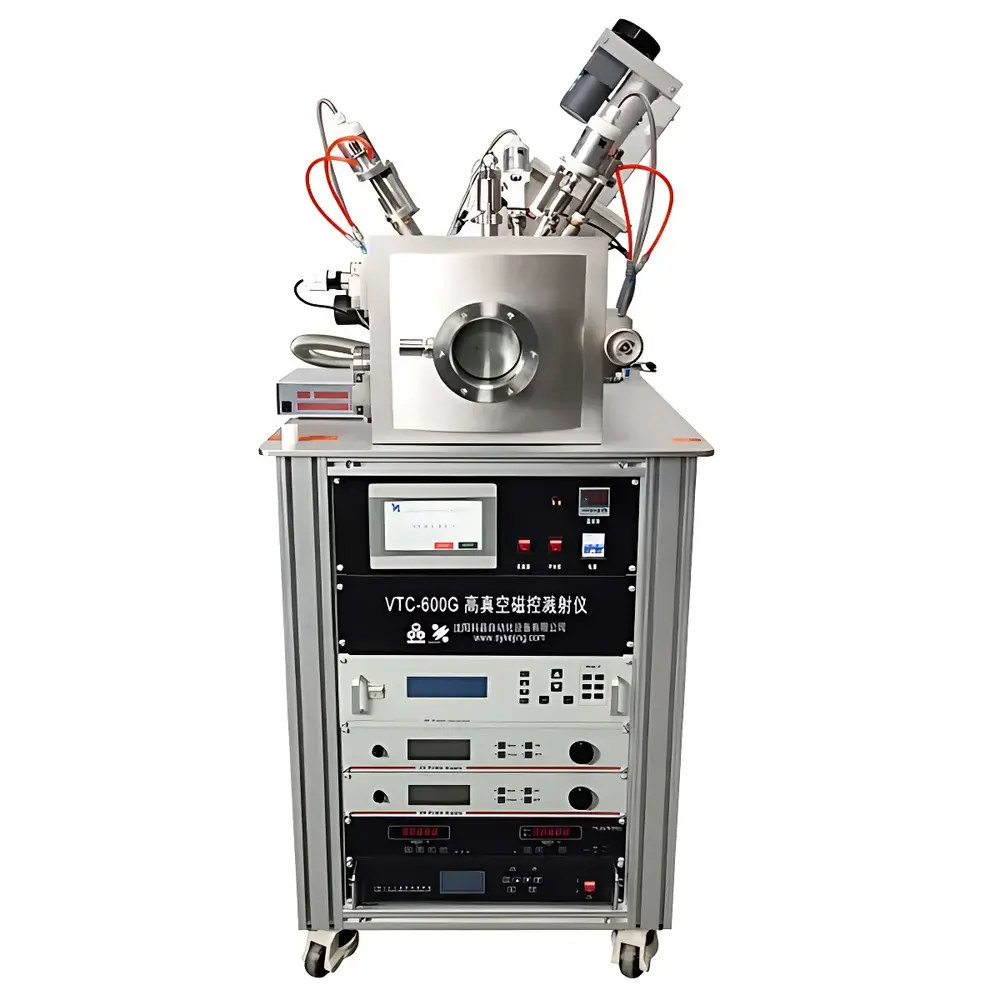
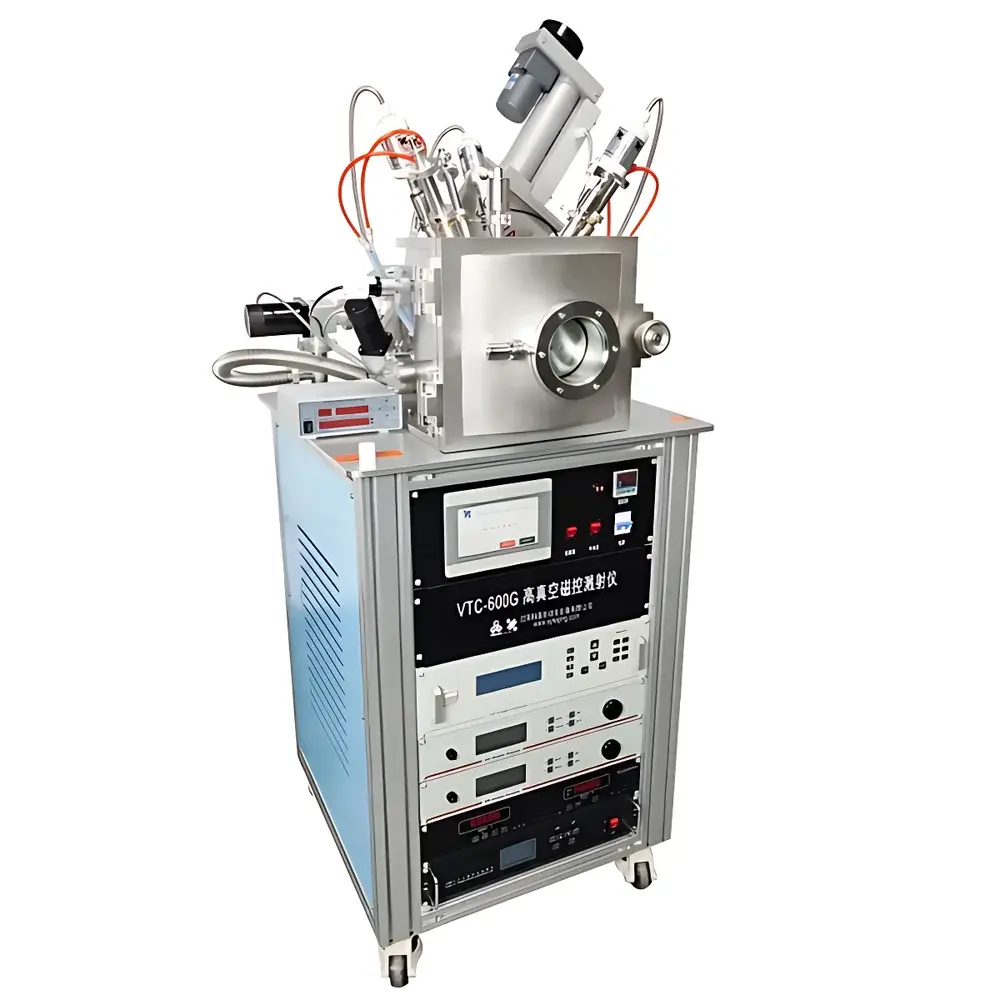
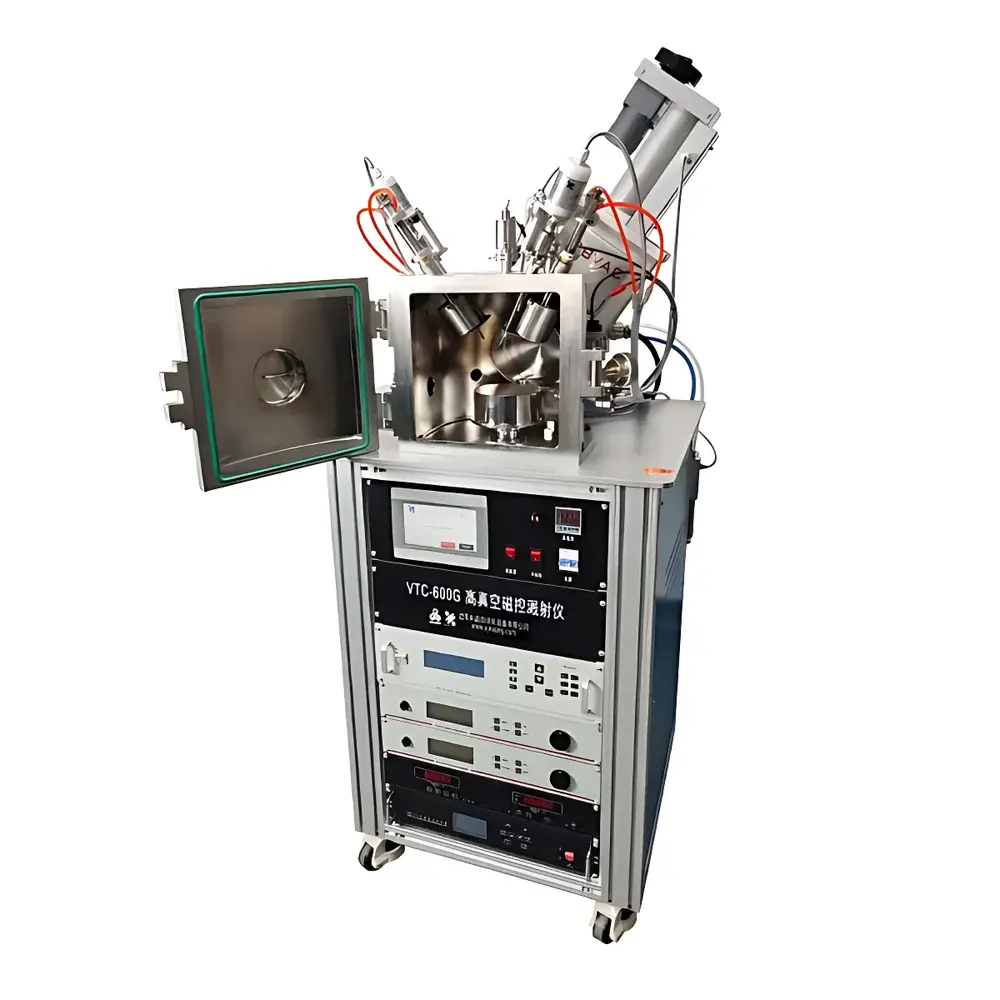
KJ GROUP VTC-600G High-Vacuum Magnetron Sputtering System
| Brand | KJ GROUP |
|---|---|
| Origin | Liaoning, China |
| Manufacturer Type | Direct Manufacturer |
| Country of Origin | China |
| Model | VTC-600G |
| Vacuum Chamber Configuration | Benchtop Front-Loading |
| Ultimate Vacuum | ≤6.0 × 10⁻⁵ Pa |
| Leak Rate | ≤0.5 Pa/h |
| Pumping Time (Atm → 5.0 × 10⁻³ Pa) | ~20 min |
| Vacuum System | Dual-stage (Rotary Vane Pump + Turbomolecular Pump) |
| Substrate Holder | Ø140 mm, Temp. Range: RT–500 °C (±1 °C), Rotation Speed: 5–20 rpm |
| Gas Inlet | 2-channel MFC (Ar & N₂) |
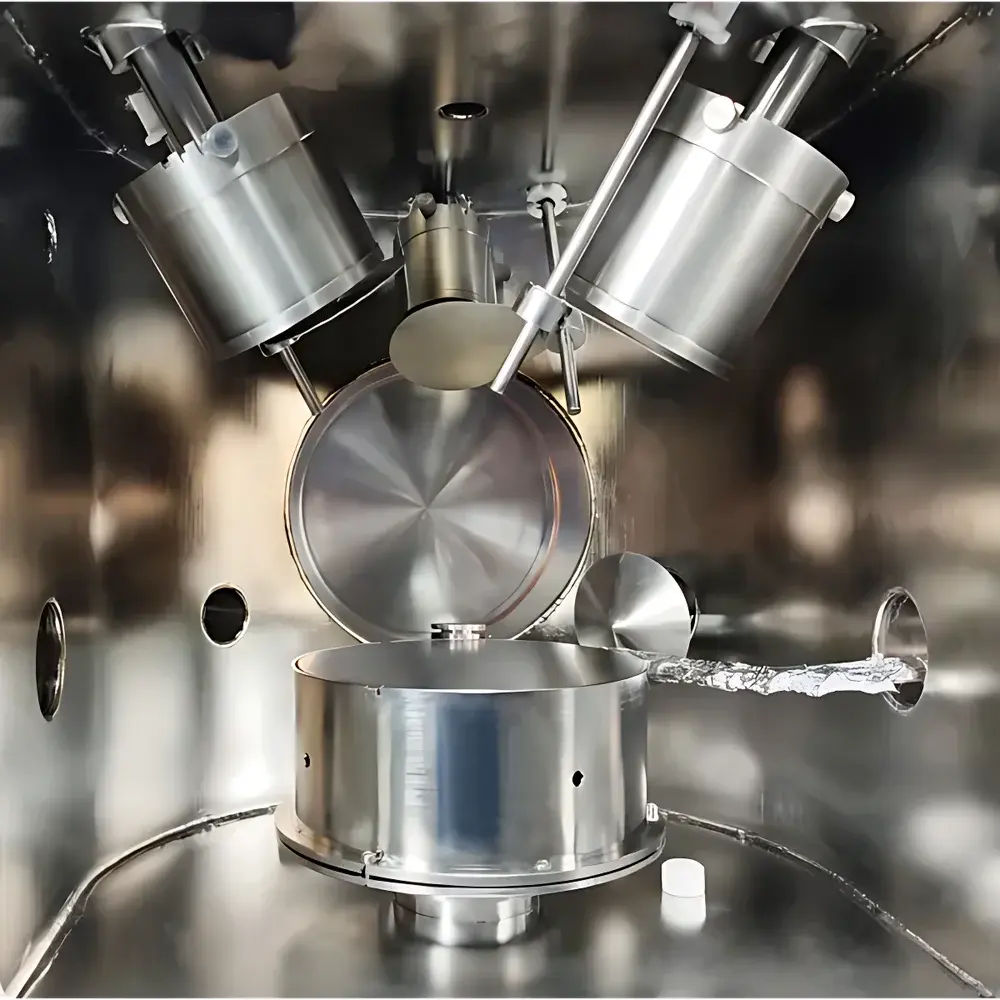
| Target Arrangement | 3 × Ø2″ magnetron cathodes at 120° spacing, 34° tilt angle to substrate normal |
| Target Cooling | Water-cooled |
| Optional Features | RF/DC dual-power configuration, substrate bias module, rotating shutter mask, sample stage baffle |
Overview
The KJ GROUP VTC-600G High-Vacuum Magnetron Sputtering System is a benchtop, front-loading thin-film deposition platform engineered for precision and flexibility in academic and industrial R&D laboratories. It operates on the principle of magnetron sputtering—where energetic argon or nitrogen ions, generated in a low-pressure plasma environment, bombard solid target materials to eject atoms that subsequently condense onto a thermally controlled substrate surface. The system achieves an ultimate vacuum of ≤6.0 × 10⁻⁵ Pa using a dual-stage pumping architecture (mechanical roughing pump + turbomolecular high-vacuum pump), ensuring minimal residual gas contamination and high film purity. Its modular design separates the vacuum chamber, pumping station, and power supply units, enabling flexible integration into existing lab infrastructure and simplifying maintenance, calibration, and future upgrades.
Key Features
- Benchtop footprint (700 × 852 × 1529 mm) with front-access door and rear-mounted vacuum train—optimized for space-constrained cleanrooms and shared instrumentation facilities.
- Triple-magnetron configuration: three independently mountable Ø2″ water-cooled cathodes arranged at 120° intervals and tilted 34° relative to the substrate normal—enabling uniform co-sputtering, sequential layering, and compositional gradient control.
- Thermally regulated substrate stage: Ø140 mm diameter, programmable temperature range from ambient to 500 °C (±1 °C stability), with adjustable rotation (5–20 rpm) to enhance film thickness uniformity across the wafer or sample.
- Dual-gas mass flow control: two independent MFCs (Ar and N₂) support reactive sputtering, nitride/oxide formation, and stoichiometric tuning without manual valve adjustments.
- Flexible power architecture: supports both DC sputtering for conductive targets (e.g., metals, doped oxides) and RF sputtering (13.56 MHz) for insulating materials (e.g., Al₂O₃, SiO₂, PTFE), with configurable wiring to enable single-source multi-target control or dedicated per-target sourcing.
- Optional substrate bias module: enables ion-assisted deposition for improved adhesion, densification, and microstructural control—critical for hard coatings, solid-state electrolytes, and OLED charge transport layers.
Sample Compatibility & Compliance
The VTC-600G accommodates substrates up to Ø140 mm—including silicon wafers, glass slides, ceramic pellets, metallic foils, and flexible polymer films. Its modular chamber design allows rapid reconfiguration for custom fixtures, shadow masks, or multi-zone heating. All vacuum components comply with ISO 2859-1 sampling standards for leak integrity verification, and the system’s pressure stabilization and gas dosing repeatability meet ASTM F1552–22 requirements for process reproducibility in thin-film R&D. While not certified for GMP production, its documented operational parameters, traceable calibration records, and stable thermal/gas delivery profiles support GLP-aligned experimental reporting and peer-reviewed publication workflows.
Software & Data Management
The system integrates a programmable PLC-based controller with a 7-inch HMI touchscreen interface. Process recipes—including vacuum ramp profiles, power ramp sequences, gas flow setpoints, substrate temperature ramps, and rotation timing—are stored locally with timestamped execution logs. Data export is supported via USB or Ethernet (Modbus TCP) for integration with laboratory information management systems (LIMS) or MATLAB/Python-based analysis pipelines. Audit trails record operator ID, parameter changes, and alarm events—facilitating compliance with internal SOPs and preliminary FDA 21 CFR Part 11 readiness for preclinical material qualification studies.
Applications
The VTC-600G serves as a foundational tool for functional thin-film synthesis across multiple domains: fabrication of ferroelectric oxide layers (e.g., PZT, BTO) for non-volatile memory devices; transparent conductive oxides (ITO, AZO) for photovoltaic and display applications; amorphous/crystalline semiconductor stacks (a-Si, MoS₂) for 2D device prototyping; dense LiPON and LLZO electrolyte films for solid-state battery research; and optical interference coatings (TiO₂/SiO₂ multilayers) for sensor and laser optics development. Its ability to deposit both conductive and dielectric films—without breaking vacuum—makes it especially suited for iterative stack optimization in OLED emissive layer architectures and heterostructure-based memristors.
FAQ
What types of target materials are compatible with the VTC-600G?
Conductive targets (metals, alloys, doped oxides) may be sputtered using the DC power supply; non-conductive or semi-insulating targets (Al₂O₃, SiO₂, PTFE, polymers) require RF excitation and are fully supported.
Can the system be upgraded to include substrate heating above 500 °C?
Yes—the base stage design allows retrofitting with high-temperature resistive heaters (up to 800 °C) and corresponding thermocouple feedthroughs, subject to vacuum chamber material compatibility assessment.
Is remote monitoring or automation possible?
The PLC controller supports Modbus TCP communication; users may implement external SCADA interfaces or Python-based automation scripts for unattended multi-step deposition protocols.
What vacuum certification documentation is provided?
Each unit ships with a factory leak test report (per ISO 20483 Annex A), ultimate vacuum validation log, and MFC calibration certificates traceable to NIST standards.
Does the system meet electromagnetic compatibility (EMC) requirements for EU labs?
The VTC-600G complies with EN 61326-1:2013 for laboratory equipment emissions and immunity; CE marking is available upon request with full technical construction file documentation.



