
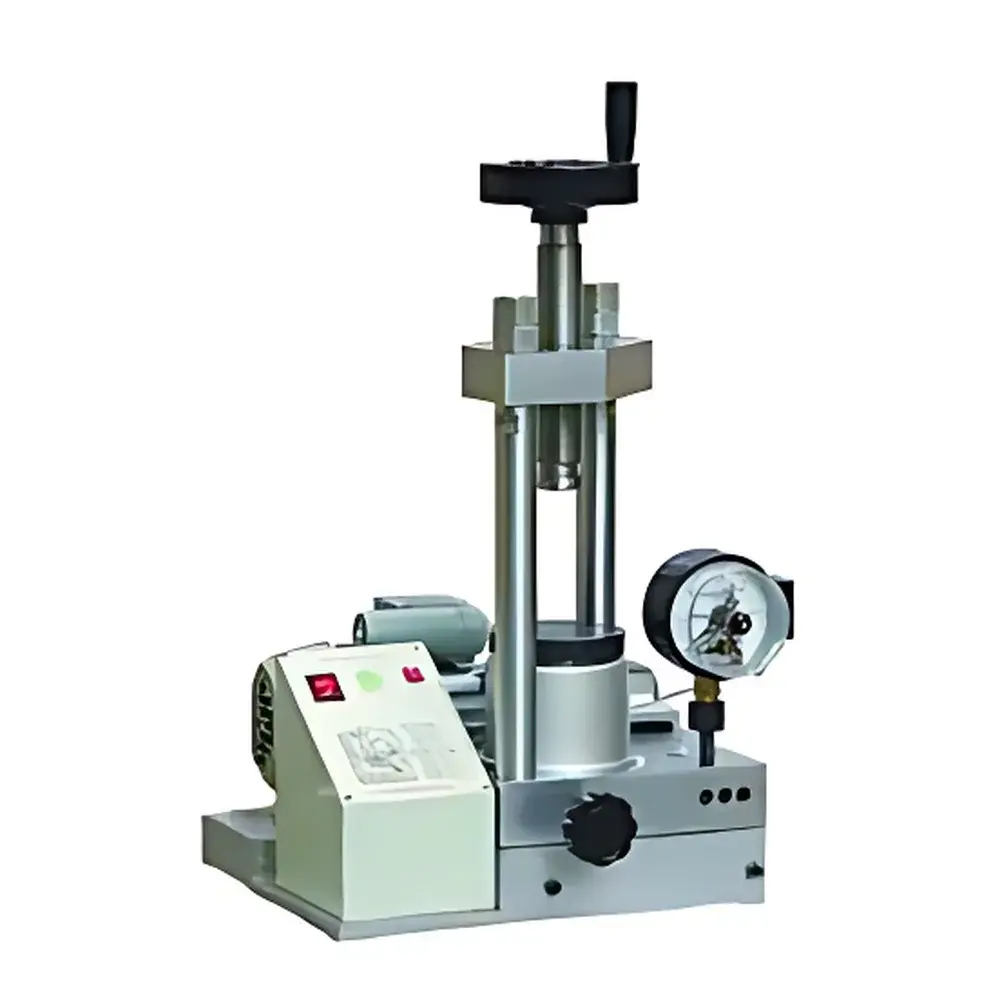
KJ GROUP YLJ-20TA Semi-Automatic Electric Pellet Press
| Brand | KJ GROUP |
|---|---|
| Origin | Liaoning, China |
| Manufacturer Type | Authorized Distributor |
| Country of Origin | China |
| Model | YLJ-20TA |
| Instrument Type | Semi-Automatic Pellet Press |
| Power Supply | 220 V, 50 Hz |
| Rated Power | 180 W |
| Maximum Pressure | 20 Ton (0–33.3 MPa) |
| Cylinder Stroke | 0–20 mm |
| Working Chamber Dimensions | 140 mm × 140 mm × 200 mm (W × D × H) |
| Platen Diameter | Ø100 mm |
| Overall Dimensions | 560 mm × 440 mm × 430 mm (W × D × H) |
| Net Weight | 64 kg |
Overview
The KJ GROUP YLJ-20TA Semi-Automatic Electric Pellet Press is an engineered solution for reproducible, high-precision sample compaction in analytical and materials science laboratories. Designed around a hydraulically actuated, electrically driven press mechanism, it applies controlled uniaxial compressive force to powdered or granular specimens—enabling consistent pellet formation for quantitative spectroscopic and elemental analysis. Its operational principle relies on regulated hydraulic pressure transmission via a piston-cylinder assembly, with real-time force feedback achieved through integrated load-sensing architecture. The system supports standardized sample preparation protocols required for X-ray fluorescence (XRF), Fourier-transform infrared (FTIR), and wavelength-dispersive X-ray spectroscopy (WDXRF), where uniform density, surface flatness, and minimal particle segregation are critical for measurement accuracy and inter-laboratory comparability.
Key Features
- Compact footprint (560 × 440 × 430 mm) optimized for benchtop integration—including glovebox-compatible operation for air-sensitive or moisture-sensitive material processing (e.g., solid-state battery cathodes, metal hydrides, or perovskite precursors).
- Semi-automatic control interface with manual pressure hold and programmable dwell time, ensuring operator-defined consolidation cycles without continuous manual intervention.
- Modular platen configuration: Ø100 mm hardened steel platens with parallelism tolerance ≤ ±5 µm, supporting interchangeable die sets for standard 13 mm, 20 mm, 32 mm, and custom-shaped molds (cylindrical, rectangular, annular, or multi-cavity).
- Integrated safety mechanisms including dual-circuit emergency stop, mechanical overload limiter, and optional transparent polycarbonate safety shield (CE-compliant per EN 61000-6-2/6-4 for EMC immunity and emission).
- Stainless-steel-reinforced hydraulic circuit with low-viscosity ISO VG 32 mineral oil, rated for ≥10,000 operational cycles under nominal 20-ton loading without seal degradation.
Sample Compatibility & Compliance
The YLJ-20TA accommodates a broad spectrum of inorganic and organic powders—including oxides (Al2O3, SiO2, TiO2), carbonates (CaCO3, MgCO3), metal alloys (Ni, Co, Fe powders), polymer composites, and ceramic precursors—with particle size distributions ranging from submicron (<1 µm) to coarse granules (≤500 µm). It meets ASTM E1193–22 (Standard Practice for Preparation of Solid Samples for Spectrochemical Analysis) and aligns with ISO/IEC 17025:2017 requirements for documented sample preparation traceability. When used in conjunction with certified reference materials (CRMs) and calibrated dies, the press supports GLP-compliant workflows for regulatory submissions (e.g., EPA Method 6010D, ISO 12847 for soil XRF analysis).
Software & Data Management
While the YLJ-20TA operates via analog/digital hybrid controls (no embedded microprocessor), its mechanical repeatability enables full integration into LIMS and ELN ecosystems. Operators may log pressing parameters—including applied tonnage, dwell duration, ambient temperature/humidity, and die identification—using external audit-trail-capable software (e.g., LabWare LIMS or Thermo Fisher SampleManager). Optional USB-connected digital pressure transducer kits (0.5% FS accuracy, 10 Hz sampling) provide timestamped force profiles exportable as CSV for statistical process control (SPC) analysis and 21 CFR Part 11–compliant electronic records when paired with validated signature modules.
Applications
- XRF and XRD sample preparation: Producing homogeneous, binder-free pellets for major/minor element quantification in geological, metallurgical, and environmental matrices.
- FTIR spectroscopy: Fabricating KBr or polyethylene dispersion pellets for functional group identification in pharmaceutical excipients and polymer additives.
- Battery R&D: Compacting cathode/anode slurries (NMC, LFP, Si/C composites) at defined pressures to simulate calendering effects and correlate density with electrochemical impedance.
- Ceramic sintering preforms: Generating green bodies with controlled green density (typically 55–65% theoretical) for subsequent thermal densification studies.
- Reference material certification: Supporting ISO Guide 35 workflows by enabling identical compaction conditions across multiple CRM batches for inter-laboratory validation.
FAQ
What is the maximum recommended operating pressure for routine calibration verification?
For long-term repeatability and seal integrity, KJ GROUP recommends performing annual verification at 15 Ton (25 MPa), using NIST-traceable load cells and ISO 376 Class 0.5 verification standards.
Can the YLJ-20TA be used with corrosive or abrasive powders?
Yes—when equipped with optional tungsten-carbide-coated platens (part no. YLJ-PLATEN-WC) and stainless-steel die inserts; standard tool steel components are suitable for non-halogenated, pH-neutral powders only.
Is die heating capability available as a factory option?
No—the YLJ-20TA is a cold-press system; for hot pressing, KJ GROUP recommends the HPD series (up to 1000 °C, 30 Ton) with integrated PID-controlled furnace and vacuum chamber.
Does the press comply with CE or UL safety directives?
The base unit conforms to CE marking requirements under the Machinery Directive 2006/42/EC and Low Voltage Directive 2014/35/EU; UL listing requires site-specific evaluation per UL 508A for North American installations.
How is maintenance scheduled for hydraulic system longevity?
Oil replacement every 2,000 hours or biannually (whichever occurs first); filter cartridge replacement every 500 hours; visual inspection of cylinder rod chrome plating and O-ring integrity during each quarterly preventive maintenance cycle.



