
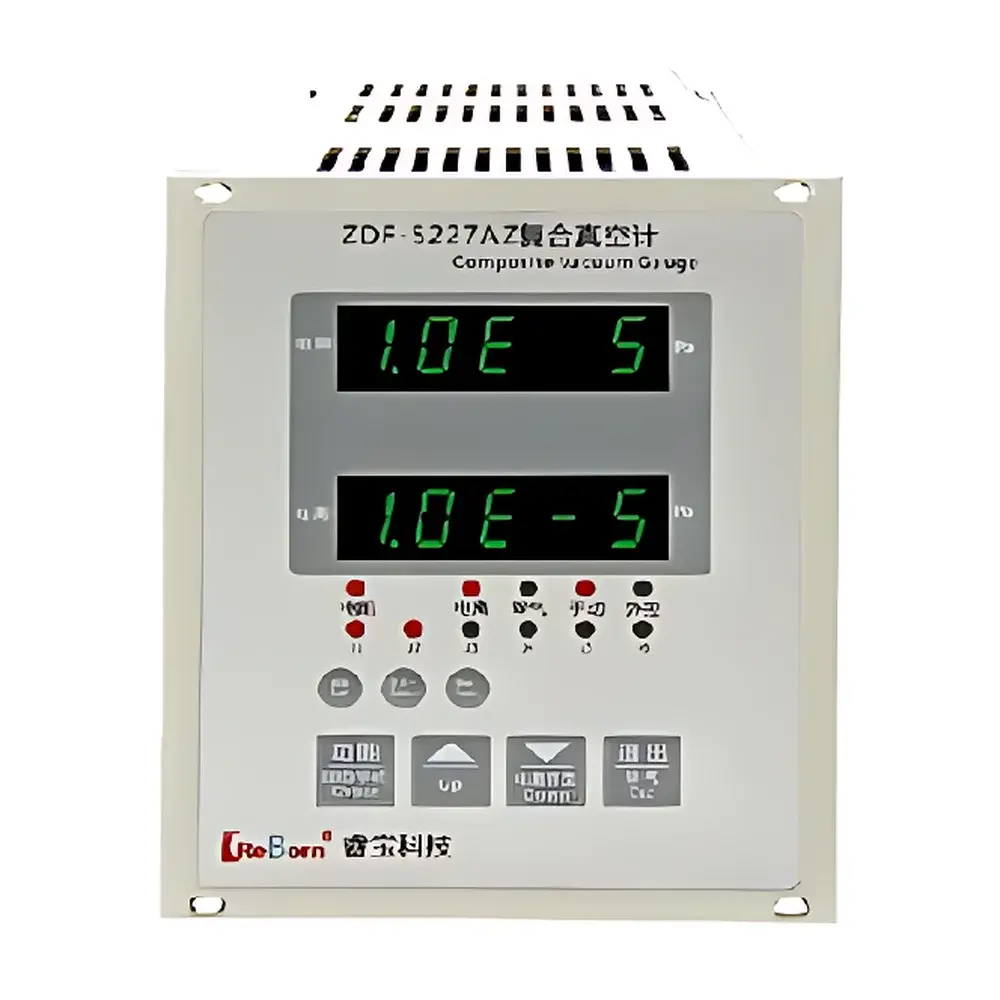
KJ GROUP ZDF-5227AZ Dual-Sensor Composite Vacuum Gauge
| Brand | KJ GROUP |
|---|---|
| Origin | Liaoning, China |
| Manufacturer Type | Authorized Distributor |
| Country of Origin | China |
| Model | ZDF-5227AZ |
| Pricing | Upon Request |
| Measurement Principle | Combined Pirani (thermal conductivity) and Hot-Cathode Ionization (electron impact ionization) |
| Full Range | 1.0×10⁵ to 1×10⁻⁵ Pa |
| Effective Range | 3×10³ to 1×10⁻⁵ Pa |
| Reference Range (Pirani only) | 1.0×10⁵ to 3×10³ Pa |
| Compatible Gauges | ZJ-52T (Pirani), ZJ-27 (Hot-Cathode Ionization) |
| Sensor Channels | 2 independent measurement channels |
| Display | Dual 5-digit LED displays with scientific notation (e.g., 1.2E−1 = 1.2×10⁻¹ Pa) |
| Control Outputs | 4 relay channels (expandable to 6), AC220V/3A or DC28V/10A per channel |
| Control Modes | Setpoint (point control) or band-based (region control) with power-loss memory |
| Analog Output | Optional 0–5 V DC |
| Communication | Optional RS-232 or RS-485 interface |
| Gauge Cable Length | Standard 5 m (custom lengths available) |
| Gauge Flange Options | ZJ-52T — glass envelope, metal direct-insert, DN16/DN25/DN35 CF, DN10/DN16/DN25/DN40 KF |
| Power Supply | AC 85–265 V, 50/60 Hz |
| Weight | ~1.5 kg |
| Enclosure Dimensions | 107 mm (W) × 129 mm (H) |
| Panel Cutout | 104 mm × 110 mm |
Overview
The KJ GROUP ZDF-5227AZ Dual-Sensor Composite Vacuum Gauge is an engineered solution for wide-range vacuum monitoring in research laboratories, semiconductor process tools, vacuum coating systems, and industrial thermal processing equipment. It integrates two physically distinct vacuum sensing technologies—Pirani thermal conductivity measurement and hot-cathode ionization—into a single compact instrument. This dual-principle architecture enables continuous, gap-free pressure coverage from atmospheric conditions (1.0×10⁵ Pa) down to high vacuum (1×10⁻⁵ Pa), with optimal accuracy maintained across the effective range of 3×10³ to 1×10⁻⁵ Pa. The ZJ-52T Pirani sensor operates on thermal loss modulation in low-to-medium vacuum, while the ZJ-27 hot-cathode ionization gauge provides stable electron-impact ion current measurement under high vacuum conditions. Unlike cold-cathode or capacitance manometer alternatives, this configuration delivers high repeatability, rapid response (<1 s typical settling time), and strong immunity to electromagnetic interference—critical in environments with RF sputtering sources or high-power magnetron drivers.
Key Features
- Dual independent measurement channels with dedicated LED displays—each showing real-time pressure in scientific notation (e.g., 2.7E−3 = 2.7×10⁻³ Pa)
- Intelligent menu-driven interface with intuitive navigation, requiring no external software for basic operation or calibration verification
- Four programmable relay outputs (expandable to six) supporting both point-set and band-based control logic, with non-volatile memory retention of setpoints during power interruption
- Robust mechanical design optimized for panel mounting: compact 107 mm × 129 mm housing with standardized 104 mm × 110 mm cutout
- Modular gauge compatibility—including glass-envelope and metal-direct-insert configurations—for ZJ-52T (Pirani) and ZJ-27 (hot-cathode) sensors, with multiple flange options (CF and KF standards from DN10 to DN40)
- Optional analog output (0–5 V DC) and serial communication interfaces (RS-232 / RS-485) for integration into SCADA, PLC, or centralized vacuum system controllers
Sample Compatibility & Compliance
The ZDF-5227AZ is calibrated for nitrogen and dry air, consistent with ISO 20487:2017 (vacuum metrology—calibration of thermal conductivity gauges) and ASTM E1964–05 (standard practice for calibrating vacuum gauges). Due to gas-dependent thermal conductivity characteristics, Pirani measurements require correction factors when used with hydrogen, helium, or other non-standard gases; hot-cathode ionization readings are similarly subject to ionization cross-section variations. Users must apply appropriate gas-specific correction coefficients—available in manufacturer-provided lookup tables—to ensure traceable measurement uncertainty. The instrument’s electrical design complies with IEC 61000-6-2 (immunity) and IEC 61000-6-4 (emissions), and its relay outputs meet UL 508 industrial control equipment requirements. While not certified to FDA 21 CFR Part 11, audit-trail-capable data logging can be implemented via optional RS-485 integration with validated third-party software under GLP/GMP frameworks.
Software & Data Management
The ZDF-5227AZ operates autonomously without host software, but optional RS-232/RS-485 connectivity supports ASCII-based command protocols for remote readout, setpoint adjustment, and relay status interrogation. When integrated into automated vacuum systems, it feeds time-stamped pressure values and alarm states into central databases—enabling trend analysis, pass/fail qualification against process windows, and electronic batch records. The analog output (0–5 V) maps linearly to logarithmic pressure over user-defined sub-ranges (e.g., 10⁰ to 10⁻³ Pa), facilitating analog input to legacy PLCs. All configuration parameters—including control hysteresis, display brightness, and unit preference (Pa, mbar, Torr)—are retained in EEPROM, eliminating reconfiguration after power cycles.
Applications
- Process monitoring and endpoint detection in physical vapor deposition (PVD) and chemical vapor deposition (CVD) reactors
- Vacuum integrity verification during leak testing and chamber bake-out procedures
- Real-time feedback control in diffusion pump backing lines and turbo-molecular pump forelines
- Quality assurance in vacuum brazing, electron beam welding, and freeze-drying equipment
- Education and R&D labs requiring cost-effective, multi-decade vacuum characterization without sacrificing reliability
FAQ
Can the ZDF-5227AZ measure vacuum in gases other than air or nitrogen?
Yes—but Pirani readings require gas-specific thermal conductivity correction factors, and hot-cathode ionization signals must be adjusted using known ionization cross-section ratios. Calibration certificates include reference tables for common process gases.
Is the ZJ-27 hot-cathode gauge susceptible to filament burnout in poor vacuum?
The instrument implements automatic filament protection: the ionizer activates only when the Pirani reading confirms pressure is below 5×10⁻² Pa, preventing premature cathode degradation.
What is the minimum recommended cable length between the gauge controller and the ZJ-52T/ZJ-27 sensors?
Standard cabling is 5 m; shorter lengths may increase noise susceptibility, while longer runs (>15 m) require shielded twisted-pair cables and grounding at the controller end only to avoid ground loops.
Does the device support Modbus RTU protocol over RS-485?
Yes—the RS-485 option implements standard Modbus RTU (function codes 03h/06h) for register read/write access to pressure values, relay states, and configuration parameters.
How often does the ZDF-5227AZ require recalibration?
Annual verification against a NIST-traceable reference standard is recommended for GMP-compliant applications; routine zero checks using atmospheric venting (for Pirani) and filament emission tests (for ionizer) should be performed before critical process runs.



