
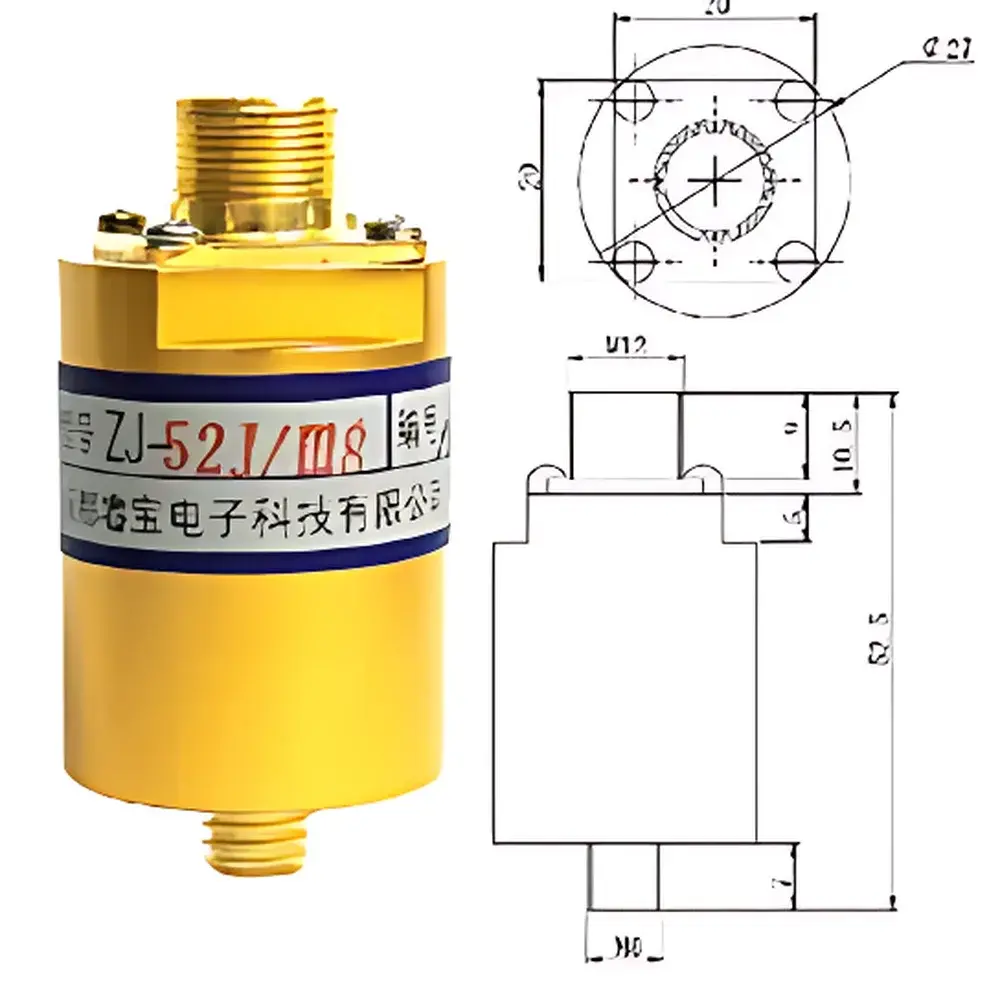
KJ GROUP ZJ-52J Hot Cathode Thermocouple Vacuum Gauge
| Brand | KJ GROUP |
|---|---|
| Origin | Liaoning, China |
| Manufacturer Type | Authorized Distributor |
| Country of Origin | China |
| Model | ZJ-52J |
| Pricing | Available Upon Request |
| Measurement Range | 1×10⁵ to 1×10⁻¹ Pa |
| Filament Material | Tungsten |
| Cold Filament Resistance | 86.5 ± 1.7 Ω at 23 ± 3 °C |
| Filament Operating Temperature | 40–300 °C |
| Accuracy (Scatter) | ≤ ±25% in 3×10³–1×10⁻¹ Pa range |
| Vacuum Port Options | Φ15.5±0.5 mm glass seal (max bakeout: 80 °C) |
| Φ15.5±0.1 mm metal seal (max bakeout | 80 °C) |
| KF10/KF16/KF25/KF40 quick-release flanges (max bakeout | 80 °C) |
| CF16/CF25/CF35 conflat flanges (max bakeout | 450 °C) |
Overview
The KJ GROUP ZJ-52J Hot Cathode Thermocouple Vacuum Gauge is a robust, analog-type vacuum measurement instrument engineered for reliable and stable pressure monitoring in rough to low vacuum environments (1×10⁵ Pa to 1×10⁻¹ Pa). Unlike cold cathode or capacitance manometer technologies, the ZJ-52J operates on the thermocouple principle: a tungsten filament is electrically heated to a controlled temperature; as gas molecules collide with the hot filament, heat is conducted away at a rate proportional to gas density — and thus pressure. A thermocouple junction welded directly to the filament converts this thermal gradient into a millivolt signal linearly correlated with pressure under defined gas composition (typically N₂ or air). Its design emphasizes mechanical simplicity, long-term baseline stability, and resilience against particulate contamination and mild oxidation — making it especially suitable for industrial vacuum ovens, diffusion pump backing lines, vacuum drying chambers, and entry-level coating systems where high accuracy is secondary to operational durability and cost-effective maintenance.
Key Features
- Stabilized tungsten filament with low thermal mass ensures rapid thermal response (< 1 s typical stabilization time) and minimizes thermal lag during dynamic pressure changes.
- Integrated automatic temperature compensation circuitry mitigates drift caused by ambient temperature fluctuations, enhancing measurement reproducibility across laboratory and factory floor environments.
- Dust-resistant filament geometry and optional protective mesh reduce sensitivity to particulate accumulation — critical in applications involving powder handling, sintering, or reactive evaporation processes.
- Low zero-point drift: < 0.5% full-scale shift per 1000 hours under continuous operation at nominal filament temperature.
- Multiple vacuum interface options support integration into diverse system architectures — including standard glass seals, metal-sealed ports, and industry-standard KF and CF flange configurations.
- Compatible with both air and inert gas calibration protocols; traceable calibration certificates available per ISO/IEC 17025-accredited procedures upon request.
Sample Compatibility & Compliance
The ZJ-52J is optimized for use with non-corrosive, non-condensable gases such as nitrogen, argon, helium, and dry air. It is not recommended for use with vapors that may condense on the filament (e.g., water, solvents, oils) or highly reactive species (e.g., halogens, ammonia), which can accelerate filament degradation. The gauge complies with general-purpose industrial vacuum instrumentation requirements outlined in ISO 3567 (vacuum gauges — terminology and classification) and meets electromagnetic compatibility (EMC) criteria per IEC 61326-1 for laboratory and industrial use. While not intrinsically safe, its low-power filament drive (< 1.5 W) and passive analog output make it compatible with Class I, Division 2 hazardous area control systems when installed with appropriate barrier isolation.
Software & Data Management
The ZJ-52J delivers a raw analog mV output (typically 0–10 mV or 0–1 V, configurable via external amplifier module) compatible with standard data acquisition systems (DAQ), PLC analog inputs, and legacy vacuum controllers. No proprietary software or drivers are required. For digital integration, KJ GROUP offers optional signal conditioning modules supporting RS-485 Modbus RTU or 4–20 mA current loop outputs — enabling seamless incorporation into SCADA platforms compliant with ISA-88 and ISA-95 frameworks. All firmware-enabled modules maintain audit trails for calibration events and parameter changes, supporting GLP/GMP documentation workflows per FDA 21 CFR Part 11 when paired with validated host software.
Applications
- Rough vacuum monitoring in rotary vane and liquid ring pump inlet/outlet lines.
- Process pressure supervision in vacuum furnaces, freeze dryers, and vacuum impregnation units.
- Backstreaming detection in diffusion and turbomolecular pump forelines.
- Educational lab setups for vacuum physics instruction and student experiments.
- Quality assurance checks in packaging vacuum seal integrity testing.
- Pre-vacuum verification prior to high-vacuum gauge activation (e.g., ionization or Pirani gauges).
FAQ
What gases can the ZJ-52J accurately measure?
It is calibrated for nitrogen and provides reasonable accuracy for other non-reactive, non-condensable gases (e.g., Ar, He, O₂, CO₂) within ±25% scatter. Accuracy degrades significantly for vapors or corrosive gases.
Can the ZJ-52J be baked out? If so, what are the limits?
Yes — only when equipped with CF-series conflat flanges (CF16/CF25/CF35), which support bakeout up to 450 °C. Glass and KF-sealed variants are limited to 80 °C maximum to avoid seal failure or filament annealing.
Is filament replacement possible in the field?
No — the ZJ-52J is a sealed, factory-assembled gauge. Filament replacement requires return to an authorized KJ GROUP service center and voids warranty if attempted externally.
Does the gauge require a separate controller or power supply?
Yes — it must be operated with a dedicated thermocouple vacuum gauge controller providing regulated filament heating current and thermocouple signal amplification. KJ GROUP’s VC-52 series controllers are fully compatible.
How often should calibration be performed?
Annual calibration is recommended for quality-critical applications. In stable industrial environments with minimal process variation, biannual verification against a reference standard (e.g., a traceable capacitance manometer) may suffice.



