
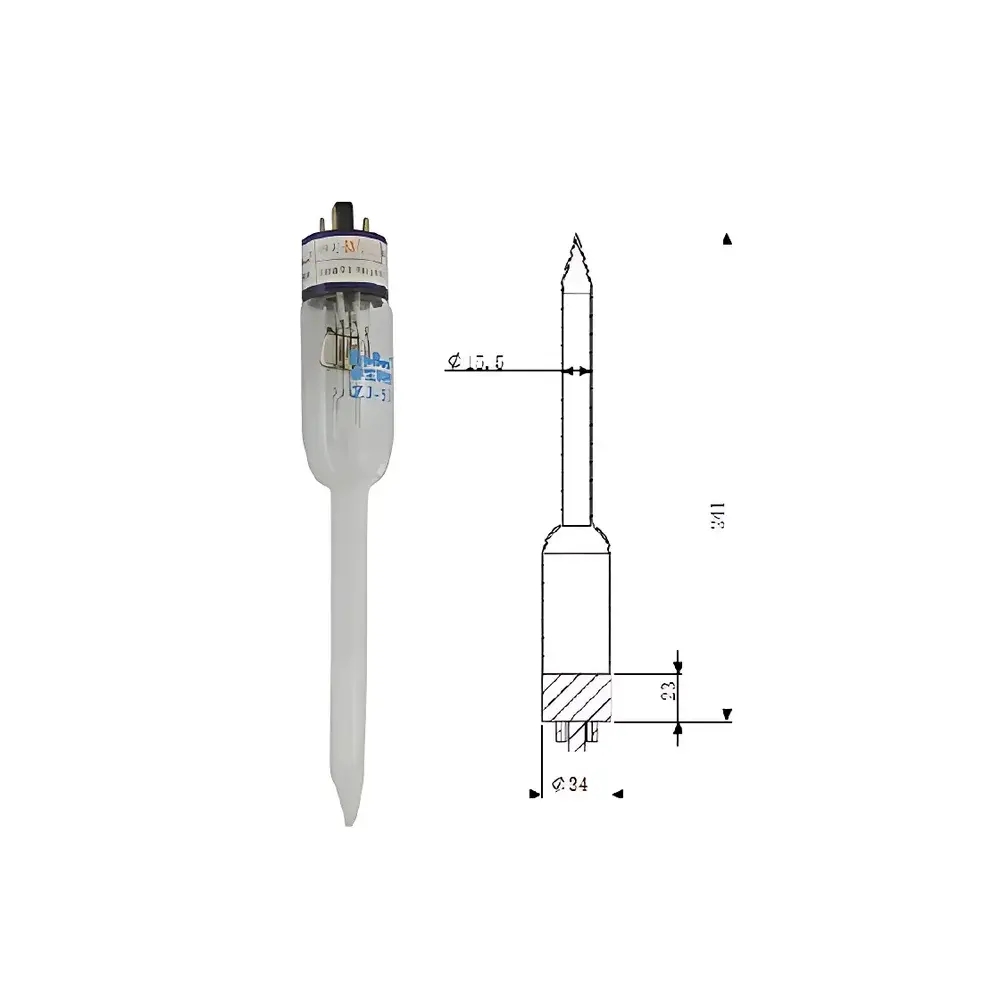
KJ GROUP ZJ-53B Thermocouple Vacuum Gauge
| Brand | KJ GROUP |
|---|---|
| Origin | Liaoning, China |
| Manufacturer Type | Authorized Distributor |
| Country of Origin | China |
| Model | ZJ-53B |
| Pricing | Available Upon Request |
| Measurement Range | 4×10²–1×10⁻¹ Pa |
| Heating Current | 28 ± 1.5 mA |
| Cold Filament Resistance | 9.5 ± 1 Ω @ 23 ± 3 °C |
| Filament Operating Temperature | 40–150 °C |
| Output Scatter | ≤ ±20 % |
| Vacuum Port | Φ15 ± 0.5 mm Glass Seal |
| Maximum Bakeout Temperature | 80 °C |
Overview
The KJ GROUP ZJ-53B Thermocouple Vacuum Gauge is a robust, analog thermal-conductivity-based vacuum measurement sensor engineered for reliable low-vacuum monitoring in industrial, academic, and R&D environments. It operates on the principle that thermal conductivity of residual gas in a vacuum chamber varies predictably with pressure — a relationship exploited by heating a fine filament and measuring the temperature-dependent voltage output from an integrated thermocouple junction. The gauge employs a stabilized NiCr-Constantan (nickel-chromium/copper-nickel) filament-heater and thermocouple pair, selected for low thermal mass, high oxidation resistance, and minimal thermal drift over extended operation. Its design incorporates passive ambient temperature compensation and inherent particulate shielding, enabling stable performance in non-ultra-clean vacuum systems where oil mist, dust, or mild process contaminants may be present. Unlike ionization gauges, the ZJ-53B requires no high voltage or filament emission control circuitry, making it intrinsically safe, power-efficient, and compatible with basic analog readout electronics.
Key Features
- Thermocouple-based thermal conductivity sensing with proven repeatability across 4×10² to 1×10⁻¹ Pa (0.3 to 0.75 mTorr)
- Stabilized NiCr-Constantan filament/heater assembly offering low thermal inertia and enhanced oxidation resistance
- Integrated ambient temperature compensation circuitry to minimize zero-point drift under fluctuating lab conditions
- Dust-protected housing and optimized filament geometry for improved contamination tolerance in mechanical pump-backed systems
- Standard Φ15 ± 0.5 mm glass-to-metal sealed flange for direct mounting onto vacuum chambers or feedthroughs
- Compatible with standard ZJ-54D thermocouple gauge controllers and signal conditioners — fully interchangeable per Chinese national metrological specification JJG 1067–2011
- Rated for continuous bakeout up to 80 °C, supporting moderate outgassing protocols without sensor degradation
Sample Compatibility & Compliance
The ZJ-53B is intended for use with dry, non-corrosive gases including nitrogen, argon, air, and helium — typical in roughing lines, diffusion pump forelines, and low-vacuum coating systems. It is not suitable for reactive, condensable, or highly reducing atmospheres (e.g., H₂ at elevated temperatures, halogenated vapors, or solvent-laden exhaust streams). While not certified to ISO/IEC 17025 or NIST-traceable calibration standards out-of-box, its design conforms to GB/T 3163–2007 (Chinese national standard for vacuum gauges) and aligns with functional requirements outlined in ASTM E883–22 (Standard Guide for Thermal Conductivity Vacuum Gauges). Units are supplied with factory calibration data traceable to KJ GROUP’s internal reference manifold, and users may perform field verification using calibrated reference gauges per ISO 27874:2015.
Software & Data Management
As an analog transducer, the ZJ-53B outputs a millivolt-level thermoelectric signal proportional to filament temperature — and thus indirectly to gas thermal conductivity and pressure. It interfaces directly with legacy analog vacuum controllers (e.g., ZJ-54D, VGC-101 series) or modern PLC-based DAQ systems via standard 0–10 mV or 0–1 V signal conditioning modules. No proprietary software or drivers are required. When integrated into GLP/GMP-compliant vacuum monitoring systems, the gauge supports audit-ready data logging when paired with validated analog input cards featuring 21 CFR Part 11–compliant timestamping, user access controls, and electronic signature capability. Calibration history and sensor replacement logs should be maintained per laboratory quality management system (QMS) requirements.
Applications
- Rough vacuum monitoring in rotary vane and diaphragm pump backing lines
- Process pressure control during physical vapor deposition (PVD), sputtering, and thermal evaporation
- Leak detection pre-screening and vacuum integrity verification in gloveboxes and environmental chambers
- Educational vacuum physics laboratories requiring durable, cost-effective pressure sensors
- Quality assurance testing of vacuum packaging equipment and sterilization autoclaves
- Integration into OEM vacuum systems where simplicity, reliability, and low power consumption are prioritized over ultra-high resolution
FAQ
Can the ZJ-53B be used in ultra-high vacuum (UHV) systems?
No — its operational range ends at 1×10⁻¹ Pa; it is unsuitable for UHV (≤10⁻⁷ Pa) or high vacuum (10⁻³–10⁻¹ Pa) applications requiring ionization or capacitance manometer technology.
Is the ZJ-53B compatible with vacuum systems requiring >80 °C bakeout?
No — the glass-to-metal seal and internal thermocouple junction are rated only to 80 °C continuous exposure. For higher-temperature bakeout, consider all-metal-sealed thermocouple gauges or alternative sensor types.
Does the ZJ-53B require external power beyond the heater current supply?
Yes — it requires a regulated DC current source (28 ± 1.5 mA) for filament heating; the thermocouple output is passive and does not require excitation.
How often should the ZJ-53B be recalibrated?
Annual recalibration is recommended for critical applications; however, stability testing per ISO 27874 suggests recalibration intervals may extend to 18–24 months under controlled, low-contamination operating conditions.



