
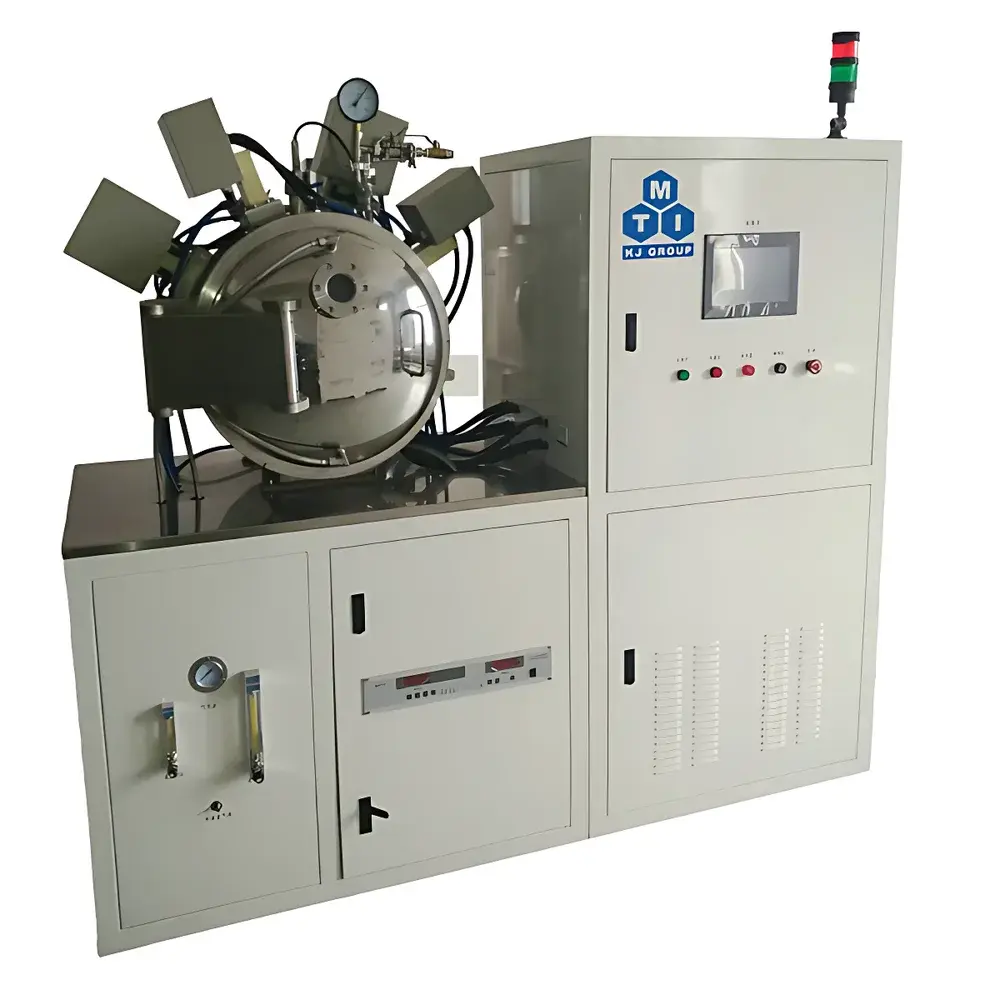
KJ GROUP ZK Series Microwave Vacuum Sintering Furnace
| Brand | KJ GROUP |
|---|---|
| Origin | Liaoning, China |
| Manufacturer Type | Authorized Distributor |
| Country of Origin | China |
| Model | ZK |
| Pricing | Available Upon Request |
| Microwave Frequency | 2.45 GHz |
| Max Operating Temperature (Atmosphere) | ≤1600 °C |
| Max Operating Temperature (Vacuum) | ≤1500 °C |
| Vacuum Level | ≤1×10⁻³ Pa |
| Microwave Power Range | 0.01–5.60 kW (continuous, stepless adjustment) |
| Heating Chamber Dimensions (ZK6016) | Φ180×150 mm |
| Temperature Measurement | Infrared Pyrometer (300–1800 °C, ±0.1% of reading) |
| Control System | Mitsubishi PLC + Schneider HMI Touchscreen |
| Programmable Stages | 40-segment ramp/soak profiles with data logging, export, real-time curve display, dynamic screen saver, and one-touch auto-vacuum initiation |
| Atmosphere Control | Dual-channel mass flow-controlled gas system (O₂, N₂, Ar, H₂, forming gas, etc.) |
| Cooling | Closed-loop recirculating chiller (2 m³/h flow rate, 5.2 kW cooling capacity) |
| Rotation Mechanism | Magnetic fluid rotary seal, 4–6 rpm |
| Microwave Leakage | <0.5 mW/cm² |
| Safety Interlocks | Door-closed sensor, overtemperature protection, overcurrent cutoff, coolant flow monitoring, magnetron fault alarm |
Overview
The KJ GROUP ZK Series Microwave Vacuum Sintering Furnace is a standardized, multi-environment high-temperature experimental workstation engineered for precision materials synthesis, thermal processing, and vacuum-assisted sintering under controlled atmospheres. It integrates industrial-grade 2.45 GHz microwave energy delivery with high-vacuum capability (≤1×10⁻³ Pa) and dual-channel programmable gas introduction—enabling reproducible execution of processes such as microwave-enhanced solid-state reactions, rapid densification of ceramics and composites, and atmosphere-sensitive reduction or oxidation treatments. Unlike conventional resistive furnaces, this system leverages volumetric microwave coupling to achieve rapid, uniform heating with minimal thermal gradients—reducing grain growth kinetics and promoting fine-grained, high-density microstructures in sintered samples. Its architecture supports both static and rotational sample platforms, facilitating homogenization in powder-based or pelletized specimens.
Key Features
- Industrial 2.45 GHz magnetron source with continuous, stepless microwave power regulation (0.01–5.60 kW), ensuring stable long-duration operation and precise thermal input control.
- Integrated dual-stage vacuum system paired with two independently regulated mass-flow-controlled gas lines—supporting inert (Ar, N₂), oxidizing (O₂), reducing (H₂, forming gas), or mixed-atmosphere environments while maintaining vacuum integrity during gas purging.
- Rotating sample platform driven by magnetic fluid sealed bearing (4–6 rpm), enhancing temperature uniformity across cylindrical samples and mitigating hot-spot formation.
- High-purity insulation and crucible options—including quartz, alumina, and graphite—designed to minimize elemental contamination and preserve sample compositional fidelity.
- Real-time infrared pyrometry (300–1800 °C, ±0.1% of reading) with non-contact measurement, calibrated against blackbody reference and compatible with emissivity compensation for diverse material classes.
- Comprehensive safety architecture: interlocked door switch, magnetron overtemperature/overcurrent protection, chiller flow monitoring, and verified microwave shielding (<0.5 mW/cm² leakage at 5 cm distance per IEC 61000-4-3).
Sample Compatibility & Compliance
The ZK furnace accommodates a broad range of sample geometries and chemistries—including oxide ceramics (Al₂O₃, ZrO₂), carbides (SiC, WC), nitrides (Si₃N₄), battery cathode precursors (LiCoO₂, NMC), and metallic alloys—within its Φ180×150 mm (ZK6016) heated cavity. Crucible compatibility extends to high-purity quartz, sintered alumina, and high-density graphite, selected based on thermal stability, chemical inertness, and microwave coupling characteristics. The system meets electromagnetic compatibility requirements per IEC 61000-6-3 (Emission) and IEC 61000-6-2 (Immunity), and its control software architecture supports audit-ready data logging aligned with GLP principles. While not certified to FDA 21 CFR Part 11 out-of-the-box, the PLC-HMI system provides timestamped, user-attributed event logs and exportable CSV datasets suitable for internal validation protocols.
Software & Data Management
Operation is managed via a Schneider Electric touchscreen HMI interfaced with a Mitsubishi FX5U PLC. The control interface enables full programmability of 40-segment thermal profiles—including ramp rates, soak durations, and gas flow sequences—with real-time graphical visualization of temperature, pressure, power, and atmosphere composition. All process data are logged at user-configurable intervals (minimum 1 s), stored internally on SD card, and exportable via USB to standard CSV format for post-processing in MATLAB, Python, or Excel. The system supports manual, automatic, and hold-mode operation; includes dynamic screen-saver functionality that preserves live trend plots during idle periods; and features a one-touch “Auto-Vacuum Start” sequence that synchronizes pump-down, leak-check, and gate-valve actuation without operator intervention.
Applications
- Rapid sintering of advanced ceramics and ultra-high-temperature materials (e.g., ZrB₂–SiC composites) with suppressed grain coarsening.
- Atmosphere-controlled synthesis of metastable phases—such as oxygen-deficient perovskites or lithium-rich layered oxides—for solid-state battery research.
- Vacuum-assisted carbothermal reduction of metal oxides (e.g., TiO₂ → TiC) with minimized carbon residue and improved phase purity.
- Thermal stabilization and crystallization of amorphous precursors (e.g., sol-gel derived SiO₂ or AlPO₄) under inert or reducing atmospheres.
- Process development for scalable microwave-assisted manufacturing routes compliant with ASTM C1161 (flexural strength) and ISO 2738 (density) test standards.
FAQ
What vacuum level can the ZK furnace achieve, and how is it measured?
The system achieves a static base pressure of ≤1×10⁻³ Pa using a dual-stage mechanical + turbomolecular pumping configuration. Vacuum integrity is verified via integrated capacitance manometer and logged alongside temperature and power data.
Can the furnace operate under hydrogen or other reactive gases?
Yes—the dual-channel mass flow controller supports programmable introduction of H₂, CO, NH₃, or forming gas (5% H₂/95% N₂), with real-time pressure feedback and interlocked purge cycles to prevent explosive mixtures.
Is remote monitoring or integration with lab-wide SCADA systems possible?
The Mitsubishi PLC supports Modbus TCP/IP communication; optional Ethernet gateway modules enable integration into centralized laboratory automation platforms for supervisory control and historical data aggregation.
How is temperature uniformity validated inside the cavity?
Uniformity is characterized per ASTM E220 using multiple calibrated thermocouples embedded in a dummy load matrix; typical radial deviation is <±15 °C at 1400 °C under argon, confirmed during factory acceptance testing.
What maintenance is required for the microwave generator and vacuum system?
Magnetron lifetime exceeds 5,000 hours under rated conditions; scheduled maintenance includes quarterly inspection of waveguide flanges, annual replacement of turbomolecular pump oil, and biannual calibration of mass flow controllers per manufacturer guidelines.



