
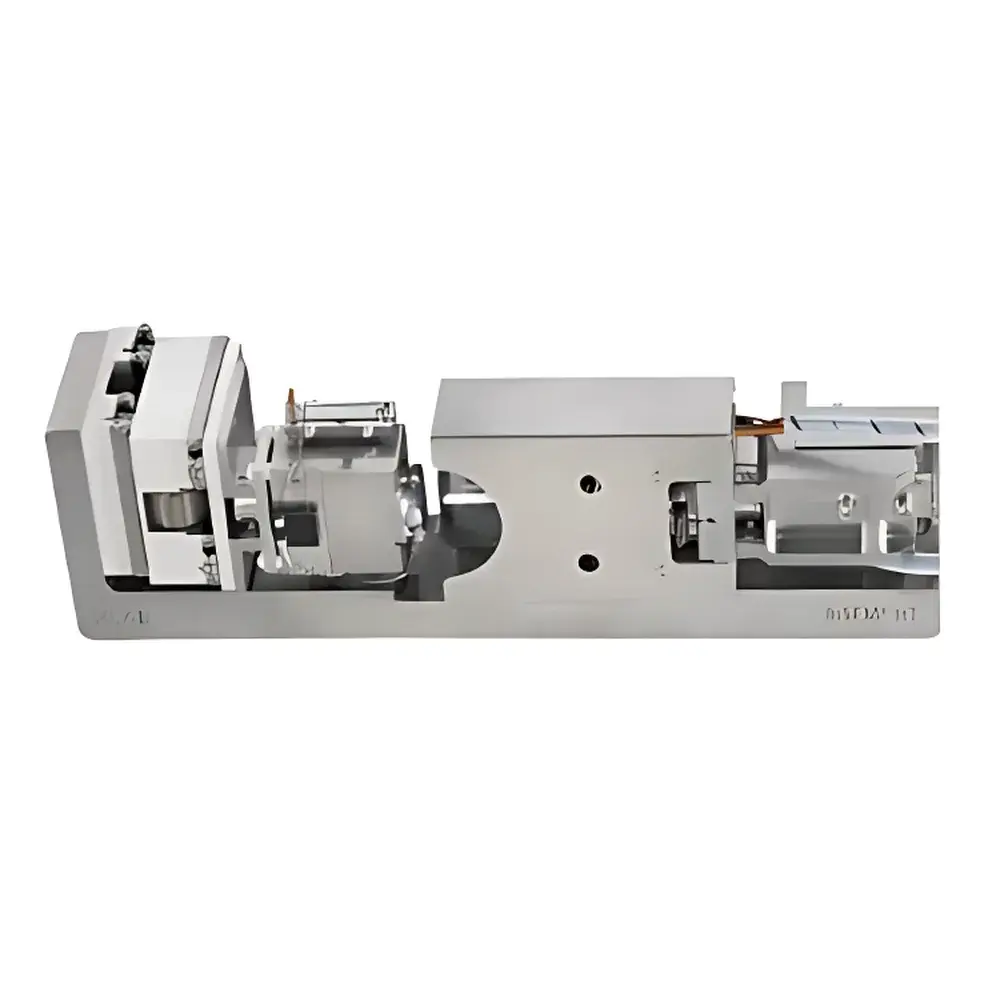
KLA InSEM HT High-Temperature In-Situ Nanoindentation System
| Brand | KLA |
|---|---|
| Origin | USA |
| Model | InSEM HT |
| Instrument Type | Nanoindentation System |
| Temperature Range | Up to 800 °C |
| Actuator Options | InForce 50 (50 mN) and InForce 1000 (1000 mN) |
| Data Acquisition Rate | 100 kHz |
| Time Constant | 20 µs |
| XYZ Stage Travel | 20 mm × 20 mm × 25 mm |
| Software Platform | InView (Windows® 10 compatible) with User Method Development, CSM, NanoBlitz 3D, AccuFilm™, ProbeDMA™, DataBurst™ |
Overview
The KLA InSEM HT High-Temperature In-Situ Nanoindentation System is an advanced nanomechanical characterization platform engineered for quantitative measurement of hardness, elastic modulus, contact stiffness, creep behavior, and strain-rate sensitivity under controlled elevated temperatures—up to 800 °C—in vacuum environments. Unlike conventional ex-situ high-temperature indentation systems, the InSEM HT employs independent, synchronized heating of both the indenter tip and sample substrate within the same vacuum chamber, eliminating thermal drift artifacts and enabling true in-situ mechanical testing during real-time microstructural observation. Its design integrates seamlessly with scanning electron microscopy (SEM) and focused ion beam (FIB) workstations—or operates in standalone ultra-high vacuum (UHV) chambers—allowing concurrent imaging, site-specific positioning, and mechanical probing at sub-micron spatial resolution. The system implements a capacitive displacement sensor coupled with electromagnetic force actuation (via KLA’s InForce series actuators), ensuring high-fidelity load-displacement data acquisition with sub-nanometer depth resolution and long-term stability. Measurement principles adhere to ASTM E2546 and ISO 14577 standards for nanoindentation, with Oliver-Pharr analysis embedded in the InView software suite for automated property extraction.
Key Features
- Independent dual-zone heating: Separate temperature control of tungsten carbide (WC) single-crystal Berkovich, cube-corner, or spherical indenters mounted on molybdenum base, and of the sample stage—both stable up to 800 °C in vacuum
- InForce 50 and InForce 1000 electromagnetic actuators: Deliver calibrated forces from 10 µN to 1000 mN with <0.2% linearity and <1% hysteresis; compatible with interchangeable tips and advanced test modes
- InQuest high-speed digital controller: 100 kHz sampling rate, 20 µs time constant, and real-time closed-loop feedback for dynamic loading protocols including continuous stiffness measurement (CSM)
- Integrated XYZ nanopositioning stage: 20 mm × 20 mm lateral travel and 25 mm vertical range, enabling multi-site mapping across heterogeneous samples and height-varied topographies
- Synchronized SEM video capture: Time-stamped overlay of live SEM images with indentation force–displacement curves, facilitating correlation between microstructure and local mechanics
- InView software platform: Windows® 10–based interface supporting full GLP-compliant audit trails, user-defined scripting (User Method Development), and built-in calibration routines for tip geometry and area function validation
Sample Compatibility & Compliance
The InSEM HT accommodates standard 10 mm diameter disk specimens or custom substrates mounted via vacuum-compatible kinematic fixtures. It supports conductive and non-conductive materials—including ceramics, intermetallics, MAX phases, nuclear fuel claddings, thermal barrier coatings, and refractory alloys—without requiring conductive coating. All hardware components meet UHV compatibility standards (<1×10⁻⁹ mbar base pressure), and thermal management complies with ASTM E2983 for high-temperature mechanical testing reproducibility. The system satisfies requirements for GMP-aligned material qualification workflows, including 21 CFR Part 11–compliant electronic signatures and secure data archiving when configured with enterprise-grade InView licensing. Calibration traceability follows NIST-traceable reference standards for hardness and modulus, and tip certification adheres to ISO 14577 Annex B guidelines.
Software & Data Management
InView serves as the unified control, acquisition, and analysis environment for all InSEM HT operations. Its modular architecture includes native support for CSM, NanoBlitz 3D, AccuFilm™, ProbeDMA™, and DataBurst™ modules—all accessible through a consistent graphical workflow. NanoBlitz 3D enables rapid grid-based indentation (≤1 s per point) over arrays up to 300×300 points, generating statistically robust 3D maps of E, H, and S with histogram-based phase discrimination. AccuFilm™ implements Hay-Crawford modeling to deconvolute thin-film properties from substrate influence—critical for coatings <1 µm thick. DataBurst™ extends temporal resolution beyond 1 kHz for transient event capture (e.g., pop-in, dislocation nucleation). All raw and processed datasets are stored in HDF5 format with embedded metadata (test parameters, environmental conditions, instrument configuration), ensuring FAIR (Findable, Accessible, Interoperable, Reusable) data principles. Export options include CSV, MATLAB .mat, and MTEX-compatible formats for third-party microstructure–property correlation.
Applications
The InSEM HT addresses fundamental and applied challenges in high-temperature materials science. It is routinely deployed for: (1) evaluating creep kinetics and stress relaxation in turbine blade superalloys above 0.5 Tm; (2) quantifying thermal softening thresholds in ceramic matrix composites used in hypersonic vehicle leading edges; (3) mapping modulus gradients across diffusion-bonded interfaces in nuclear cladding materials; (4) assessing irradiation-induced hardening in Fe–Cr model alloys post-ion implantation; and (5) validating constitutive models for additive-manufactured Inconel 718 subjected to thermal cycling. Its capability to perform constant-strain-rate, load-controlled, and frequency-swept CSM tests enables extraction of activation energies, apparent activation volumes, and viscoelastic master curves—data essential for life-prediction modeling in ASME Section III and NASA NPR 7150.2 frameworks.
FAQ
What vacuum level is required for optimal InSEM HT operation?
The system achieves highest thermal stability and lowest contamination risk at base pressures ≤5×10⁻⁸ mbar; however, it remains fully functional down to 1×10⁻⁶ mbar for most metallurgical and ceramic applications.
Can the InSEM HT be retrofitted into an existing SEM/FIB column?
Yes—KLA provides mechanical, electrical, and vacuum interface kits certified for Thermo Fisher, Zeiss, and Hitachi platforms; integration typically requires ≤5 days of on-site engineering support.
Is ISO 14577-compliant hardness reporting available out-of-the-box?
Yes—InView automatically applies Oliver-Pharr analysis with iterative area function correction and outputs hardness/modulus values with uncertainty estimates per ISO 14577-1:2022 Annex D.
How does the dual-heating architecture mitigate thermal drift during long-duration creep tests?
By actively matching tip and sample temperatures within ±2 °C and decoupling thermal expansion paths via differential mounting, axial thermal drift is reduced to <0.5 nm/s over 1-hour holds at 750 °C.
Does KLA provide application support for method development in novel material systems?
Yes—KLA’s Applications Engineering team offers remote and on-site collaboration, including experimental design, parameter optimization, and publication-ready data interpretation, under annual support contracts.



