
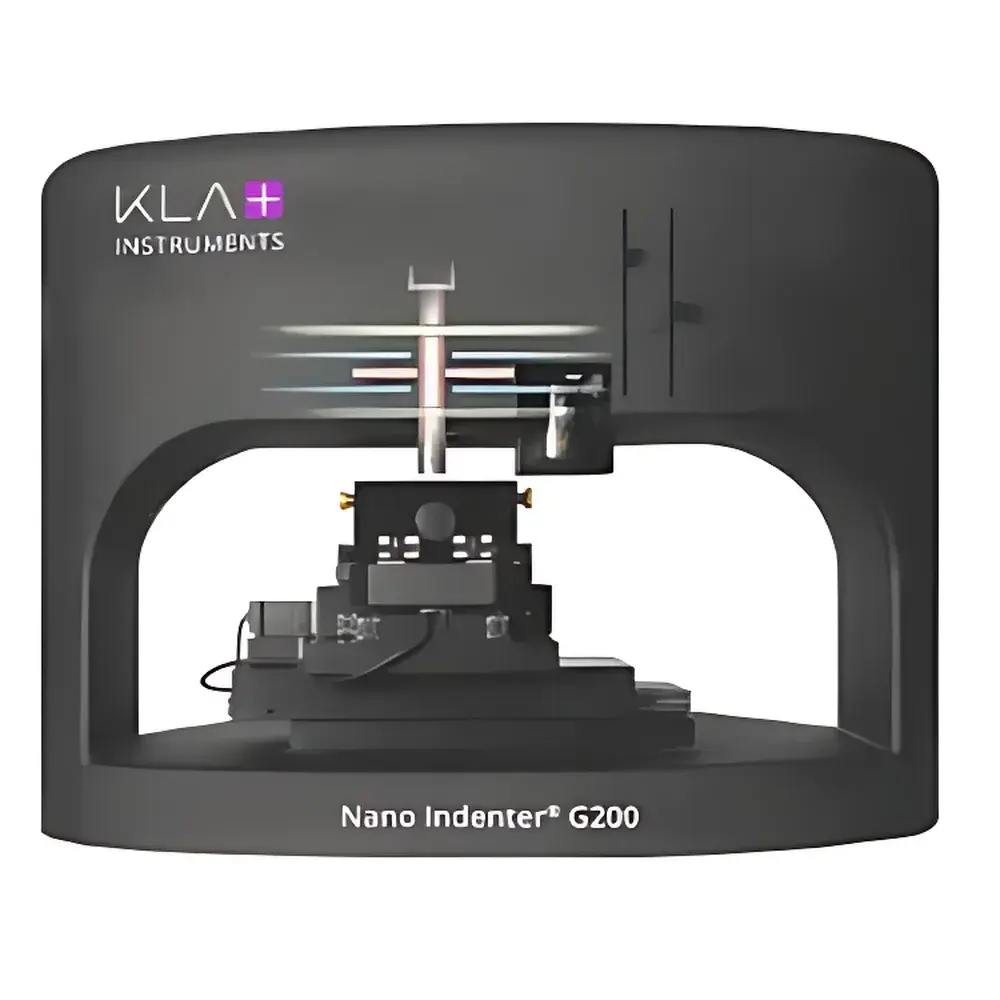
KLA Nano Indenter G200 Scratch and Nanoindentation Tester
| Brand | KLA |
|---|---|
| Origin | USA |
| Model | G200 |
| Instrument Type | Integrated Nanoindentation and Scratch Tester |
| Maximum Load Capacity | 10 N |
| Displacement Resolution | < 0.01 nm (10 pm) |
| Load Resolution | < 50 nN |
| Compatible Modules | DCM II, XP Actuator, CSM, ProbeDMA™, AccuFilm™, Laser Heating, LFM, NanoVision, Survey Scanning, Express Test |
Overview
The KLA Nano Indenter® G200 is a production-proven, fully automated nanomechanical testing platform engineered for high-precision measurement of mechanical properties at length scales ranging from sub-nanometer to millimeter. Based on electromagnetic actuation and capacitive displacement sensing, the system implements quasi-static and dynamic contact mechanics principles—including Oliver–Pharr analysis for hardness and reduced modulus, continuous stiffness measurement (CSM) for depth-resolved property mapping, and controlled-force scratch testing governed by ASTM C1624 and ISO 20502 standards. Its modular architecture supports quantitative characterization of elastic, plastic, viscoelastic, adhesive, and fracture-related behaviors across thin films, bulk solids, polymers, biomaterials, and multilayer systems—making it a foundational tool for R&D labs, semiconductor process development, and quality assurance environments operating under GLP/GMP or ISO/IEC 17025 frameworks.
Key Features
- Electromagnetic force actuator with linear response, enabling simultaneous high-resolution force (< 50 nN) and displacement (< 0.01 nm) measurement over six orders of magnitude in deformation
- Modular expansion capability: DCM II actuator (30 mN max load, 0.2 pm resolution), XP actuator (500 mN standard, upgradable to 10 N), laser-heated indenter/sample stage, lateral force module (LFM), and NanoVision closed-loop nanopositioning stage
- Real-time thermal drift compensation via active reference sensing, ensuring measurement stability during extended tests or elevated-temperature experiments (up to 500 °C with laser heating)
- Express Test option delivering one indentation per second—enabling statistically robust property mapping across heterogeneous surfaces within minutes
- Intuitive NanoSuite Professional software interface with pre-validated test methods compliant with ISO 14577-1/2/3, ASTM E2546, and USP , supporting audit-ready data traceability per FDA 21 CFR Part 11
- Integrated scanning probe imaging (Survey Scanning + NanoVision) enabling 500 µm × 500 µm coarse survey and 100 µm × 100 µm high-resolution topographic mapping at ≤1 nm step size
Sample Compatibility & Compliance
The G200 accommodates rigid and compliant specimens—from brittle ceramics and single-crystal semiconductors to hydrogels, polymer blends, and biological tissues—without requiring conductive coating or vacuum environments. Its open-sample design supports inert gas purging (N₂, Ar) to prevent oxidation during high-temperature nanoindentation or reactive material testing. All hardware and software modules comply with international metrological requirements for nanomechanical instrumentation, including traceable calibration against NIST-traceable reference materials (e.g., fused silica, sapphire, and certified polymer standards). Data acquisition, storage, and reporting workflows are structured to meet regulatory expectations for analytical instrument qualification (AIQ), method validation, and electronic record integrity in pharmaceutical, medical device, and aerospace applications.
Software & Data Management
NanoSuite® software provides dual operational modes: Professional (for standardized, SOP-driven testing) and Explorer (for protocol customization and algorithm development). Both versions include simulation mode for offline method design, batch processing, statistical analysis (Weibull, Gaussian distribution fitting), and export to CSV, MATLAB, or HDF5 formats. The Analyst reporting module generates customizable PDF reports with embedded metadata—including operator ID, timestamp, environmental conditions, calibration history, and raw force-displacement curves. Remote diagnostics via TeamViewer integration enables secure, time-stamped engineering support without compromising network security. Software licensing supports concurrent use of multiple modules (e.g., CSM + ProbeDMA™ + AccuFilm™), with version-controlled updates preserving legacy test methods and historical dataset compatibility.
Applications
- Thin-film mechanical characterization: Independent extraction of film modulus and hardness using AccuFilm™ methodology, decoupling substrate influence for dielectric stacks, barrier coatings, and ALD-grown layers
- Adhesion and interfacial failure analysis: Quantitative scratch testing to determine critical delamination load, friction coefficient evolution, and residual stress profiles in PVD/CVD coatings
- Viscoelastic property mapping: Frequency- and temperature-dependent complex modulus (E*, tan δ) measurement in thermoplastics and hydrogels using ProbeDMA™ protocols
- Fracture toughness assessment: Crack-length quantification via post-indentation 3D imaging (NanoVision + Survey Scanning), coupled with indentation-induced cracking models per ASTM E1820
- High-temperature deformation kinetics: In situ nanoindentation across 25–500 °C to resolve thermal activation energy, creep compliance, and phase-transition onset in shape-memory alloys and intermetallics
- Wear resistance screening: Controlled oscillatory scratching under variable normal load and sliding velocity to simulate CMP, tribological contact, or MEMS stiction scenarios
FAQ
What standards does the G200 support for hardness and modulus measurement?
The system implements ISO 14577-1/2/3 and ASTM E2546 methodologies through NanoSuite Professional, with built-in uncertainty propagation and calibration certificate management.
Can the G200 perform measurements on soft biological tissues?
Yes—the XP actuator’s sub-micron force control and active thermal compensation enable stable indentation of hydrated gels and excised tissues; optional humidity chamber integration maintains physiological conditions.
Is high-load testing (up to 10 N) compatible with nanoscale resolution?
The high-load option preserves native displacement resolution (< 0.01 nm) and load linearity across the full 10 N range via dual-range sensor architecture and real-time cross-talk correction.
How is data integrity ensured for regulated environments?
NanoSuite enforces electronic signatures, audit trails, role-based access control, and immutable raw-data archiving—fully aligned with FDA 21 CFR Part 11 and EU Annex 11 requirements.
Does the system support third-party automation or integration into factory MES platforms?
Yes—via TCP/IP API and OPC UA-compliant drivers, enabling bidirectional communication with LabVantage, Thermo Fisher SampleManager, or custom SCADA systems.



