
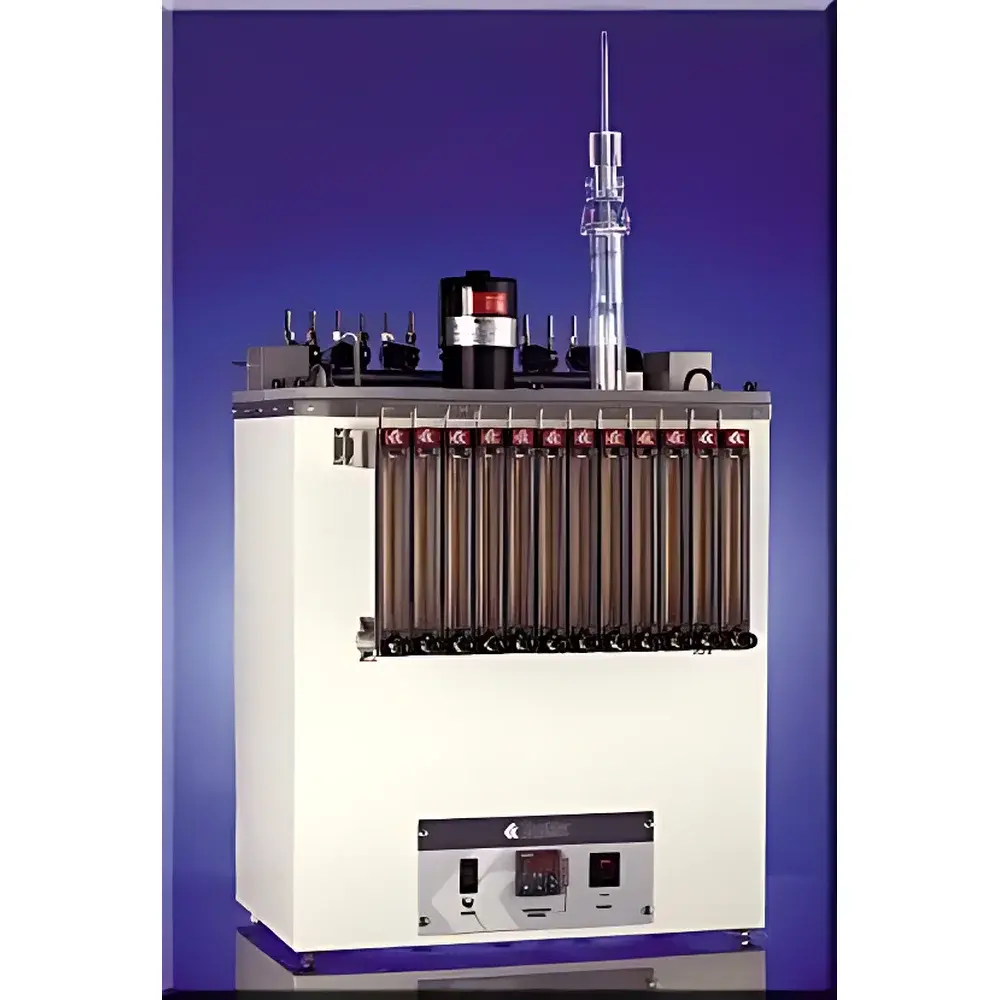
Koehler K12290 / K12219 / K12339 Petroleum Product Oxidation Stability Test Bath
| Brand | Koehler |
|---|---|
| Origin | USA |
| Manufacturer Type | Authorized Distributor |
| Origin Category | Imported |
| Model | K12290, K12219, K12339 |
| Quotation | Upon Request |
| Standards Compliance | ASTM D943, D2274, D2893*, D4310, D6158 |
| Sample Capacity | 8 / 12 / 30 / 60 positions |
| Temperature Range | Ambient to 100 °C |
| Temperature Stability | ±0.1 °C |
| Bath Medium | White mineral oil |
| Heating System | Immersed copper heater with 1⁄20 hp circulation agitator |
| Temperature Control | Microprocessor-based PID controller with LED digital display (°C/°F), overheat cut-off protection |
| Air Flow Rate | 3 L/h (independent flowmeter + control valve) |
| Bath Volume | 37.8 L (8-position), 71.9 L (12-position), 227 L (30-position), 432 L (60-position) |
| Dimensions & Weight | K12290: 44×64×107 cm, 62.1 kg |
| K12219 | 65×61×107 cm, 96.6 kg |
| K12339 | 109×140×132 cm, 404.6 kg |
| K12395 | 109×198×132 cm, 451.3 kg |
| Electrical Supply | 220–240 V, 50/60 Hz, single-phase |
Overview
The Koehler K12290, K12219, and K12339 Oxidation Stability Test Baths are precision-engineered thermal immersion systems designed for standardized accelerated oxidation testing of petroleum products under rigorously controlled conditions. These instruments operate on the fundamental principle of exposing sealed samples—typically lubricating oils, turbine oils, distillate fuels, or greases—to elevated temperatures and continuous, metered airflow in the presence of a catalytic metal surface (e.g., copper wire or coil), thereby accelerating oxidative degradation pathways. The resulting chemical changes—including sludge formation, acid number increase, viscosity shift, and corrosivity—are quantified per internationally recognized test methods to assess long-term storage stability and service life prediction. Each bath model is configured for discrete sample throughput (8, 12, 30, or 60 positions), enabling laboratories to scale testing capacity without compromising temperature uniformity or air-flow consistency across all reaction vessels.
Key Features
- Microprocessor-based PID temperature control system ensures rapid thermal equilibration and exceptional stability of ±0.1 °C across the full operating range (ambient to 100 °C).
- Dual-layer insulated bath construction with immersed copper heating elements and a 1⁄20 hp circulation agitator guarantees homogeneous thermal distribution and minimizes axial and radial gradients.
- Independent, calibrated mass flow control for compressed air at precisely 3 L/h per sample station—critical for reproducible oxidation kinetics in ASTM D2274 and D4310 protocols.
- Digital LED display simultaneously shows setpoint and actual bath temperature in both °C and °F, with automatic power cutoff upon thermal excursion beyond user-defined safety limits.
- Integrated cold-water condenser manifold and calibrated flowmeters simplify setup and ensure compliance with condensation requirements in ASTM D943 and ISO 4263.
- Robust stainless-steel frame and corrosion-resistant internal components support extended operation in high-humidity, high-temperature environments typical of multi-day oxidation trials.
Sample Compatibility & Compliance
These test baths accommodate standard ASTM glass oxidation tubes (e.g., 300-mL or 500-mL tapered borosilicate vessels) fitted with copper catalyst coils or wires, as specified in D943 (turbine oil life measurement), D2274 (distillate fuel oxidation stability), D4310 (gasoline oxidation stability), and D6158 (oxidation stability of engine oils). The system supports both inhibitor-containing mineral oils and synthetic base stocks, and is validated for use with solid catalysts, water-contaminated samples, and multi-component blends. All models meet the mechanical, thermal, and airflow performance criteria outlined in ASTM D943 Annex A1, D2274 Section 7.2, and ISO 12205 Annex B. The bath design conforms to GLP laboratory infrastructure requirements, including traceable calibration documentation, audit-ready temperature logging capability (when paired with optional data acquisition modules), and compatibility with FDA 21 CFR Part 11-compliant software platforms.
Software & Data Management
While the base units operate as standalone analog-digital hybrid controllers, Koehler offers optional PC-based data acquisition interfaces compatible with Windows OS and third-party LIMS environments. These modules record time-stamped temperature profiles, airflow verification logs, and operator-initiated event markers (e.g., “test start”, “sample withdrawal”). Raw data exports comply with ASTM E2524 and ISO/IEC 17025 reporting formats, supporting automated pass/fail evaluation against method-defined endpoints (e.g., sludge mass > 50 mg, acid number ≥ 2.0 mg KOH/g). All firmware versions undergo annual revision cycles aligned with updates to ASTM and ISO method revisions, ensuring ongoing regulatory alignment without hardware modification.
Applications
- Quantitative assessment of antioxidant package efficacy in turbine oils per ASTM D943 (RBOT – Rotating Bomb Oxidation Test variant).
- Accelerated oxidation screening of diesel and jet fuels under D2274 conditions to predict sediment formation during long-term storage.
- Corrosion tendency evaluation of inhibited lubricants using copper strip immersion and gravimetric sludge analysis per D4310.
- Comparative stability ranking of base oil formulations during R&D, particularly for Group III and PAO synthetics exposed to thermal-oxygen stress.
- Quality assurance testing of finished lubricants prior to batch release, satisfying OEM specifications such as Caterpillar TO-4, Cummins CES 20081, and GM Dexos approvals.
- Supporting ASTM D2893* (oxidation stability of used oils) when integrated with post-test analytical workflows (FTIR, TAN, GC-MS).
FAQ
What ASTM standards are fully supported by the K12290/K12219/K12339 series?
ASTM D943, D2274, D2893*, D4310, and D6158 are natively supported through mechanical configuration, airflow calibration, and thermal stability validation. Additional standards including AOCS CD12-57 and ISO 4263 require minor accessory adaptations (e.g., custom tube holders), which are available through Koehler’s application engineering team.
Is bath medium replacement required between test runs?
White mineral oil must be replaced after every 1000 hours of cumulative operation or following any contamination event (e.g., sample overflow, acid carryover). Koehler provides certified bath oil (K-1010) with documented oxidative induction time (OIT) baseline values for traceability.
Can these units be integrated into an automated lab workflow?
Yes—RS-232 and optional Ethernet interfaces enable integration with SCADA systems, robotic sample handlers, and centralized calibration management platforms compliant with ISO/IEC 17025 Clause 6.5.
What maintenance intervals are recommended for long-term reliability?
Monthly verification of airflow calibration, quarterly inspection of heater insulation resistance (>10 MΩ), and biannual PID controller recalibration using NIST-traceable reference thermometers are advised per Koehler Maintenance Protocol MP-KOSB-2023.
Do the K12290/K12219/K12339 models support dual-voltage configurations?
All listed models are supplied with fixed 220–240 V, 50/60 Hz, single-phase input. Custom 110–120 V variants (e.g., K12290-115) are available upon special order with lead-time extension and UL/cUL certification revalidation.




