
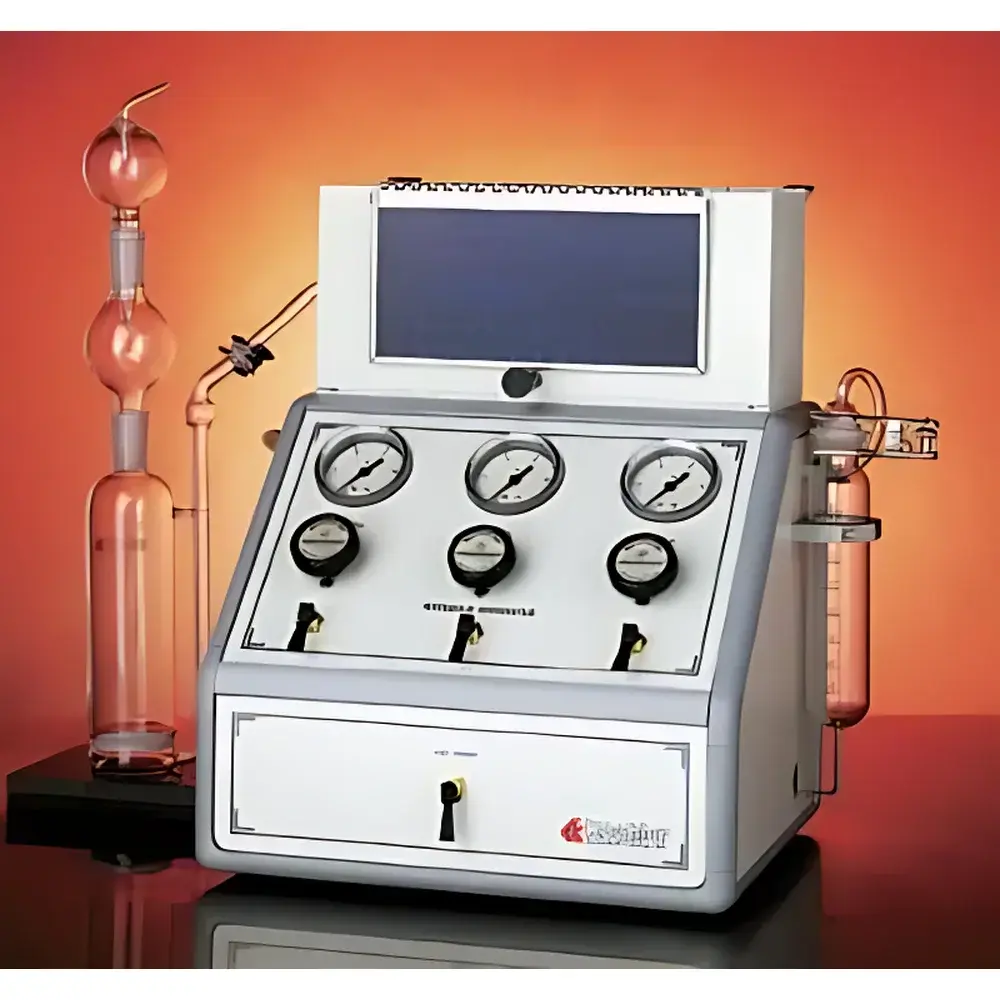
Koehler K47590 Wickbold Combustion Sulfur Analyzer
| Brand | Koehler |
|---|---|
| Origin | USA |
| Model | K47590 |
| Standards Compliance | ASTM D2384, D2747, D2784, D2785 |
| Detection Range | 0.1–300 ppm total sulfur |
| Sample Types | LPG, liquefied petroleum gases, liquid petroleum products, butane-butene mixtures |
| Combustion Method | Wickbold oxygen-hydrogen flame combustion |
| Ignition | Manual press-button ignition |
| Gas Control | Integrated pressure regulators for H₂, O₂, and N₂ |
| Construction | Stainless steel burner housed in insulated chamber with flame observation window |
| Accessories Included | Pyrex™ and quartz glassware set (200 mL sample reservoir, capillary sample delivery tube, combustion chamber, absorber, spray trap, cooling coil) |
| Optional Accessory | Gas sample adapter (for LPG, natural gas, and refinery gas) |
Overview
The Koehler K47590 Wickbold Combustion Sulfur Analyzer is a precision laboratory instrument engineered for the quantitative determination of total sulfur and trace volatile chlorides in petroleum-based fuels and gaseous hydrocarbon streams. It operates on the established Wickbold combustion principle—where sample is introduced via capillary into a high-temperature hydrogen–oxygen flame within a controlled, insulated stainless-steel combustion chamber. Sulfur compounds are quantitatively oxidized to sulfur dioxide (SO₂), which is subsequently absorbed in standardized alkaline peroxide solution and titrated iodometrically or measured spectrophotometrically (per ASTM D2384 and D2785). The system supports both manual endpoint detection and integration with automated titration modules for enhanced reproducibility. Designed for regulatory compliance and method validation, the K47590 delivers consistent performance across diverse matrices—including viscous, high-aromatic, and high-sulfur samples—when appropriately diluted with suitable solvents such as xylene or kerosene.
Key Features
- Stainless-steel Wickbold burner housed in a thermally insulated observation chamber, enabling real-time visual monitoring of flame stability and combustion efficiency
- Integrated, independently adjustable pressure regulators for hydrogen, oxygen, and nitrogen supply lines—ensuring precise stoichiometric control over combustion conditions
- Manual push-button ignition system with fail-safe gas interlock logic to prevent uncontrolled ignition events
- Complete Pyrex™ and fused-quartz glassware suite: 200 mL sample reservoir, calibrated capillary delivery tube, combustion chamber, absorption vessel, spray trap, and condenser cooling coil
- Modular design accommodates optional gas sample adapters (sold separately) for direct analysis of LPG, natural gas, and refinery off-gas streams per GPA 2140 and ISO 4260
- No moving parts in the combustion path—minimizing maintenance requirements and maximizing operational longevity
Sample Compatibility & Compliance
The K47590 is validated for use with liquid petroleum products (e.g., gasoline, diesel, jet fuel, naphtha), liquefied petroleum gas (LPG), butane–butene blends, and other volatile hydrocarbon mixtures. It meets the procedural and performance criteria outlined in multiple international standards, including ASTM D2384 (sulfur in distillate fuels), ASTM D2747 (trace sulfur in gasoline), ASTM D2784 (volatile chlorides in butane–butene), and ASTM D2785 (total sulfur in LPG). Additional compliance extends to IP 243 (UK), ISO 4260 (global LPG specification), DIN EN 41 (European refined product testing), and NF T 60-142 (French national standard for sulfur analysis). The analyzer supports GLP-compliant workflows when paired with audit-trail-capable titration systems and electronic lab notebooks.
Software & Data Management
As a benchtop combustion platform, the K47590 operates without embedded firmware or proprietary software. All analytical output is generated through external titration instrumentation or UV-Vis spectrophotometers connected via standard analog or RS-232 interfaces. Laboratories may integrate the K47590 into LIMS environments using vendor-neutral data acquisition protocols. When used with FDA 21 CFR Part 11–compliant titrators (e.g., Metrohm or Mettler Toledo platforms), full electronic signature support, user access controls, and audit trail generation are achievable. Raw absorbance or titrant volume data can be exported in CSV or ASCII format for statistical process control (SPC) and trending analysis per ISO/IEC 17025 requirements.
Applications
- Determination of total sulfur in gasoline, diesel, and aviation turbine fuels per ASTM D2747 and D2384
- Quantification of trace sulfur (0.1–300 ppm) in liquefied petroleum gas (LPG) and propane–butane mixtures per ASTM D2785 and GPA 2140
- Analysis of volatile chloride impurities in butane–butene feedstocks for alkylation units per ASTM D2784
- Quality assurance testing of reformulated fuels and low-sulfur blending components prior to distribution
- Refinery process stream monitoring for sulfur breakthrough in hydrotreater effluents and amine unit regenerants
- Support of environmental compliance reporting under EPA Tier 3 gasoline regulations and EU Fuel Quality Directive (2009/30/EC)
FAQ
What sample preparation is required for viscous or high-sulfur petroleum products?
Viscous or high-sulfur samples must be diluted with an appropriate solvent (e.g., xylene, kerosene, or white spirit) to ensure homogeneous capillary delivery and complete combustion. Dilution factors should be documented and applied during final concentration calculation.
Can the K47590 analyze natural gas directly?
No—natural gas and other gaseous samples require the optional gas sample adapter kit (Koehler P/N K47590-GSA), which enables controlled vapor-phase introduction and flow regulation compatible with ASTM D2785 and ISO 4260.
Is the instrument compatible with automated titration systems?
Yes—the absorber outlet and titrant burette interface are designed for seamless coupling with standard automatic titrators. Koehler provides mechanical mounting brackets and signal interface documentation for common OEM platforms.
What safety certifications does the K47590 carry?
The instrument complies with UL 61010-1 (Laboratory Equipment Safety) and CSA C22.2 No. 61010-1. Hydrogen handling conforms to NFPA 55 and CGA G-5.5 guidelines. Local institutional review and gas cabinet installation are mandatory prior to commissioning.
How often does the quartz combustion chamber require cleaning or replacement?
Under normal operation with clean fuels, the quartz chamber requires inspection after every 50–100 analyses. Cleaning with dilute nitric acid followed by deionized water rinse is sufficient. Replacement is recommended after visible etching or microfracture development—typically every 12–18 months in high-throughput labs.






