
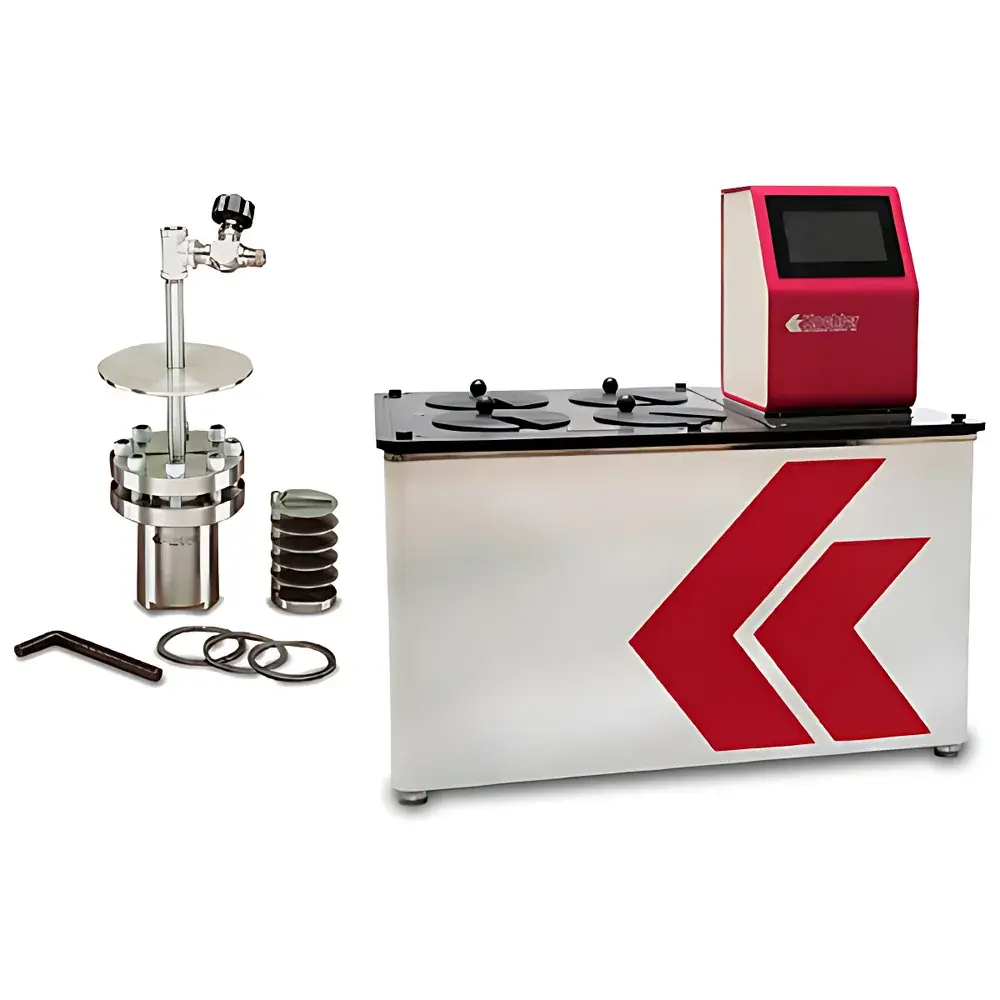
Koehler K64500 Lubricating Grease Oxidation Stability Tester
| Brand | Koehler |
|---|---|
| Origin | USA |
| Manufacturer Status | Authorized Distributor |
| Product Type | Laboratory Instrument |
| Test Parameter | Oxidation Stability |
| Compliance Standard | ASTM D942, IP 142, DIN 51808, FTM 791-3453 |
| Sample Capacity | 4 test specimens |
| Temperature Range | Ambient to 135 °C |
| Bath Medium | 47.3 L white mineral oil |
| Pressure Measurement Range | 0–1378 kPa |
| Oxygen Pressure | 758 kPa (initial) |
| Test Temperature | 99 °C ± 0.1 °C |
| Oxygen Bomb Working Pressure Rating | 1241 kPa at 99 °C |
| Power Supply | 220–240 V, 50/60 Hz, Single Phase, 6.8 A |
Overview
The Koehler K64500 Lubricating Grease Oxidation Stability Tester is a precision-engineered laboratory instrument designed to evaluate the oxidative resistance of lubricating greases under accelerated, controlled conditions. It operates on the principle of static oxygen pressure decay measurement in sealed bomb systems—a gravimetric and manometric method standardized in ASTM D942. In this test, grease samples are placed inside high-integrity oxygen bombs, pressurized to 758 kPa with pure oxygen, and immersed in a thermally stabilized bath maintained at 99 °C. Oxidation proceeds over time, consuming oxygen and causing measurable pressure decline. The rate and magnitude of pressure drop—recorded at defined intervals—are directly correlated with the sample’s inherent antioxidant capacity and degradation kinetics. This methodology provides quantitative, reproducible data essential for formulation development, quality control, and shelf-life prediction of grease products across automotive, industrial, and aerospace applications.
Key Features
- Compliance with multiple international standards: ASTM D942, IP 142, DIN 51808, and U.S. Department of Defense FTM 791-3453.
- Four-position test configuration enabling parallel evaluation of up to four grease specimens under identical thermal and oxidative conditions—enhancing statistical robustness and throughput efficiency.
- ASTM-compliant oxygen bomb (K11000) rated for 1241 kPa at 99 °C, constructed from corrosion-resistant alloy with PTFE-carbon fluoropolymer sealing (11029) to ensure long-term integrity and zero gas leakage.
- Microprocessor-controlled oxidation bath with PID temperature regulation; achieves ±0.1 °C stability at 99 °C and features dual safety layers—overheat cutoff and insulated polyimide enamel-coated enclosure for chemical and thermal resilience.
- Oxidata™ electronic pressure monitoring system running natively on Windows OS; provides real-time acquisition, visualization, and logging of pressure vs. time profiles with 0–1378 kPa full-scale range.
- Direct sensor-to-bomb connection via calibrated stainless-steel pressure line (K10551 + K10556), eliminating intermediate fittings and minimizing dead volume or hysteresis errors.
- Dual-format LED display (°C/°F) showing both setpoint and actual bath temperature, coupled with intuitive front-panel controls for standalone operation without PC dependency.
Sample Compatibility & Compliance
The K64500 accommodates standard ASTM 22C-compliant grease specimens (typically 10–15 g per bomb) and is compatible with NLGI grades ranging from 000 to 6. All wetted components—including the oxygen bomb, pressure lines, and sealing hardware—are selected for inertness toward hydrocarbon-based greases and oxidizing environments. Regulatory alignment extends beyond ASTM D942: raw data output supports GLP-compliant audit trails when used with validated Oxidata™ software configurations; optional 21 CFR Part 11 compliance modules are available for pharmaceutical-grade lubricant testing. Calibration documentation adheres to ISO/IEC 17025 requirements, and routine verification follows Koehler’s certified reference procedure using NIST-traceable pressure transducers and Class AA thermometry (250-000-22C).
Software & Data Management
Oxidata™ software delivers fully automated test execution, including timed pressure sampling, alarm-triggered event logging (e.g., pressure deviation >5 kPa), and dynamic curve fitting for induction period estimation. All acquired data—including timestamps, ambient barometric correction, and operator ID—are stored in structured binary archives with embedded metadata. Export formats include CSV, PDF reports (with configurable headers and footers), and XML for LIMS integration. Local storage capacity is unrestricted; historical datasets remain accessible for trend analysis, comparative benchmarking, or regulatory submission. Audit logs record user actions, parameter changes, and system events—supporting FDA and EMA inspection readiness where required.
Applications
- Formulation screening of antioxidant packages (e.g., hindered phenols, amines, sulfur compounds) in lithium, calcium-sulfonate, and polyurea-thickened greases.
- Batch release testing for OEM specifications requiring D942 conformance (e.g., GM 6277M, Ford WSS-M2C948-A).
- Accelerated aging studies correlating oxidation onset with rheological breakdown (e.g., ASTM D1831 cone penetration loss).
- Root-cause analysis of premature bearing failure linked to oxidative thickener degradation.
- Supporting ISO 2137 and ASTM D217 repeatability assessments by isolating oxidation-induced consistency shifts.
FAQ
What is the primary measurement principle employed by the K64500?
It quantifies oxidation-induced oxygen consumption via high-precision manometry in sealed, heated oxygen bombs—directly implementing the ASTM D942 static pressure decay method.
Can the instrument operate without a connected computer?
Yes—the integrated microprocessor controller enables autonomous temperature regulation and manual pressure readout; however, full data acquisition, reporting, and archival require Oxidata™ software on a Windows host.
Is white mineral oil included with the system?
A 1-gallon container (355-001-001) is supplied as standard; 5-gallon refills (355-001-003) and replacement ASTM 22C thermometers (250-000-22C) are available as optional accessories.
How is over-pressurization prevented during oxygen charging?
The K10556 oxygen manifold incorporates a mechanical pressure relief valve set to activate at 827 kPa—ensuring safe operation below the bomb’s 1241 kPa rating while preventing inadvertent overfilling.
What maintenance intervals are recommended for pressure sensor calibration?
Annual recalibration against NIST-traceable references is advised; Koehler-certified field service includes zero-point verification, span adjustment, and certificate issuance per ISO 17025 guidelines.







