
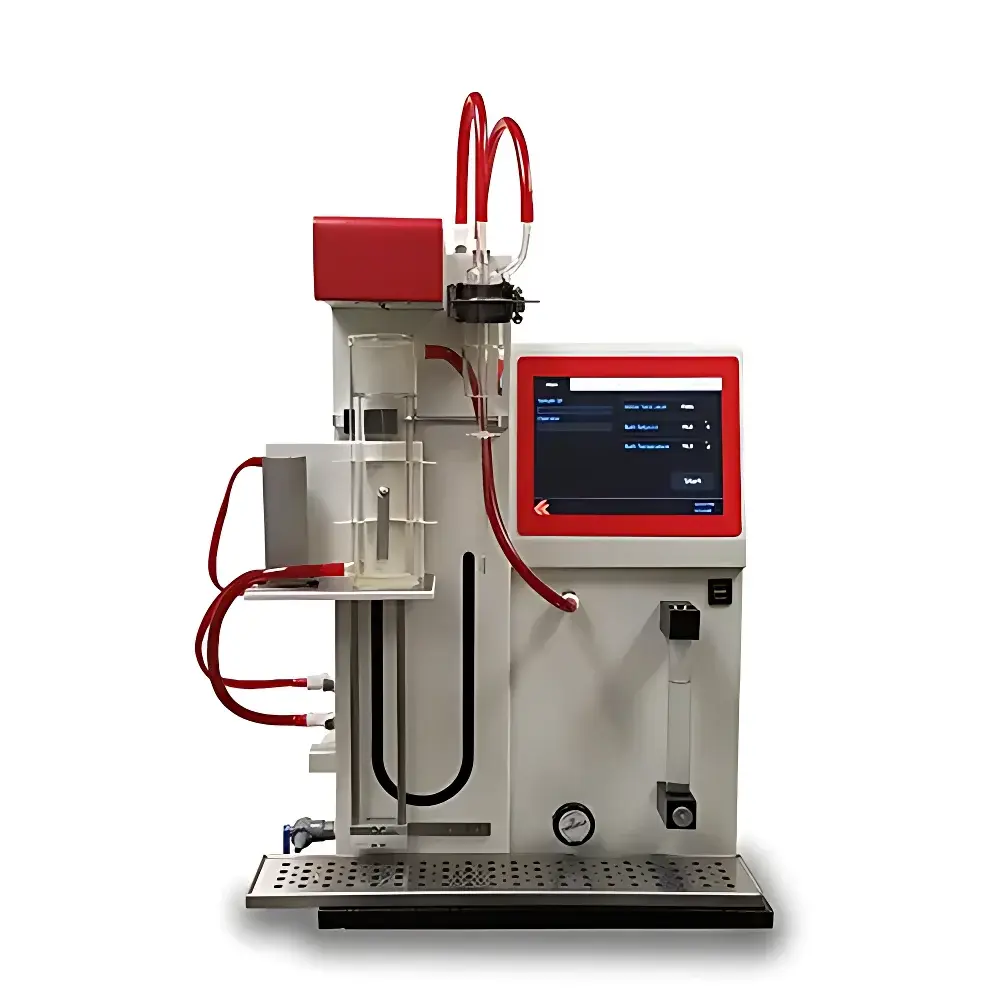
Koehler K88539 Automatic Air Release Value Analyzer
| Brand | Koehler |
|---|---|
| Origin | USA |
| Manufacturer Status | Authorized Distributor |
| Origin Category | Imported |
| Model | K88539 |
| Product Type | Laboratory Instrument |
| Test Parameter | Air Release Time (ART) |
| Standards Compliance | ASTM D3427, IP 313, ISO 9120, DIN 51381, NF E 48-614, NF T 60-149, BS 2000 Part 313 |
Overview
The Koehler K88539 Automatic Air Release Value Analyzer is a fully integrated, standards-compliant laboratory instrument engineered for the precise determination of air release time (ART) in turbine oils, hydraulic fluids, and other lubricating oils. It operates on the principle of controlled gas sparging—introducing heated, dry compressed air at a defined flow rate into a thermally stabilized oil sample, followed by automated monitoring of the time required for entrained air volume to decay to ≤0.2% (v/v). This measurement directly correlates with an oil’s ability to separate dispersed microbubbles under dynamic operating conditions, a critical performance indicator for systems subject to high-shear agitation, such as steam turbines, hydraulic power units, and gearboxes. The analyzer conforms strictly to ASTM D3427, IP 313, ISO 9120, and six additional international test methods, ensuring data traceability and regulatory acceptability across global lubricant quality assurance and R&D laboratories.
Key Features
- Integrated 7-inch color touchscreen interface with guided workflow navigation—from sample loading and preheating to final ART calculation—minimizing operator dependency and procedural variability.
- Onboard density calculation module that automatically applies measured sample density to normalize air release kinetics, improving inter-laboratory reproducibility per ASTM D3427 Annex A1.
- Integrated precision balance (0.001 g resolution) and thermostatically controlled circulation bath (±0.1 °C stability), enabling real-time mass tracking during air release without manual intervention.
- Automated lift mechanism that sequentially positions the jacketed measurement cell between the heated air delivery nozzle and the balance-mounted plumb bob assembly, eliminating manual handling errors and thermal shock risks.
- Dual-stage safety architecture: overtemperature cutoff for the air heating system (max 100 °C) and pressure relief valve integrated into the compressed air manifold, compliant with OSHA and CE machinery directive requirements.
- Preheating convection oven (K885-240-1, optional) capable of conditioning samples up to 100 °C prior to transfer—critical for high-viscosity or wax-containing formulations.
Sample Compatibility & Compliance
The K88539 accommodates standard 100 mL glass test cells (ASTM D3427 geometry) and supports viscosity ranges from 20 to 400 cSt at 50 °C. It is validated for mineral-based, synthetic hydrocarbon (SHC), polyalphaolefin (PAO), and phosphate ester fluids. All operational parameters—including airflow rate (200 ±5 mL/min), bath temperature setpoints (typically 50 °C or 75 °C), and timing resolution (0.1 s)—are programmable and auditable. Full compliance with ASTM D3427 Section 7 (apparatus specifications), ISO 9120 Clause 5 (performance criteria), and IP 313 Annex B (calibration verification protocol) is documented in the factory acceptance test report (FATR) supplied with each unit. The system architecture supports GLP/GMP environments through configurable user access levels and electronic signature-ready audit trails.
Software & Data Management
The embedded firmware provides native CSV export via USB port and optional Ethernet connectivity for LIMS integration. Test records include timestamped raw data streams (temperature, mass, elapsed time), calculated ART value, density-corrected result, and pass/fail status against user-defined specification limits. All data entries are immutable post-acquisition and retain full metadata (operator ID, calibration certificate IDs, environmental logs). The software architecture satisfies FDA 21 CFR Part 11 requirements for electronic records and signatures when deployed with network authentication and role-based permissions enabled—making it suitable for regulated QC laboratories supporting ISO/IEC 17025 accreditation.
Applications
- Quality control of new turbine oils prior to commissioning in power generation facilities.
- Monitoring oxidative degradation and additive depletion in service-aged lubricants via trending of ART elongation.
- Formulation development of anti-foam additive packages in OEM lubricant R&D labs.
- Root-cause analysis of air-binding failures in hydraulic servo-valves and pump cavitation events.
- Third-party certification testing for API RP 686, GEK 32568, and Siemens TLV 90000 specifications.
FAQ
What is the maximum allowable sample viscosity for reliable ART measurement?
Samples up to 400 cSt at 50 °C can be tested; above this range, preheating to 75 °C (or using the optional convection oven) is recommended to ensure complete air bubble detachment.
Does the K88539 require external calibration gases or certified reference oils?
No—airflow calibration is performed internally using a NIST-traceable mass flow controller; density correction uses the onboard balance and volumetric flask calibration routine per ASTM D1298.
Can the instrument store method templates for multiple test standards?
Yes—up to 20 user-defined protocols may be saved, each specifying temperature, airflow, dwell time, and acceptance criteria per ASTM, ISO, or proprietary specifications.
Is remote diagnostics supported?
Yes—via optional Koehler Remote Support Module (K-RSM), enabling secure technician access for firmware updates and sensor diagnostics under ITAR-compliant encryption.
What maintenance intervals are recommended for long-term accuracy?
Daily: visual inspection of tubing and seals; quarterly: balance recalibration and airflow verification; annually: full thermocouple and pressure transducer calibration by Koehler-certified service engineer.







