
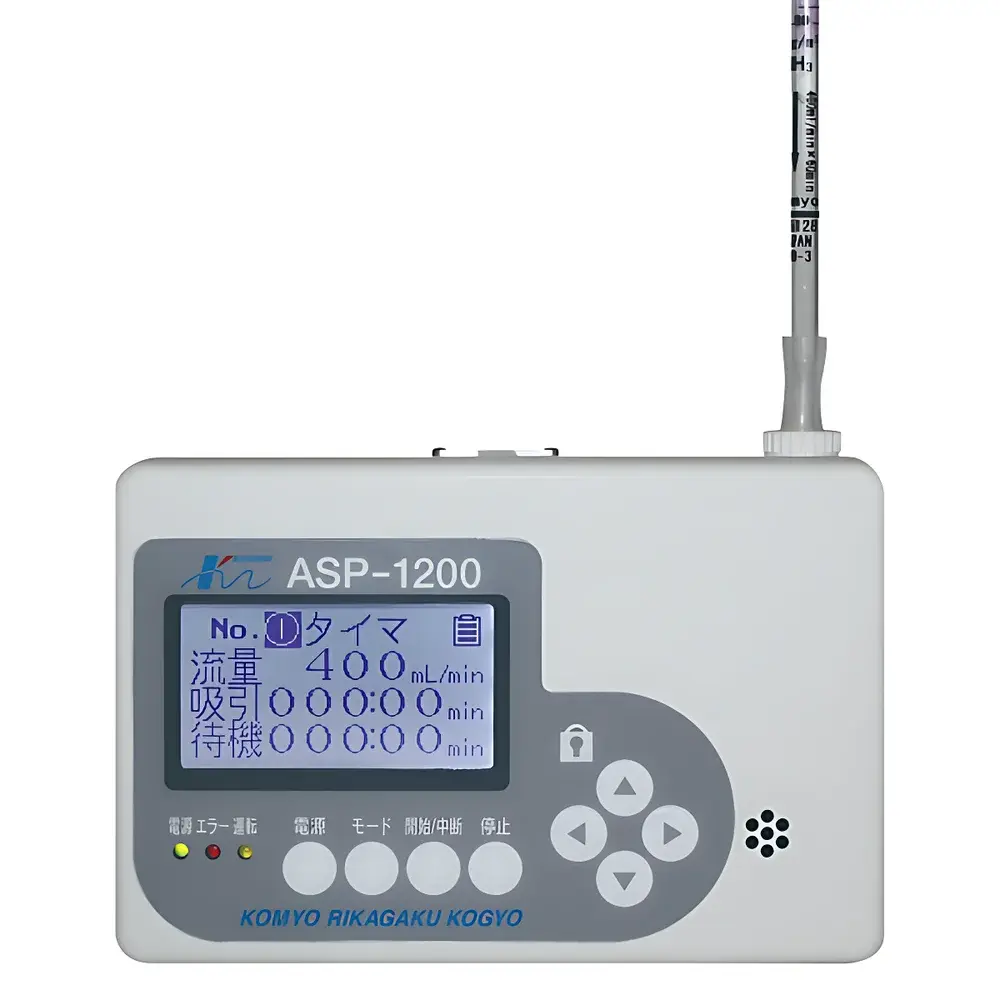
Komyo Rikagaku 900NHL Low-Range Ammonia Quick-Test Colorimetric Detection Tube
| Brand | Komyo Rikagaku |
|---|---|
| Origin | Japan |
| Model | 900NHL |
| Measurement Range | 1–12 µg/m³ |
| Detection Principle | Colorimetric Reaction with Fixed-Volume Gas Sampling |
| Compatible Pump | ASP-1200 Electric Suction Pump |
| Calibration Traceability | NIST-traceable reference standards (per JIS K 0321) |
| Shelf Life | 24 months from manufacture date (unopened, 25°C or below) |
| Tube Dimensions | Ø6 mm × 120 mm |
| Minimum Detectable Volume | 50 mL (adjustable via pump stroke count) |
Overview
The Komyo Rikagaku 900NHL is a precision-engineered, single-use colorimetric detection tube designed for quantitative measurement of trace-level ammonia (NH₃) concentrations in ambient air and controlled environments. Operating on the well-established length-of-stain principle, the tube contains a chemically impregnated silica gel reagent that undergoes a stoichiometric, irreversible color reaction upon exposure to gaseous ammonia. When drawn through the tube at a defined volumetric flow rate using the ASP-1200 electric suction pump, ammonia molecules react uniformly along the reagent column, producing a sharp, stable color front. The distance traveled by this front—measured against the calibrated scale printed on the tube—is directly proportional to the integrated ammonia concentration (µg/m³), calculated per ISO 8518:2021 and JIS K 0321:2019 standards for gas detection tubes. With a validated linear range of 1–12 µg/m³ and a lower limit of quantification (LLOQ) of 1 µg/m³, the 900NHL is specifically optimized for ultra-low-concentration monitoring where conventional electrochemical or semiconductor sensors lack sufficient sensitivity and selectivity.
Key Features
- Ultra-low-range quantification: Certified measurement range of 1–12 µg/m³ NH₃—ideal for cleanroom validation, semiconductor fab ambient monitoring, and museum-grade conservation spaces.
- High specificity: Selective reagent formulation minimizes interference from common co-contaminants including amines, formaldehyde, hydrogen sulfide, and volatile organic compounds (VOCs) at typical background levels.
- NIST-traceable calibration: Each production lot is calibrated against gravimetrically prepared ammonia reference gases certified to ISO/IEC 17025-accredited laboratories; certificate of analysis included with every box.
- Controlled sampling protocol: Requires use of the ASP-1200 pump (sold separately), ensuring reproducible draw volume (±2% accuracy) and consistent flow profile—critical for achieving stated precision (CV ≤ 8% at 3 µg/m³).
- Stable post-exposure reading window: Color front remains fixed for ≥15 minutes after sampling, enabling field verification and secondary review without time pressure.
- Compact and transport-stable: Sealed glass tube with protective foil cap; compliant with IATA Section II for air transport of non-hazardous diagnostic devices.
Sample Compatibility & Compliance
The 900NHL is validated for use with ambient air, nitrogen-purged enclosures, dry compressed air lines, and low-humidity inert atmospheres (RH 50 ppb), which may accelerate reagent degradation or cause false-positive staining. All batches comply with Japanese Industrial Standard JIS K 0321 for gas detection tubes and meet the performance criteria outlined in ASTM D5467–22 (Standard Practice for Use of Gas Detection Tubes). For regulated environments—including ISO Class 1–5 cleanrooms and GLP-compliant artifact storage facilities—the 900NHL supports documented, auditable gas monitoring when used within its specified operating conditions and paired with calibrated pump instrumentation.
Software & Data Management
As a passive, analog field measurement device, the 900NHL does not incorporate onboard electronics or digital output. However, it integrates seamlessly into structured environmental monitoring workflows: recorded readings (tube ID, sampling location, date/time, pump strokes, ambient T/RH, observer initials) are entered manually into LIMS or electronic lab notebooks (ELN) per 21 CFR Part 11 requirements. Optional companion tools include Komyo’s TubeLog™ mobile app (iOS/Android), which digitizes scale reading via image capture and optical character recognition (OCR), auto-calculates concentration using batch-specific calibration coefficients, and exports timestamped CSV reports with audit trail metadata. All data files retain full traceability to individual tube lot numbers and associated CoA documentation.
Applications
- Semiconductor manufacturing: Monitoring NH₃ breakthrough in point-of-use (POU) ultra-high-purity (UHP) gas lines and tool ambient purge zones where sub-ppb equivalent levels (≈1 µg/m³) can induce particle nucleation or photoresist defects.
- Flat-panel display (FPD) fabrication: Verifying ammonia-free conditions during TFT-LCD and OLED panel assembly, particularly in photolithography and encapsulation cleanrooms.
- Cultural heritage preservation: Quantifying off-gassing from adhesives, varnishes, and storage materials in archival vaults and exhibition cases—where chronic NH₃ exposure accelerates silver mirroring and parchment hydrolysis.
- Pharmaceutical isolator qualification: Supporting ISO 14644-1 Class 5 verification in aseptic processing suites where ammonia serves as a surrogate for basic airborne molecular contaminants (AMCs).
- Field-based industrial hygiene surveys: Rapid screening of low-level ammonia leaks near refrigeration systems, wastewater treatment units, or fertilizer-handling areas without requiring power or calibration gas.
FAQ
What is the recommended sampling volume for the 900NHL tube?
For optimal accuracy across the full 1–12 µg/m³ range, draw 100 mL of air using the ASP-1200 pump at 100 mL/min (1-minute draw). Lower concentrations (<3 µg/m³) may require up to 200 mL to enhance visual resolution of the stain front.
Can the 900NHL be reused after sampling?
No. The tube is a single-use, disposable analytical device. The chemical reaction is irreversible, and re-exposure risks cross-contamination and inaccurate scaling.
How should unused tubes be stored?
Store unopened tubes in their original aluminum pouch at ≤25°C and <60% RH. Avoid direct sunlight and proximity to strong oxidizers or volatile solvents. Discard if pouch is punctured or desiccant indicator turns pink.
Is the 900NHL compatible with manual hand pumps?
No. Manual pumps cannot guarantee the precise flow rate and total volume required for trace-level quantification. Only the ASP-1200 electric pump (with built-in flow sensor and programmable stroke control) is validated for use with the 900NHL.
Does this tube meet regulatory requirements for cleanroom certification?
Yes—when deployed per JIS K 0321 and documented with full chain-of-custody (tube lot, pump calibration record, environmental logs), the 900NHL satisfies evidentiary requirements for AMC monitoring under ISO 14644-8 Annex C and SEMI F21-0318 guidelines.







