
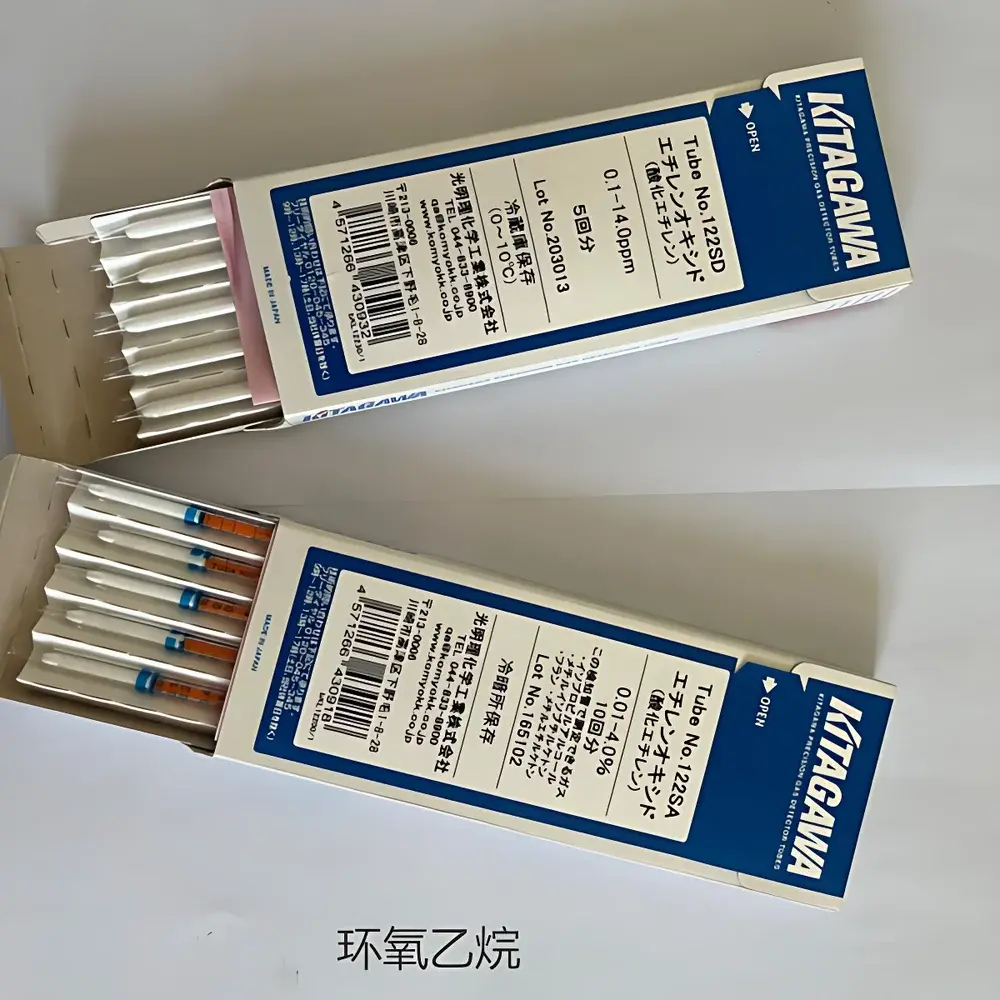
KOMYO RIKAGAKU Ethylene Oxide Gas Detection Tubes (Model 122SA, 122SD)
| Brand | KOMYO RIKAGAKU |
|---|---|
| Origin | Japan |
| Model Numbers | 122SA, 122SD |
| Detection Range (122SA) | 0.01–1.8% and 1.0–4.0% (v/v) |
| Detection Range (122SD) | 0.7–14.0 ppm and 0.1–2.0 ppm |
| Pack Size | 5×2 tubes/box |
| Principle | Colorimetric reaction with pre-impregnated reagent |
| Compatible Pump | AP-20 handheld piston pump |
| Compliance | Designed per JIS K 0321 and ISO 8573-6 for qualitative/semi-quantitative gas analysis |
Overview
KOMYO RIKAGAKU Ethylene Oxide (EO) Gas Detection Tubes are precision-engineered, single-use colorimetric devices for rapid, on-site quantification of ethylene oxide vapor concentrations in ambient air, workplace environments, sterilization chambers, and exhaust ducts. Based on the established North-Kawakami (Kitagawa-type) capillary tube principle, each tube contains a fixed bed of chemically impregnated silica gel or glass beads. When a defined volume of sampled air is drawn through the tube using the AP-20 manual piston pump, EO reacts stoichiometrically with the reagent—typically a mixture of acidified chromotropic acid or p-rosaniline derivatives—generating a discrete, linear color stain along the tube’s calibrated scale. The length of the stained zone corresponds directly to the concentration, enabling immediate visual interpretation without electronics or calibration gases. These tubes are not analytical instruments in the regulatory sense but serve as validated field screening tools aligned with ISO 8573-6 (compressed air purity) and JIS K 0321 (gas detection tube methodology), supporting initial hazard assessment, leak verification, and post-sterilization aeration monitoring in healthcare and pharmaceutical facilities.
Key Features
- Two-tier dual-range configuration per tube (e.g., 122SA: 0.01–1.8% and 1.0–4.0% v/v; 122SD: 0.1–2.0 ppm and 0.7–14.0 ppm), enabling broad dynamic coverage across occupational exposure limits (OEL) and sterilization process validation thresholds
- Pre-calibrated linear scale with ±15% accuracy under controlled temperature (20–25°C) and humidity (30–70% RH), traceable to KOMYO’s in-house reference standards
- Stable reagent formulation with shelf life of ≥24 months when stored unopened at ≤30°C and protected from light and moisture
- Compatible exclusively with the AP-20 hand pump (sold separately), which delivers precise 100 mL strokes—critical for maintaining stoichiometric equivalence between drawn volume and stated range
- No power, software, or zero-gas required; operation requires only trained personnel following standardized draw protocols (e.g., number of strokes, pause intervals)
- CE-marked packaging compliant with UN transport regulations for hazardous goods (Class 6.1), including batch-specific expiry labeling and lot traceability
Sample Compatibility & Compliance
These detection tubes are validated for use in cleanroom air, nitrogen-purged sterilizer exhaust, hospital corridor atmospheres, and industrial ventilation ducts. They are incompatible with high-humidity (>85% RH) or particulate-laden streams without optional particulate filters (e.g., KOMYO FP-1). Cross-sensitivity to aldehydes (e.g., formaldehyde) and strong oxidizers (e.g., chlorine dioxide) is documented in KOMYO Technical Bulletin TB-EO-07; users must assess matrix interference prior to deployment. While not intended for GLP/GMP-compliant quantitative reporting, data generated may support Annex 1 (EU GMP) environmental monitoring investigations when paired with documented SOPs, operator training records, and pump calibration logs. Tubes meet JIS K 0321:2019 requirements for tube geometry, reagent uniformity, and repeatability (n=5, CV ≤12%).
Software & Data Management
No embedded firmware or proprietary software is associated with these passive detection tubes. Quantitative results are recorded manually in laboratory notebooks or electronic logbooks (e.g., LIMS or ELN systems) using standardized templates that capture: tube lot number, pump stroke count, ambient T/RH, sampling location ID, observer name, and timestamp. For audit readiness, KOMYO provides Certificate of Analysis (CoA) with each shipment, listing batch-specific performance verification against NIST-traceable EO standards. Digital record retention must comply with 21 CFR Part 11 if used within FDA-regulated environments—requiring electronic signatures, audit trails, and version-controlled SOPs governing tube selection, pump maintenance, and result transcription.
Applications
- Verification of EO residue levels in medical device packaging post-sterilization (per ISO 10993-7 and AAMI TIR28)
- Routine workplace exposure monitoring near EO sterilizers (comparing against OSHA PEL of 1 ppm TWA and ACGIH TLV of 0.1 ppm STEL)
- Emergency response screening during EO cylinder leaks or facility breaches
- Validation of aeration room efficiency prior to material release
- Educational demonstrations of gas-phase stoichiometric reactions and diffusion kinetics
FAQ
Can these tubes be reused after initial sampling?
No. Each tube is a single-use consumable; re-use invalidates calibration and introduces carryover risk.
Is the AP-20 pump included with the tubes?
No. The AP-20 manual piston pump is sold separately and must be calibrated every 6 months per KOMYO Maintenance Guide MG-AP20 Rev. 3.
Do these tubes require temperature correction during reading?
Yes. Readings must be adjusted using the temperature correction chart provided in the product insert when ambient temperature deviates from 20–25°C.
Are there documented interferences I should screen for?
Yes. Acetaldehyde, propylene oxide, and high concentrations of sulfur dioxide may produce false-positive staining; consult KOMYO Interference Matrix IM-EO-2023 before deployment.
How are expiration dates determined and enforced?
Expiry is based on accelerated aging studies per JIS Z 8401; tubes beyond expiry lack certified accuracy and must be discarded—even if unopened.
Related Products







