
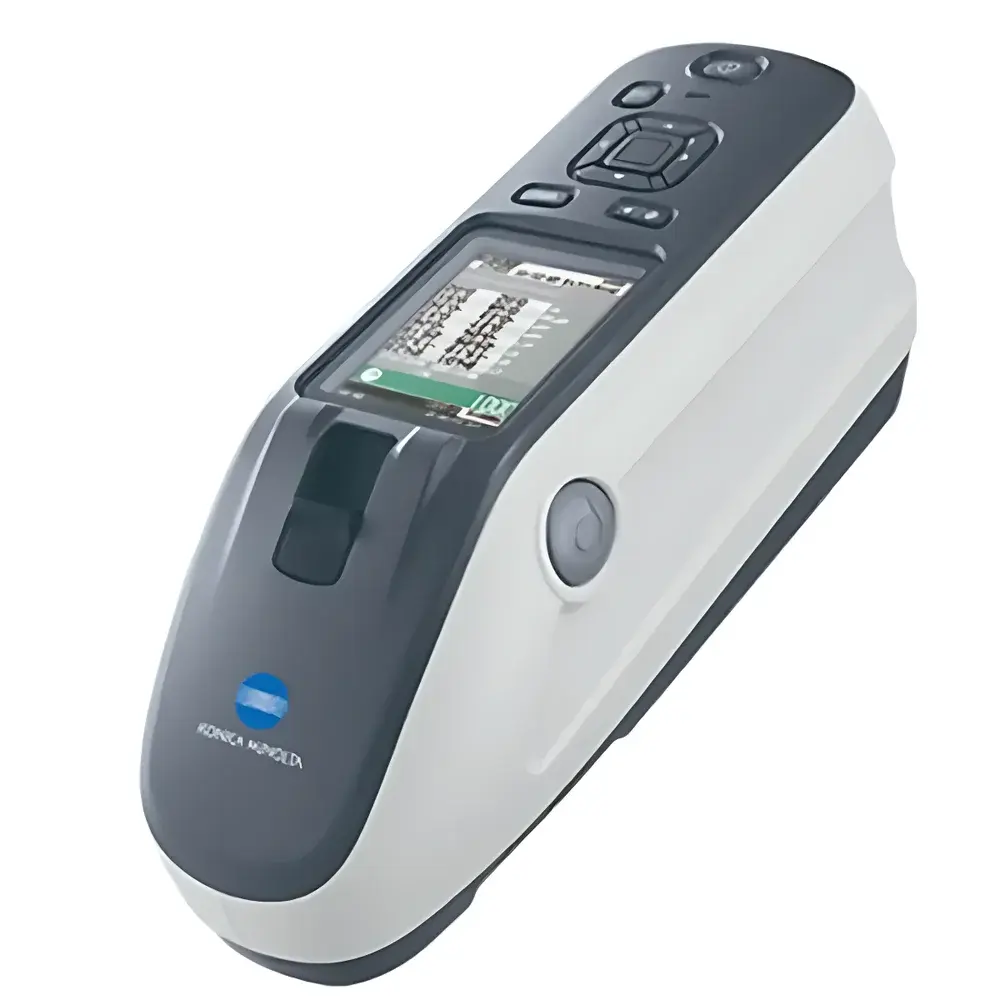
Konica Minolta CM-23d Portable Spectrophotometer Color Difference Meter
| Brand | Konica Minolta |
|---|---|
| Origin | Japan |
| Model | CM-23d |
| Product Type | Spectrophotometric Color Difference Meter |
| Instrument Type | Portable |
| Optical Geometry | d/8° integrating sphere |
| Light Source | Pulsed Xenon Lamp |
| Spectral Range | 400–700 nm |
| Repeatability | Standard Deviation ≤ ΔE*ab 0.08 |
Overview
The Konica Minolta CM-23d is a portable, integrating-sphere spectrophotometer engineered for high-precision color difference measurement in industrial quality control, R&D, and field service environments. Operating on the CIE standard d/8° geometry with a pulsed xenon lamp illumination system, it delivers stable spectral reflectance data across the visible spectrum (400–700 nm) without thermal drift or lamp aging effects. Unlike filtered tristimulus meters, the CM-23d captures full spectral curves at each measurement, enabling robust color evaluation under multiple illuminants (D65, A, F2, etc.) and observer conditions (2° or 10° standard observer), all calculated in real time using CIE 1976 L*a*b*, ΔE*ab, ΔE00, and other industry-standard color difference metrics. Its compact, ergonomic housing—designed for one-handed operation—integrates optical alignment aids and rapid acquisition logic to support consistent measurements on curved, textured, or recessed surfaces where benchtop instruments cannot reach.
Key Features
- Compact, handheld form factor weighing under 600 g, optimized for extended use and accessibility in confined or non-laboratory settings
- d/8° integrating sphere optical configuration compliant with ISO 7724-1, ASTM E308, and CIE No. 15:2018 for diffuse illumination and hemispherical detection
- Pulsed xenon lamp ensures spectral stability over >1 million measurements, eliminating warm-up time and intensity decay associated with tungsten-halogen sources
- 2.7-inch high-contrast LCD display with intuitive icon-based interface; supports both English and multilingual firmware options
- Measurement cycle completed in 0.7 seconds; minimum interval of 1.5 seconds in standard mode; auto-averaging function reduces effective interval during multi-shot sequences
- Integrated viewfinder with crosshair reticle enables precise targeting on small or irregularly shaped samples, minimizing edge effects and misalignment errors
- Onboard memory stores up to 1,000 measurement records with metadata (date/time, sample ID, illuminant, observer)
Sample Compatibility & Compliance
The CM-23d accommodates flat, curved, granular, and textured surfaces—including plastics, paints, textiles, ceramics, and printed materials—without requiring external calibration tiles for routine use. Its 8 mm measuring aperture and 12 mm measurement area provide sufficient spatial resolution for most industrial applications while maintaining statistical representativeness. All color calculations adhere to ISO/CIE traceable algorithms, and spectral data output conforms to CGATS.17 (ISO 12647-7) and ANSI IT8.7/1–7 standards. The device meets IEC 61326-1 for electromagnetic compatibility and carries CE marking for conformity with EU safety directives. It supports audit-ready workflows compliant with ISO 9001 and ISO/IEC 17025 requirements when used with documented calibration procedures and annual verification against NIST-traceable standards.
Software & Data Management
Data export is supported via USB 2.0 to Konica Minolta’s proprietary SpectraMagic NX software (Windows-compatible), enabling advanced analysis including tolerance setting (ellipsoidal or rectangular ΔE limits), pass/fail reporting, trend charts, batch statistics, and SPC charting. SpectraMagic NX includes built-in GLP/GMP logging features: user authentication, electronic signatures, and full audit trail for all measurement, calibration, and configuration changes—fully compliant with FDA 21 CFR Part 11 when deployed with appropriate system validation protocols. Raw spectral data (.spc files) can be exported for third-party analysis in MATLAB, Python (NumPy/Pandas), or Excel-based color modeling environments.
Applications
- Automotive interior trim and paint consistency verification across production lines and supplier audits
- Plastics compounding and masterbatch color matching in extrusion and injection molding facilities
- Textile dye lot approval and fastness testing under standardized viewing conditions
- Printing and packaging QC for brand-critical color fidelity across substrates (paper, film, foil)
- R&D labs evaluating pigment dispersion, metamerism, and goniochromatic effects
- Maintenance and calibration verification of larger benchtop spectrophotometers in metrology labs
FAQ
What calibration standards are required for daily verification?
A single white calibration tile (provided with instrument) is sufficient for daily zero and white calibration. Annual recalibration against NIST-traceable standards is recommended for ISO/IEC 17025 compliance.
Can the CM-23d measure transparent or translucent samples?
No—it is designed for opaque and diffusely reflecting surfaces only. Transmission or transmittance measurements require a dedicated transmission accessory not supported by this model.
Is Bluetooth or Wi-Fi connectivity available?
The CM-23d does not include wireless communication modules; data transfer is conducted exclusively via USB cable to ensure signal integrity and cybersecurity in regulated environments.
How is measurement repeatability validated per ISO 13655?
Repeatability (≤ ΔE*ab 0.08 SD) is verified using a set of 20 consecutive measurements on a stable ceramic tile under controlled ambient conditions (23 ± 2°C, 50 ± 5% RH), following the procedure outlined in ISO 13655 Annex B.
Does the device support custom illuminants or user-defined color spaces?
SpectraMagic NX software allows definition of custom illuminants via spectral power distribution (SPD) files and supports user-defined tolerances, but the CM-23d firmware itself operates only with preloaded CIE-compliant illuminants and observers.




