
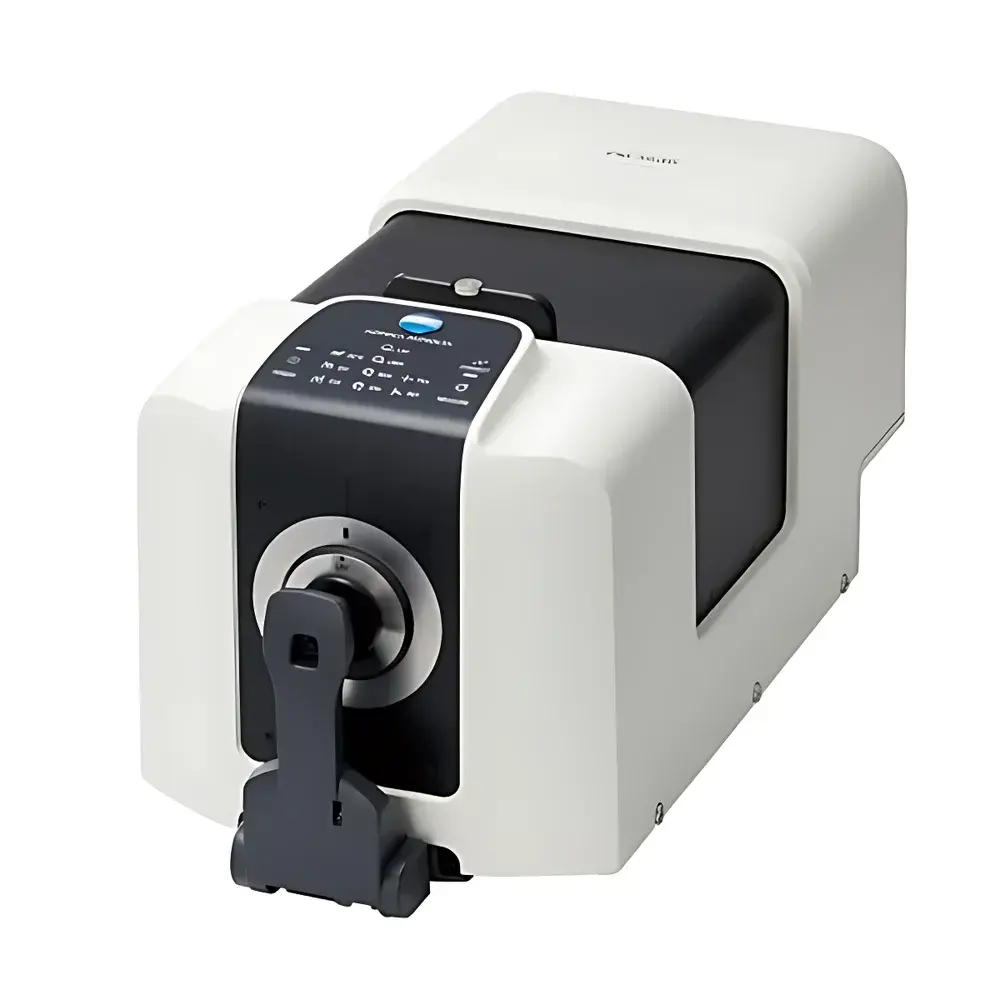
Konica Minolta CM-36dG / CM-36dGV / CM-36d Benchtop Spectrophotometer (Color & Gloss Meter)
| Brand | Konica Minolta |
|---|---|
| Origin | Japan |
| Model | CM-36dG / CM-36dGV / CM-36d |
| Instrument Type | Benchtop |
| Optical Geometry | d/8° integrating sphere |
| Light Source | Pulsed xenon lamp |
| Spectral Range | 360–740 nm |
| Repeatability | ΔE*ab ≤ 0.02 (standard deviation) |
| Inter-instrument Agreement | ΔE*ab ≤ 0.12 (LAV, SCI) |
| UV Control | Digital dual-xenon UV calibration (400 nm / 420 nm cutoff simulation) |
Overview
The Konica Minolta CM-36dG, CM-36dGV, and CM-36d are next-generation benchtop spectrophotometers engineered for high-precision colorimetric and gloss measurement in industrial quality control environments. Based on the proven d/8° integrating sphere optical geometry per CIE No. 15 and ISO 7724-1, these instruments measure spectral reflectance (360–740 nm) with a pulsed xenon lamp as the stable, flash-based light source—eliminating thermal drift and enabling consistent illumination across repeated measurements. The CM-36dG and CM-36dGV extend this capability to simultaneous color and 60° gloss measurement in a single operation, fulfilling a critical need in automotive coatings, plastic injection molding, textile dyeing, and paper manufacturing where surface appearance metrics must be correlated and controlled jointly. The CM-36d serves as a streamlined variant optimized for reflectance-only applications, maintaining full spectral data integrity while reducing operational complexity and cost of ownership. All three models succeed the widely deployed CM-3600A/CM-3610A series and retain backward compatibility with legacy target data sets—ensuring continuity in long-term color specification management without requalification.
Key Features
- Simultaneous color and gloss measurement (CM-36dG and CM-36dGV only): Single-point acquisition delivers CIE L*a*b*, ΔE*ab, gloss (60°), and gloss uniformity indices—reducing inspection time by up to 50% versus sequential instrumentation.
- Digital UV control: Dual xenon lamp configuration with algorithmic blending enables precise simulation of 400 nm or 420 nm UV cutoff conditions—critical for accurate assessment of fluorescent whitening agents (FWAs) in paper, textiles, and detergents without mechanical filter switching.
- WAA (Wavelength Adjustment Algorithm) option: Automatically compensates for spectral shifts induced by ambient temperature and humidity fluctuations post-white calibration—enhancing long-term stability and reducing inter-laboratory variability.
- Inter-instrument agreement: ΔE*ab ≤ 0.12 (LAV, SCI) across units—representing a 20% improvement over the CM-3600A series and meeting stringent requirements for multi-site supply chain color alignment.
- Modular aperture system: Four interchangeable measuring ports (3 mm, 8 mm, 15 mm, 25 mm) support diverse sample geometries—from small electronic components to large printed panels—without requiring custom fixtures.
- Full transmittance capability: Wide-opening transmission chamber accommodates rigid and flexible sheet materials up to 100 × 100 mm; side-loading design eliminates pre-cutting for paper, film, and laminated substrates.
Sample Compatibility & Compliance
The CM-36d series supports opaque, translucent, and transparent samples—including textured plastics, woven fabrics, coated metals, anodized aluminum, and uncoated paper—under both SCI (specular component included) and SCE (specular component excluded) modes. Measurement compliance aligns with ISO 11664-4 (CIE 1976 L*a*b*), ASTM D2244 (color difference), ASTM D523 (gloss), ISO 2813 (gloss at 60°), and ISO 13655 (M0/M1/M2/M3 illumination conditions). Data traceability meets GLP/GMP documentation standards when used with SpectraMagic NX v3.0+ and configured for audit trail logging per FDA 21 CFR Part 11 requirements. Inter-instrument agreement data is validated per ISO 13655 Annex B and reported in manufacturer-certified test reports supplied with each unit.
Software & Data Management
SpectraMagic NX v3.2+ provides comprehensive spectral data handling, including real-time spectral graph overlay, multi-sample ΔE*ab matrix analysis, OK/NG pass/fail reporting with customizable tolerance ellipsoids (CIEDE2000, CMC, DIN99), and automated report generation in PDF, Excel, and CSV formats. The software supports direct instrument control, remote firmware updates, and centralized database synchronization across distributed labs. Historical target data from CM-3600A-series instruments remains fully accessible for SCI-mode comparisons—minimizing migration overhead during fleet modernization. User-defined workflows can embed gloss thresholds alongside color tolerances, enabling unified go/no-go decisions in QC checklists.
Applications
- Automotive: Paint batch verification, interior trim matching, and gloss-level consistency checks across body panels and dashboards.
- Plastics & Polymers: Color stability monitoring during extrusion, injection molding, and compounding—especially for heat-sensitive or UV-stabilized resins.
- Textiles & Apparel: Shade matching across dye lots, FWA quantification in bleached cotton, and metamerism evaluation under multiple illuminants (D65, A, F2).
- Paper & Packaging: Whiteness index (CIE, Ganz, TAPPI), brightness (ISO 2470-1), and yellowness index (ASTM E313) with integrated UV control.
- Consumer Electronics: Anodized aluminum housing color consistency, display bezel matching, and matte/gloss finish verification on polymer casings.
FAQ
What is the difference between CM-36dG and CM-36dGV?
The CM-36dG features a horizontal sample stage optimized for flat, rigid specimens such as painted panels or plastic sheets. The CM-36dGV adopts a vertical orientation with a downward-facing sensor—ideal for draping textiles, stacked paper, or irregularly shaped samples that benefit from gravity-assisted positioning.
Can the CM-36d perform gloss measurement?
No—the CM-36d is a reflectance-only spectrophotometer. Gloss measurement capability is exclusive to the CM-36dG and CM-36dGV models.
Is WAA functionality enabled by default?
WAA is an optional licensed feature activated via software key. It operates automatically after white calibration and requires no user intervention during routine measurement.
Does the instrument support transmission measurement of liquids?
Yes—when equipped with the optional liquid cell holder (sold separately), the CM-36dG and CM-36dGV support absorbance and color measurement of clear or turbid liquids per ASTM D1209 and ISO 4630.
How is inter-instrument agreement verified and maintained?
Each unit ships with a certified inter-instrument agreement report. Routine verification uses Konica Minolta’s standardized ceramic tile set (LAV/SCI mode), with results logged in SpectraMagic NX for trend analysis and ISO/IEC 17025-compliant calibration records.





