
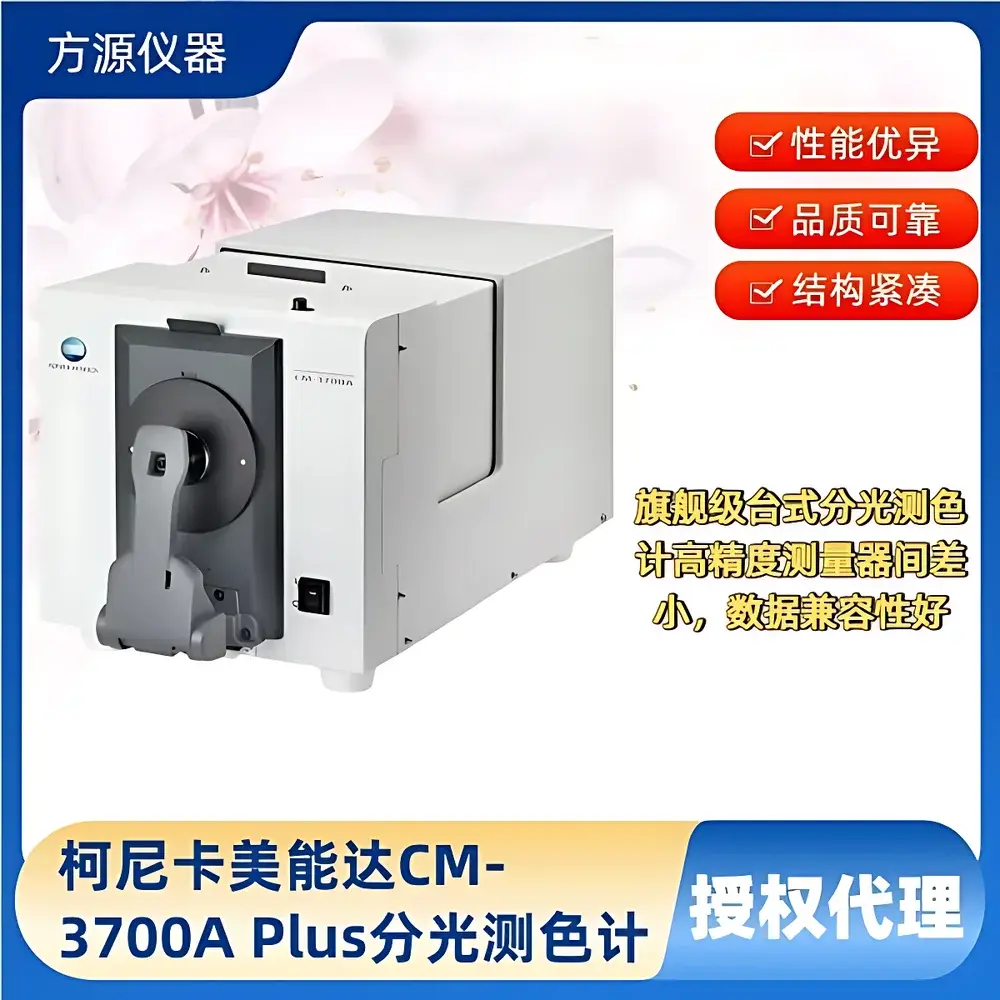
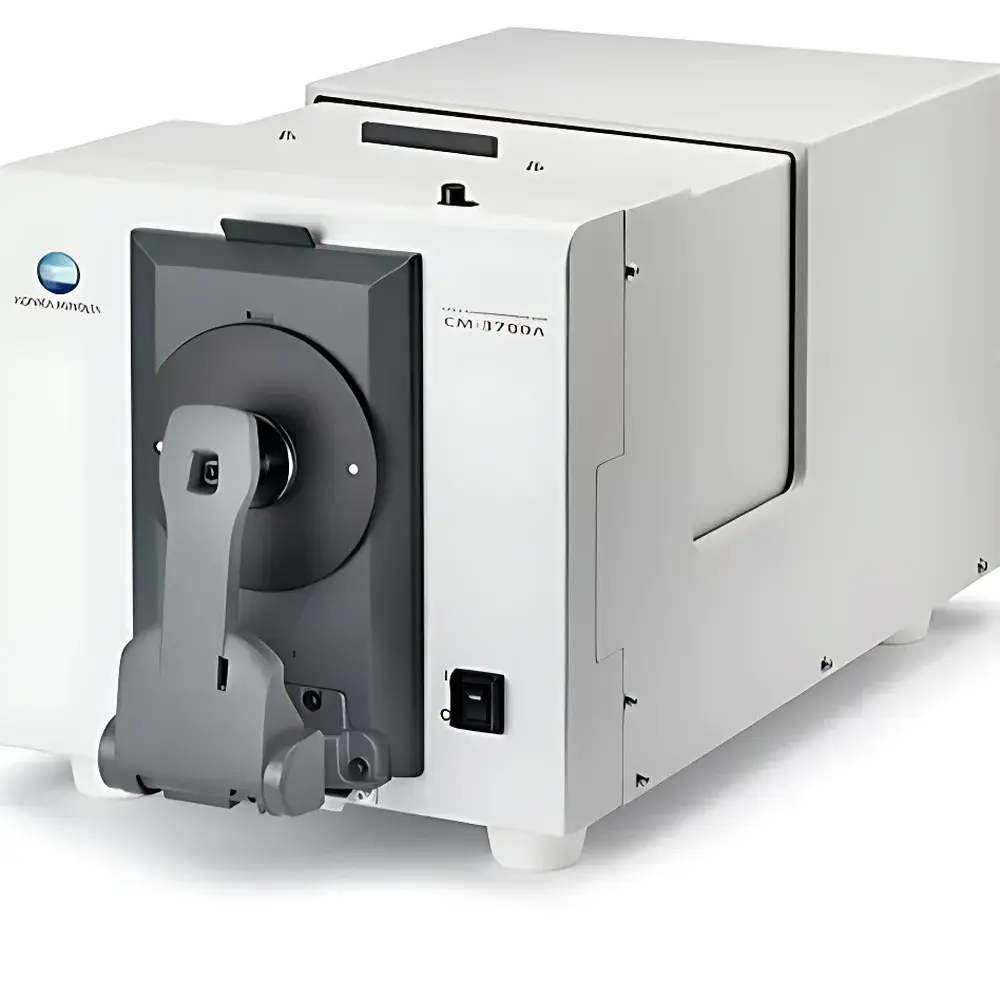
Konica Minolta CM-3700A Plus Benchtop Spectrophotometer
| Brand | Konica Minolta |
|---|---|
| Origin | Japan |
| Model | CM-3700A Plus |
| Type | Benchtop Spectrophotometer |
| Illumination/Observation | di:8°/de:8° (Diffuse Illumination / 8° Viewing) for Reflectance |
| di | 0°/de:0° for Transmittance |
| Compliance | CIE No.15:2004, ISO 7724-1, ASTM E1164, DIN 5033-7, JIS Z 8722 (Conditions c & g) |
| Integrating Sphere Diameter | ∅152 mm |
| Detector | Silicon Photodiode Array (38 channels) |
| Dispersion Element | Diffraction Grating |
| Wavelength Range | 360–740 nm |
| Interval | 10 nm |
| FWHM | ~14 nm (avg.) |
| Reflectance Range | 0–200% (0.001% resolution) |
| Light Source | Pulsed Xenon Lamp |
| Measurement Apertures | SAV (3×5 mm / 5×7 mm), MAV (∅8 / ∅11 mm), LMAV (∅16 / ∅20 mm), LAV (∅25.4 / ∅28 mm) |
| Transmittance Aperture | ∅20 / ∅25 mm |
| Repeatability (White) | ΔE*ab ≤ 0.005, Spectral Reflectance SD ≤ 0.05% |
| (Black) | ΔE*ab ≤ 0.02, Spectral Reflectance SD ≤ 0.02% |
| Inter-instrument Agreement | ΔE*ab ≤ 0.08 (BCRA Series II, 12 tiles, LAV/SCI) |
| UV Adjustment | 0.0–100.0% (1000-step, software-controlled) |
| Sample Temperature Measurement Accuracy | ±0.5°C (LAV), ±0.8°C (MAV/LMAV), ±1.2°C (SAV) |
| Measurement Time | ~2 s (SCI/SCE), ~4.5 s (with temp.), ~5 s (SCI+SCE), ~2 s (Transmittance) |
| Transmittance Chamber Max Thickness | ~50 mm |
| Dimensions (H×W×D) | 307 × 271 × 600 mm |
| Weight | ~20.0 kg |
| Operating Environment | 13–33°C, ≤80% RH (non-condensing) |
| Interface | USB 2.0 |
| Power | Dedicated AC Adapter |
Overview
The Konica Minolta CM-3700A Plus is a high-precision benchtop spectrophotometer engineered for rigorous color measurement and spectral analysis in quality control, R&D, and regulatory-compliant environments. It operates on the principle of diffuse illumination and directional viewing (di:8°/de:8°) for reflectance measurements and collimated 0°/0° geometry for transmittance, fully adhering to international photometric standards including CIE No.15:2004, ISO 7724-1, ASTM E1164, DIN 5033-7, and JIS Z 8722 (Conditions c and g). Its optical architecture centers on a 152 mm integrating sphere with a pulsed xenon lamp as the stable, flash-based light source—eliminating thermal drift and enabling consistent spectral output across repeated measurements. The instrument employs a diffraction grating coupled with a 38-channel silicon photodiode array to deliver high-fidelity spectral data from 360 nm to 740 nm at 10 nm intervals, with an average full-width half-maximum (FWHM) of approximately 14 nm. This configuration ensures robust spectral resolution suitable for detecting subtle metamerism, fluorescence, and batch-to-batch chromatic variation in pigments, plastics, coatings, textiles, and pharmaceutical packaging.
Key Features
- Simultaneous SCI (Specular Component Included) and SCE (Specular Component Excluded) measurement modes—switchable in a single operation for comprehensive surface appearance analysis.
- Four interchangeable apertures (SAV, MAV, LMAV, LAV) supporting application-specific spatial resolution and sampling area requirements—from fine-detail spot checks to large-area averaging.
- Integrated sample temperature sensor with calibrated accuracy of ±0.5°C (LAV) to ±1.2°C (SAV), enabling correlation of color shift with thermal state—a critical capability for thermochromic materials and process validation studies.
- UV-adjustable illumination (0.0–100.0%, 1000-step control) for precise evaluation of fluorescent whitening agents (FWAs), optical brighteners, and UV-reactive formulations without mechanical filter swaps.
- WaveLength Analysis & Adjustment (WAA) technology—factory-calibrated diagnostic and correction protocol for long-term wavelength stability verification and traceable recalibration.
- Dual-mode transmittance chamber accommodating solid sheets or liquid cuvettes (up to 50 mm thickness), compatible with quartz and plastic cuvettes (2/10/20 mm path lengths).
- Real-time electronic viewfinder with onboard imaging—enabling visual confirmation of sample placement, aperture alignment, and surface homogeneity prior to acquisition.
Sample Compatibility & Compliance
The CM-3700A Plus accommodates a broad spectrum of physical sample types: opaque solids (films, molded parts, painted panels), translucent materials (acrylics, laminates), and transparent liquids (solutions, solvents, pharmaceutical eluates). Its LAV aperture (∅25.4 mm) provides statistically representative data for textured or heterogeneous surfaces, while the SAV option enables localized assessment of printed microfeatures or coating defects. For regulated industries, the system supports audit-ready workflows when paired with SpectraMagic NX2 software—offering user access controls, electronic signatures, and full 21 CFR Part 11-compliant audit trails. All reflectance and transmittance geometries comply with ISO/IEC 17025 method validation requirements and are routinely referenced in ASTM D2244 (color difference), ISO 11664-4 (CIELAB), and USP <1061> (container color consistency testing).
Software & Data Management
SpectraMagic NX2—the official Konica Minolta software platform—provides full instrument control, spectral database management, and advanced color difference reporting (ΔE*ab, ΔE00, ΔEcmc, ΔE94). It enables automated pass/fail evaluation against user-defined tolerances, statistical process control (SPC) charting, and multi-instrument comparison using inter-instrument agreement (IIA) metrics. Raw spectral data is exportable in CSV, XML, and CIE .cie formats for integration into LIMS, MES, or custom QA analytics pipelines. The software supports GLP/GMP documentation templates—including calibration logs, operator credentials, environmental metadata, and timestamped measurement history—with immutable record retention. Firmware updates and WAA diagnostics are performed directly through the software interface, ensuring continuous metrological traceability.
Applications
- Automotive: Paint matching, interior trim consistency, and gloss-independent color verification across matte, satin, and metallic finishes.
- Food & Beverage: Color stability monitoring of sauces, dairy products, and confectionery under varying lighting conditions (D65, F2, A).
- Pharmaceuticals: Visual inspection equivalence validation for tablet film coatings, capsule shells, and primary packaging per ICH Q5C guidelines.
- Plastics & Polymers: Batch release testing of masterbatches, recycled resin blends, and UV-stabilized compounds.
- Printing & Packaging: G7-certified gray balance verification, substrate compensation, and spectral similarity indexing for brand-critical assets.
- Academic Research: Fundamental studies of pigment dispersion, thin-film interference, and photochromic kinetics via time-resolved spectral capture.
FAQ
Does the CM-3700A Plus support compliance with FDA 21 CFR Part 11?
Yes—when operated with SpectraMagic NX2 v3.0 or later in validated configuration, the system provides electronic signature enforcement, role-based access control, and complete audit trail functionality required for regulated submissions.
Can it measure fluorescent samples accurately?
Yes—the instrument’s UV-adjustable xenon source and spectral acquisition down to 360 nm enable quantitative fluorescence correction and excitation-emission profiling when used with appropriate reference standards.
What is the maximum sample thickness supported for transmittance measurements?
The transmittance chamber accepts samples up to 50 mm thick; side-open design allows unrestricted length for roll-fed or oversized specimens.
Is inter-instrument agreement guaranteed across multiple CM-3700A Plus units?
All units undergo factory calibration against BCRA Series II reference tiles; typical inter-instrument agreement is ΔE*ab ≤ 0.08 (LAV/SCI), meeting ISO 13655:2017 repeatability benchmarks.
How often does the WAA function require recalibration?
WAA diagnostics are recommended annually; the first year includes complimentary remote calibration support, with subsequent services available via Konica Minolta certified service centers.





