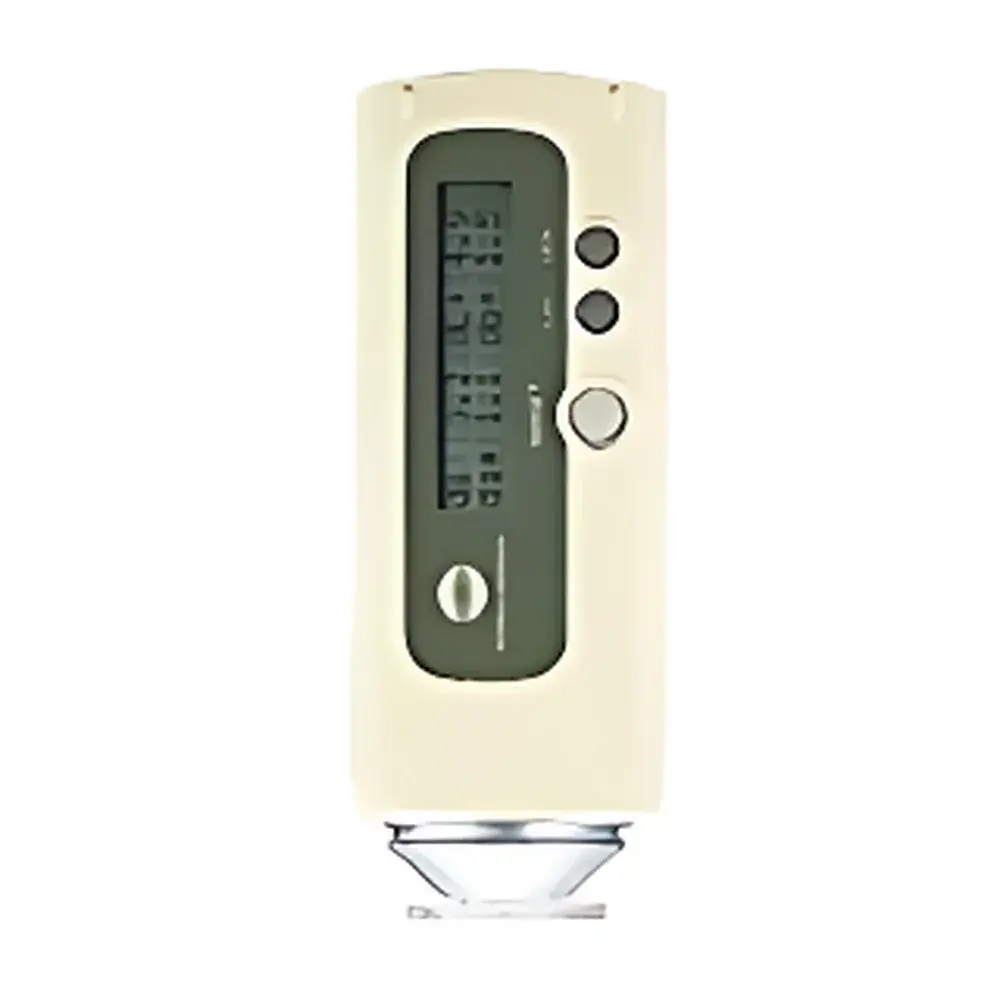
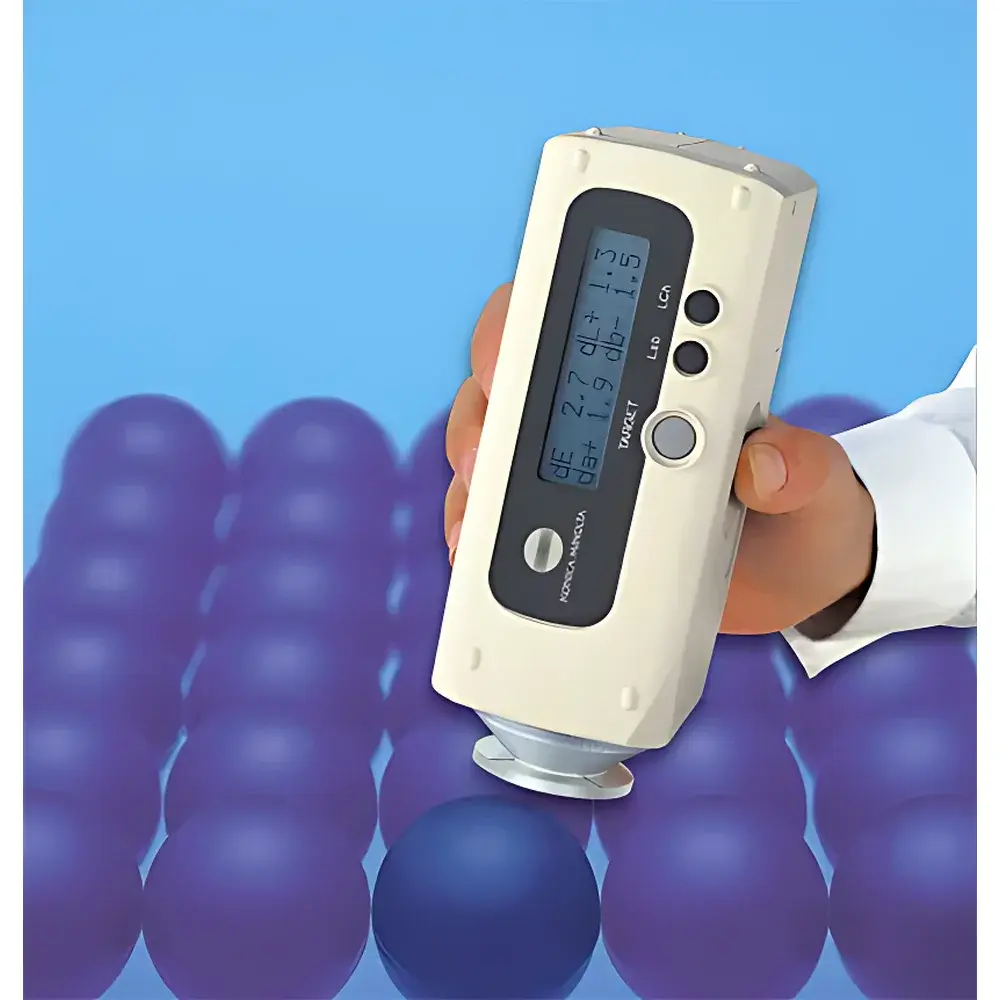
Konica Minolta CR-14 Whiteness Meter
| Brand | Konica Minolta |
|---|---|
| Origin | Japan |
| Model | CR-14 |
| Illumination/Reception Geometry | 8°/diffuse (excluding specular component) |
| Aperture Size | Ø8 mm |
| Whiteness Indices | CIE Whiteness, Hunter Whiteness, ASTM E313 Whiteness |
| Yellowness Indices | ASTM E313, ASTM D1925 |
| Color Space Display | CIE Yxy (1931) |
| Repeatability (Std. Dev.) | ≤0.5 (CIE Whiteness), ≤0.1 (Hunter Whiteness) on white calibration tile |
| Measurement Interval | ~1 s |
| Power Supply | 4 × AA alkaline batteries (2000 measurements at 10-s intervals) or optional AC adapter AC-A308 |
| Operating Environment | 0–40 °C, ≤80% RH (non-condensing at ≤35 °C) |
| Standard Accessories | CR-A74 White Calibration Tile, CR-A68 Soft Carrying Case, CR-A79 Protective Cap, CR-73 Wrist Strap, 4 × AA batteries |
Overview
The Konica Minolta CR-14 Whiteness Meter is a portable, handheld optical measurement instrument engineered for rapid, repeatable quantification of whiteness and yellowness in solid, semi-solid, and powdered materials. It operates on the principle of diffuse reflectance photometry using an 8° illumination / diffuse viewing geometry (8/d, excluding specular component), conforming to ISO 2470-1, ISO 2471, ASTM E313, ASTM D1925, and CIE Publication No. 29.2. This geometry ensures consistent evaluation of surface appearance independent of gloss-related specular contributions—critical for quality control in industries where subtle chromatic deviations from neutral white directly impact product acceptability, shelf life perception, or regulatory compliance. Designed for field and production-floor use, the CR-14 integrates optical sensing, signal processing, and display into a single compact unit, eliminating external controllers or PCs during routine operation.
Key Features
- Simultaneous calculation and display of multiple standardized whiteness indices: CIE Whiteness (ISO 11475), Hunter Whiteness (WH), and ASTM E313 Whiteness—enabling cross-laboratory comparability and audit-ready reporting.
- Dual yellowness index support: ASTM E313 (based on tristimulus values) and ASTM D1925 (YI E313 modified), facilitating compliance with food-grade pigment specifications and polymer aging assessments.
- CIE Yxy chromaticity coordinates displayed in real time, allowing correlation of whiteness shifts with chromaticity drift along the blue-yellow axis (y) or lightness axis (Y).
- Optically sealed 8 mm measurement aperture protected by fused silica window—resistant to abrasion, moisture, and particulate ingress; compatible with optional vinyl dust cover (CR-A80) for high-particulate environments.
- Integrated battery-powered architecture (4 × AA cells) supports >2,000 measurements under standard QC conditions (10 s interval), with hot-swappable operation and low-power standby mode.
- Robust mechanical design compliant with IP52 dust resistance and shock-absorbing elastomer housing, validated for daily handling in manufacturing, R&D, and incoming inspection settings.
Sample Compatibility & Compliance
The CR-14 accommodates flat, curved, granular, pasty, and powdered samples without auxiliary fixtures—enabled by its short working distance (≤2 mm) and uniform illumination profile across the 8 mm aperture. Surface texture effects are minimized via diffuse collection optics optimized for Lambertian and near-Lambertian reflectors. The instrument meets requirements for routine testing under ISO/IEC 17025-accredited laboratories when used with traceable calibration standards (e.g., NIST-traceable white tiles). Its measurement protocol aligns with FDA guidance for color consistency in food contact materials (21 CFR Part 170–189) and supports GLP documentation through manual data logging or optional RS-232 output (via CR-A75 cable) to validated LIMS environments.
Software & Data Management
While the CR-14 operates autonomously, its RS-232 interface (optional CR-A75 cable) enables direct ASCII data streaming to laboratory information management systems (LIMS) or statistical process control (SPC) platforms. All measurements include timestamp, index type, sample ID (manually entered), and raw Yxy values—supporting 21 CFR Part 11-compliant audit trails when paired with validated software. Firmware supports user-defined pass/fail thresholds per index, with visual LED alerts on deviation. Calibration history (date, operator ID, reference tile ID) is retained internally and exportable.
Applications
- Food & Beverage: Monitoring whiteness stability of rice flour, wheat starch, dairy powders, sugar, and plant-based milk alternatives during drying, storage, and blending.
- Pharmaceuticals: Verifying excipient whiteness (e.g., microcrystalline cellulose, lactose monohydrate) per USP uniformity of dosage units and visual identity testing.
- Paper & Packaging: Quantifying brightness retention in coated paperboard, recycled fiber stocks, and bleached kraft pulp—correlating with ISO 2470 brightness values.
- Plastics & Polymers: Tracking thermal or UV-induced yellowing in polypropylene, PVC, and PET resins during accelerated aging studies per ASTM G154.
- Textiles & Dyes: Objective validation of optical brightener efficacy and batch-to-batch consistency in bleached cotton or synthetic fibers.
FAQ
What white calibration standard is supplied with the CR-14?
The CR-A74 certified white calibration tile is included—traceable to JIS Z 8722 and calibrated against NIST SRM 930 series standards.
Can the CR-14 measure wet or sticky samples?
Yes, provided the surface is non-reflective and optically homogeneous; viscous pastes require gentle, consistent contact pressure to avoid air gaps—avoid measurement on freely flowing liquids.
Is the CR-14 compliant with ISO 2470-1 for paper brightness?
No—the CR-14 implements 8/d geometry, whereas ISO 2470-1 specifies d/0 geometry; it is suitable for comparative whiteness assessment but not for official ISO brightness certification.
How often must the instrument be recalibrated?
Daily verification against the CR-A74 tile is recommended before critical measurements; full recalibration by authorized Konica Minolta service centers is advised every 12 months or after physical impact.
Does the CR-14 support custom whiteness formulas?
No—only pre-programmed CIE, Hunter, and ASTM indices are implemented; no user-defined equation entry is available.