
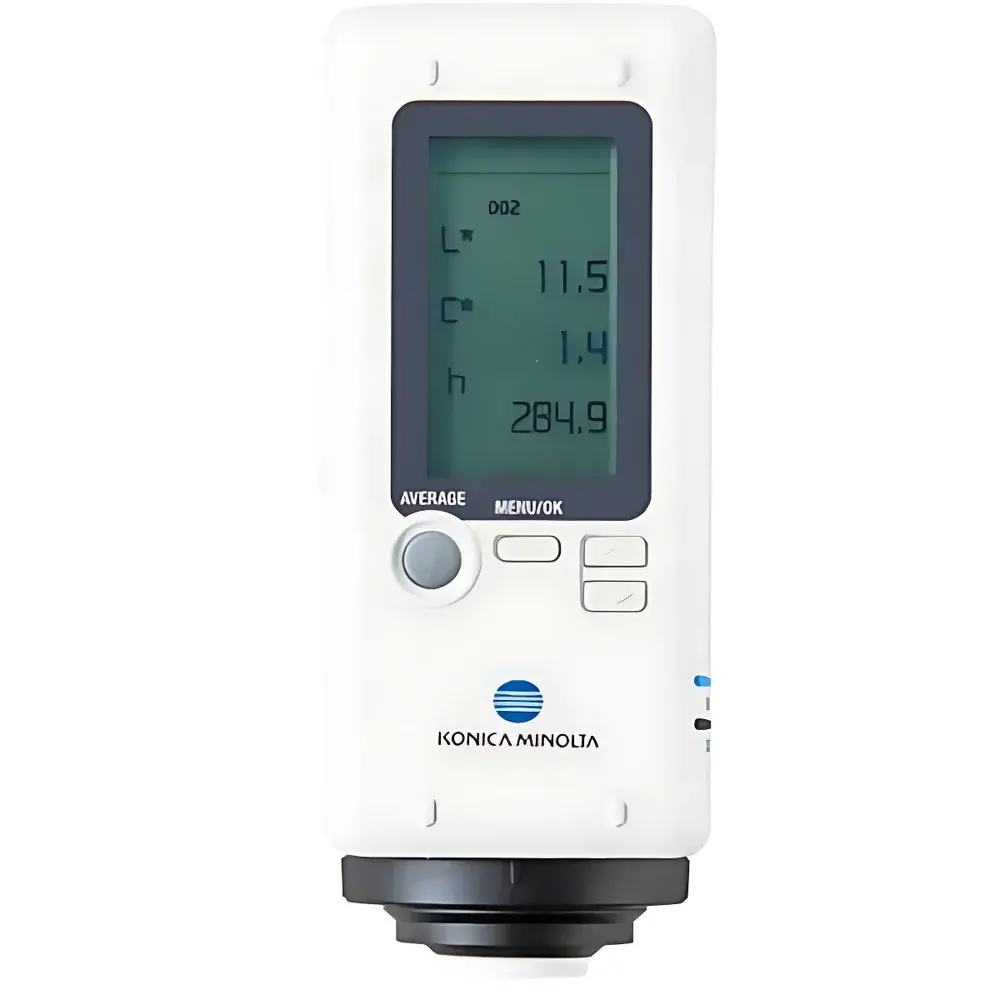
Konica Minolta CR-20 Compact Color Difference Meter
| Brand | Konica Minolta |
|---|---|
| Origin | Japan |
| Model | CR-20 |
| Instrument Type | Portable |
| Optical Geometry | d/8° integrating sphere |
| Light Source | Pulsed Xenon Lamp |
| Repeatability | ΔE*ab ≤ 0.1 (standard deviation) |
| Data Storage | Up to 1,000 measurement sets (including reference) |
| Color Spaces | CIE L*a*b*, L*C*h, Yxy, XYZ, Munsell, WI (CIE/ASTM E313-96), Tint (CIE/ASTM E313-96), YI (ASTM E313-96) |
| Compliance | ASTM E313, ISO 7724, JIS Z 8722, CIE No. 15 |
Overview
The Konica Minolta CR-20 Compact Color Difference Meter is an entry-level, portable spectrophotometric color measurement instrument engineered for rapid, repeatable color evaluation in production environments, quality control laboratories, and field applications. Utilizing a d/8° integrating sphere optical geometry with a pulsed xenon lamp as the illumination source, the CR-20 ensures stable spectral output across repeated measurements—eliminating thermal drift associated with tungsten-halogen or LED sources. Its design adheres to fundamental colorimetric principles defined in CIE Publication No. 15 and ISO 7724-1, enabling traceable calculation of tristimulus values (XYZ) and derived color spaces including CIE L*a*b*, L*C*h, and Yxy. The device operates on the principle of diffuse illumination and hemispherical collection, delivering high angular averaging performance essential for measuring textured, matte, or low-gloss surfaces without directional bias. As a successor to the CR-11/CR-13/CR-14 series, the CR-20 integrates enhanced data handling capabilities while retaining mechanical robustness and ergonomic portability suited for daily use by QC technicians across diverse industrial settings.
Key Features
- Portable d/8° integrating sphere architecture with pulsed xenon illumination for consistent spectral power distribution and minimal lamp aging effects
- High repeatability: standard deviation of ΔE*ab ≤ 0.1 under controlled conditions, meeting requirements for routine pass/fail inspection per ISO 12647-2 and ASTM D2244
- Ergonomic form factor: compact body with contoured grip zones, tactile measurement button placement, and anti-slip surface finish optimized for one-handed operation
- Large backlit LCD display supporting simultaneous visualization of up to eight colorimetric parameters across multiple standardized color spaces
- Integrated pass/fail judgment function with visual (LED color coding) and auditory (distinctive beep patterns) feedback—configurable without PC connection
- Front-end target罩 with protective sapphire-coated glass enables direct contact measurement of powders, pastes, gels, and irregular substrates without aperture contamination
Sample Compatibility & Compliance
The CR-20 accommodates a broad range of sample types—including opaque solids, translucent films, granular materials, and semi-fluid media—thanks to its 8 mm measurement aperture and pressure-sensitive contact mechanism. It complies with international standards governing color measurement methodology, including ISO 7724-1 (instrumental colorimetry), JIS Z 8722 (color difference evaluation), and ASTM E313 (whiteness and yellowness indices). Its calibration protocol follows NIST-traceable white tile references, ensuring alignment with CIE standard illuminants D65 and A. While not certified for GLP/GMP-regulated environments requiring full 21 CFR Part 11 audit trails, the device supports documented workflows compatible with internal QA procedures and supplier qualification programs governed by IATF 16949 or ISO 9001.
Software & Data Management
The CR-20 includes embedded firmware supporting standalone data logging—up to 1,000 measurement records (including reference spectra and metadata such as timestamp, operator ID, and tolerance settings) can be stored internally without external hardware. Optional Konica Minolta proprietary software (compatible with Windows OS) enables bidirectional data transfer via USB interface, facilitating export to CSV or Excel formats for statistical process control (SPC) analysis. The software supports batch reporting, trend charting, and comparative overlay of spectral curves. All measurement events—including calibration actions, pass/fail decisions, and parameter changes—are time-stamped and logged locally, providing a basic audit trail suitable for Tier-2 supplier documentation requirements.
Applications
- Automotive interior trim verification against OEM color standards (e.g., PP, ABS, PU foams)
- Plastics compounding QC during extrusion and injection molding processes
- Paper and packaging color consistency checks across batch runs and substrate variations
- Paint and coating formulation validation in R&D labs and production lines
- Textile dye lot matching in garment manufacturing and fabric sourcing
- Food packaging print verification where substrate fluorescence or gloss variation affects perceived color
FAQ
What color standards does the CR-20 support for whiteness and yellowness calculations?
It implements ASTM E313-96 for both Whiteness Index (WI) and Yellowness Index (YI), as well as Tint calculation per the same standard.
Can the CR-20 measure fluorescent or optically brightened samples?
No—it lacks UV component control and is not designed for fluorescence compensation; use the CM-700d or CM-3600A for such applications.
Is the CR-20 compliant with FDA 21 CFR Part 11 for electronic records?
No—the device does not provide electronic signature capability, audit trail encryption, or role-based access control required under Part 11.
How is calibration performed, and what reference standard is used?
Calibration uses a factory-supplied NIST-traceable white calibration tile; users perform zero and white calibration before each measurement session.
Does the CR-20 support Bluetooth or wireless data transmission?
No—data transfer is exclusively via USB cable; no built-in wireless module is included.



