
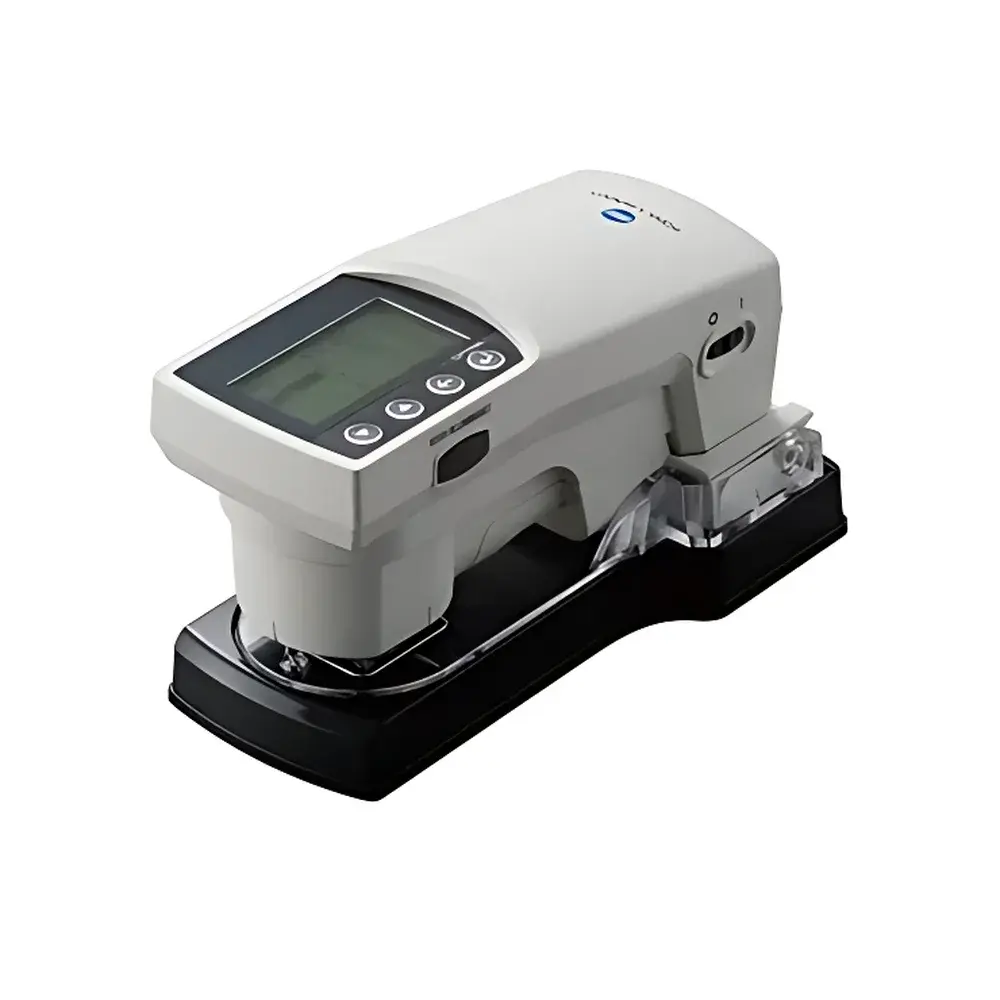
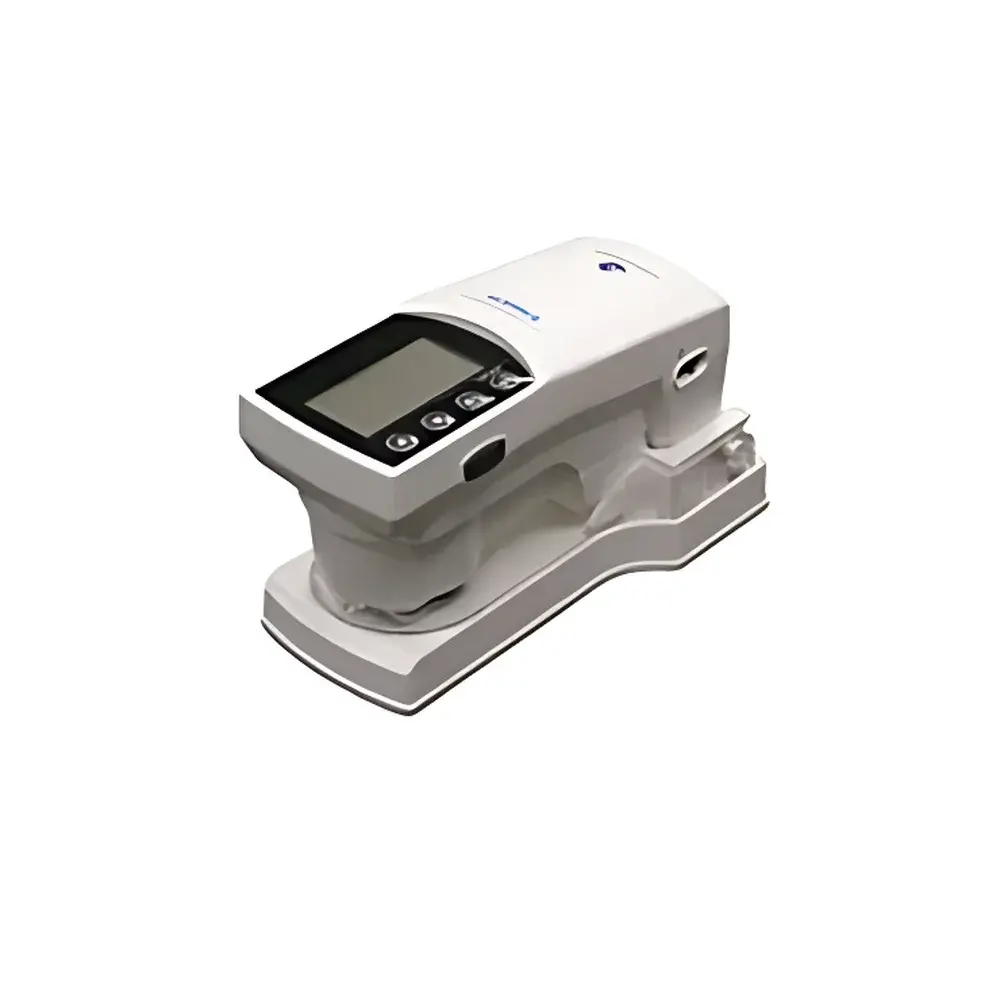
Konica Minolta FD-7 Spectrodensitometer
| Brand | Konica Minolta |
|---|---|
| Origin | Japan |
| Model | FD-7 |
| Product Type | Spectrodensitometer |
| Instrument Type | Portable |
| Optical Geometry | d/8° integrating sphere |
| Compliance | ISO 13655:2009 M1 condition |
| Key Feature | Virtual Fluorescence Standard (VFS) technology |
| Weight | 350 g (main unit), 430 g (with aperture mask) |
| Spectral Measurement Capability | Supports D50-spectrum-referenced fluorescence evaluation |
| Wavelength Compensation | Automatic, performed during routine white calibration |
| Ambient Light Measurement | Yes, supports illuminance, CCT, and CIE tristimulus values under real-world lighting |
| Software Integration | basICColor catch all for strip scanning (MediaWedge, ECI2002, IT8.7/3) |
Overview
The Konica Minolta FD-7 Spectrodensitometer is a portable, high-precision optical measurement instrument engineered specifically for spectral density and colorimetric evaluation in professional print production environments. It operates on the principle of spectrophotometric reflectance measurement using an 8°/d integrating sphere geometry, enabling accurate capture of both diffuse and specular components — critical for evaluating coated, uncoated, and fluorescent-enhanced substrates. Its defining technical distinction lies in compliance with ISO 13655:2009 Measurement Condition M1, which mandates spectral assessment under illumination matching the D50 illuminant — including full accounting for optical brightening agents (OBAs). Prior to the FD-7’s release, commercially available instruments were limited to M0 (tungsten-based A-illuminant), M2 (UV-cut), or M3 (polarized UV-cut) conditions; the FD-7 remains the first and only spectrodensitometer validated for true M1 operation via Konica Minolta’s proprietary Virtual Fluorescence Standard (VFS) algorithm. This algorithm computationally reconstructs the spectral response expected under ideal D50 illumination, even when physical D50 lamps are impractical in portable hardware — thereby bridging the gap between laboratory-grade spectral fidelity and field-deployable robustness.
Key Features
- World’s first portable spectrodensitometer compliant with ISO 13655:2009 M1 condition for D50-referenced fluorescence evaluation
- Virtual Fluorescence Standard (VFS) technology — enables accurate quantification of OBA-induced fluorescence without requiring dedicated UV-enhanced hardware
- Automatic wavelength compensation — executed synchronously during routine white calibration, eliminating dependence on manufacturer-led service interventions
- Ultra-lightweight design: 350 g (unit only), 430 g (with standard aperture mask) — optimized for extended handheld use in pressrooms and quality labs
- Ambient light characterization capability: measures illuminance (lux), correlated color temperature (CCT), and CIE XYZ values of ambient viewing conditions, supporting visual match validation per ISO 3664
- Integrated display with intuitive icon-driven interface — no external device required for basic density, color difference (ΔE*ab, ΔE00), and spectral reflectance viewing
Sample Compatibility & Compliance
The FD-7 is designed for direct contact measurement of planar, rigid, or semi-flexible substrates typical in commercial and packaging printing — including coated and uncoated papers, synthetic films, and laminated boards. Its d/8° optical configuration ensures compatibility with ISO 2846-1 (process color inks), ISO 12647-2 (offset lithographic processes), and ISO/PAS 20653 (fluorescent substrate characterization). All measurement outputs — including status-A and status-E density, CIE L*a*b*, and spectral reflectance curves — are traceable to NIST-traceable standards via Konica Minolta’s factory calibration protocol. The instrument supports GLP-compliant data logging when used with optional software, including time-stamped measurements, operator ID fields, and audit trail generation per FDA 21 CFR Part 11 requirements where applicable.
Software & Data Management
The FD-7 interfaces seamlessly with basICColor catch all — a dedicated spectral data acquisition and analysis platform supporting automated strip scanning of industry-standard targets (MediaWedge v2.0, ECI2002, IT8.7/3, Fogra PSO). The software enables batch processing of spectral reflectance, density, and color difference data; generates ICC profile input tables; and performs pass/fail evaluation against ISO 12647-2 tolerance limits. Raw spectral data (.spc format) is exportable for third-party analysis in MATLAB, Python (NumPy/SciPy), or commercial QC suites. Firmware updates and calibration file management are performed locally via USB connection, with version-controlled calibration certificates stored onboard and retrievable as PDF reports.
Applications
- Pressroom density and color control — real-time verification of dot gain, trapping, and solid ink density (SID) across CMYK and spot color workflows
- R&D validation for paper manufacturers — quantitative assessment of OBA concentration, aging behavior, and spectral stability under varying UV exposure
- Prepress and proofing verification — alignment of digital proofs (e.g., Epson UltraChrome, HP Indigo) with final press output under M1 conditions
- Food packaging color consistency — compliance with brand-specific ΔE00 tolerances under variable store lighting (e.g., LED vs. fluorescent retail fixtures)
- Regulatory documentation support — generation of auditable measurement records for ISO 9001, ISO 14001, and GMP-aligned print procurement contracts
FAQ
What distinguishes M1 measurement from M0 or M2?
M1 requires spectral evaluation under illumination matching the D50 illuminant, including its UV component — essential for accurate assessment of fluorescent whitening agents. M0 uses tungsten-A light (low UV), while M2 suppresses UV entirely; both yield non-representative results on OBA-treated papers.
Does the FD-7 require annual recalibration by the manufacturer?
No — automatic wavelength compensation during white calibration maintains long-term photometric stability. However, biennial NIST-traceable recalibration is recommended for ISO 17025-accredited laboratories.
Can the FD-7 measure transmitted color or transparency?
No — it is configured exclusively for reflective mode measurement. Transmittance applications require dedicated transmission spectrophotometers (e.g., CM-3600A with transmission chamber).
Is ambient light measurement suitable for ISO 3664-compliant viewing booth validation?
Yes — the FD-7 reports lux, CCT, Duv, and CIE XYZ under ambient conditions, enabling quantitative verification of booth spectral power distribution against ISO 3664:2009 Class 1 specifications.
What spectral resolution does the FD-7 provide?
The instrument acquires reflectance data at 10 nm intervals across the visible range (400–700 nm), consistent with ISO 13655 Annex B requirements for M1-compliant devices.




