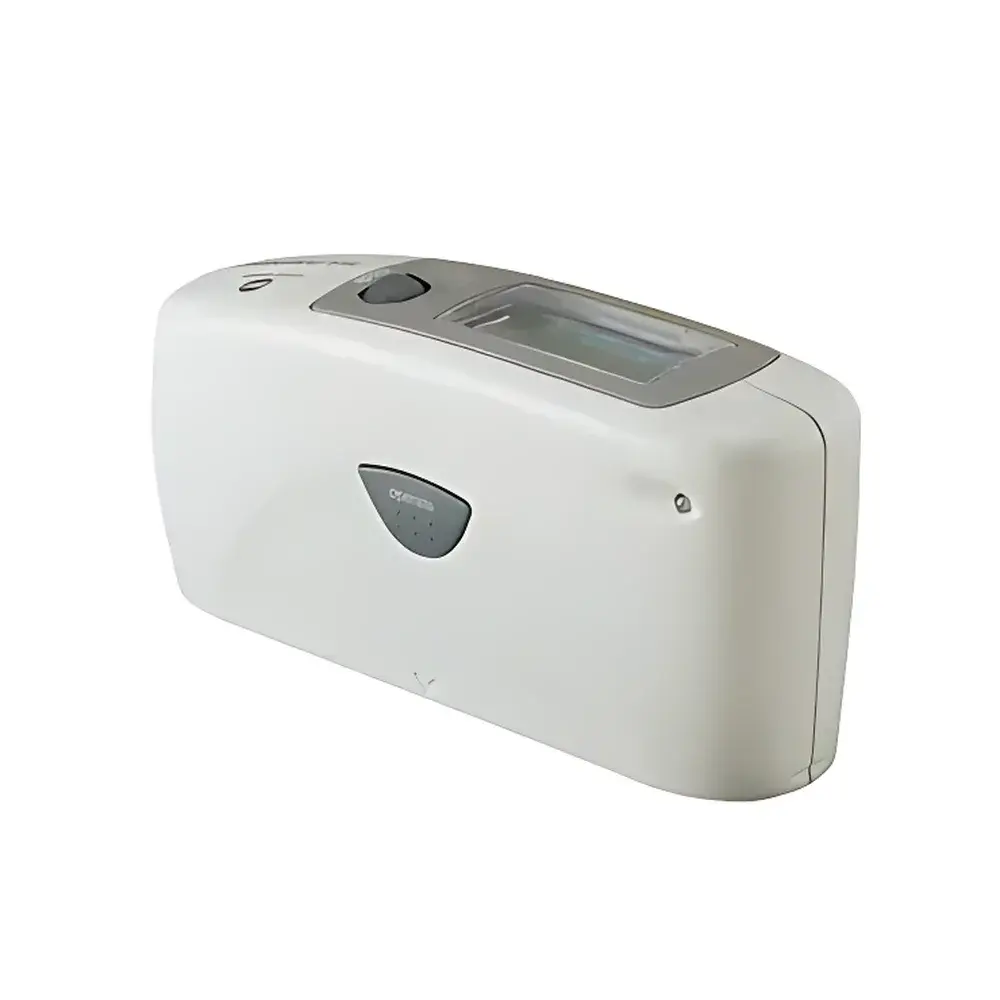
Konica Minolta UG60 Portable Gloss Meter
| Brand | Konica Minolta |
|---|---|
| Origin | Japan |
| Model | UG60 |
| Measurement Angle | 60° |
| Aperture Size | 9 × 15 mm |
| Gloss Range | 0.0–1,000 GU |
| Resolution | 0.1 GU (0–99.9 GU), 1 GU (100–2,000 GU) |
| Repeatability | ±0.2 GU (0–99.9 GU), ±0.2% of reading (100–2,000 GU) |
| Inter-instrument Agreement | ±0.5 GU (0–99.9 GU), ±0.5% of reading (100–2,000 GU) |
| Standards Compliance | ISO 2813, ISO 7668, ASTM D 523, ASTM D 2457, DIN 67530, JIS Z 8741, BS 3900, BS 6161-12 |
| Data Storage | 999 measurements with timestamp |
| Interface | USB 2.0, Bluetooth 2.0 |
| Power | Two 1.5 V AA alkaline batteries (≈10,000 measurements) or USB bus power |
| Operating Temperature | 15–40°C, ≤85% RH (non-condensing at 35°C) |
| Dimensions | 155 × 73 × 48 mm |
| Weight | 400 g |
Overview
The Konica Minolta UG60 Portable Gloss Meter is a precision-engineered optical instrument designed for rapid, field-deployable measurement of specular gloss according to internationally standardized geometries. It operates exclusively at the 60° incident angle—a widely adopted configuration for evaluating medium-gloss surfaces across industrial quality control and R&D environments. Based on the principle of directional reflectance photometry, the UG60 quantifies the ratio of reflected luminous flux from a test surface to that from a reference black glass standard under controlled illumination (CIE illuminant D65), reporting results in gloss units (GU). Its compact form factor, robust mechanical design, and adherence to ISO 2813 and ASTM D 523 ensure metrological traceability and inter-laboratory comparability—critical for suppliers operating within automotive OEM, packaging, coatings, and ceramics supply chains subject to tiered audit requirements.
Key Features
- Compact ergonomic housing (155 × 73 × 48 mm, 400 g) optimized for single-hand operation and extended use in production line or on-site inspection scenarios.
- Dual connectivity architecture: USB 2.0 interface for direct PC data transfer and firmware updates; Bluetooth 2.0 Class 2 for wireless pairing with Konica Minolta’s proprietary software suite or third-party LIMS platforms.
- High-stability optical path with temperature-compensated silicon photodiode detector and calibrated reference standard integrated into the measurement head.
- Multi-language UI supporting English, Spanish, German, French, Italian, Japanese, Portuguese, and Russian—configurable via on-device menu or PC software.
- Automatic power-off with user-selectable timeout (10–99 seconds) and low-battery indicator to maximize operational uptime and prevent data loss.
- Integrated statistical engine enabling real-time calculation of mean, standard deviation, min/max, and coefficient of variation across up to 999 stored measurements—including full timestamping (date + time) for GLP/GMP-compliant recordkeeping.
Sample Compatibility & Compliance
The UG60 accommodates flat, curved, and textured non-metallic surfaces—including molded thermoplastics, painted automotive body panels, lacquered wood finishes, ceramic glazes, and coated paperboard—provided the measurement area (9 × 15 mm) lies fully within a homogeneous region. Surface curvature radius must exceed 200 mm to avoid geometric error; highly absorptive or retroreflective materials (e.g., certain carbon-black composites or microprismatic films) require validation against reference standards prior to routine use. The instrument meets the geometric, spectral, and photometric requirements of ISO 2813 (plastics), ISO 7668 (paints), ASTM D 523 (general-purpose gloss), ASTM D 2457 (automotive clearcoats), DIN 67530, JIS Z 8741, BS 3900, and BS 6161-12. Its documented inter-instrument agreement (±0.5 GU below 100 GU; ±0.5% above) supports multi-site calibration harmonization and satisfies internal audit criteria for instrument qualification under ISO/IEC 17025.
Software & Data Management
Konica Minolta’s dedicated PC software (compatible with Windows 10/11) enables full device configuration, batch export of measurement logs in CSV or XML format, and generation of compliance-ready reports—including operator ID, sample ID, environmental conditions, and pass/fail status relative to user-defined specification limits. Audit trail functionality records all parameter changes and data exports with timestamps and user attribution—meeting foundational expectations of FDA 21 CFR Part 11 for electronic records in regulated manufacturing environments. Raw data files include embedded metadata (instrument serial number, firmware version, calibration date), facilitating traceability during regulatory inspections or technical disputes.
Applications
- Quality assurance of injection-molded polymer components (e.g., automotive interior trim, consumer electronics housings) against AQL-based acceptance criteria.
- In-process monitoring of spray-applied coatings during automotive refinish or OEM paint shop operations.
- R&D evaluation of varnish formulations, pigment dispersion stability, and substrate pretreatment efficacy on ceramic tiles and sanitaryware.
- Supplier qualification testing per OEM-specific gloss tolerances (e.g., GMW14872, Ford WSS-M2P177-A2).
- Documentation of surface finish consistency across batch production runs for ISO 9001 Clause 8.5.1 evidence.
FAQ
What measurement geometry does the UG60 employ?
The UG60 implements a fixed 60° geometry per ISO 2813, with a collimated beam diameter of 9 × 15 mm and defined aperture tolerances for incident and viewing angles.
Is the UG60 suitable for measuring metallic or pearlescent finishes?
It provides valid GU values for metallic basecoats but cannot resolve goniochromatic effects; for multi-angle characterization (e.g., DOI, distinctness of image), a dedicated multi-angle gloss meter is required.
How is calibration verified between uses?
Each unit ships with a certified ceramic reference tile (100 GU nominal); daily verification is recommended using this standard before critical measurements.
Does the UG60 support GLP-compliant data archiving?
Yes—when used with Konica Minolta’s official software, full electronic records including operator ID, timestamps, and calibration history are generated and exportable in audit-ready formats.
Can the UG60 be integrated into automated inspection stations?
While not designed for direct PLC integration, its USB HID mode allows scripted control via Python or LabVIEW, enabling semi-automated measurement sequences in lab automation workflows.