
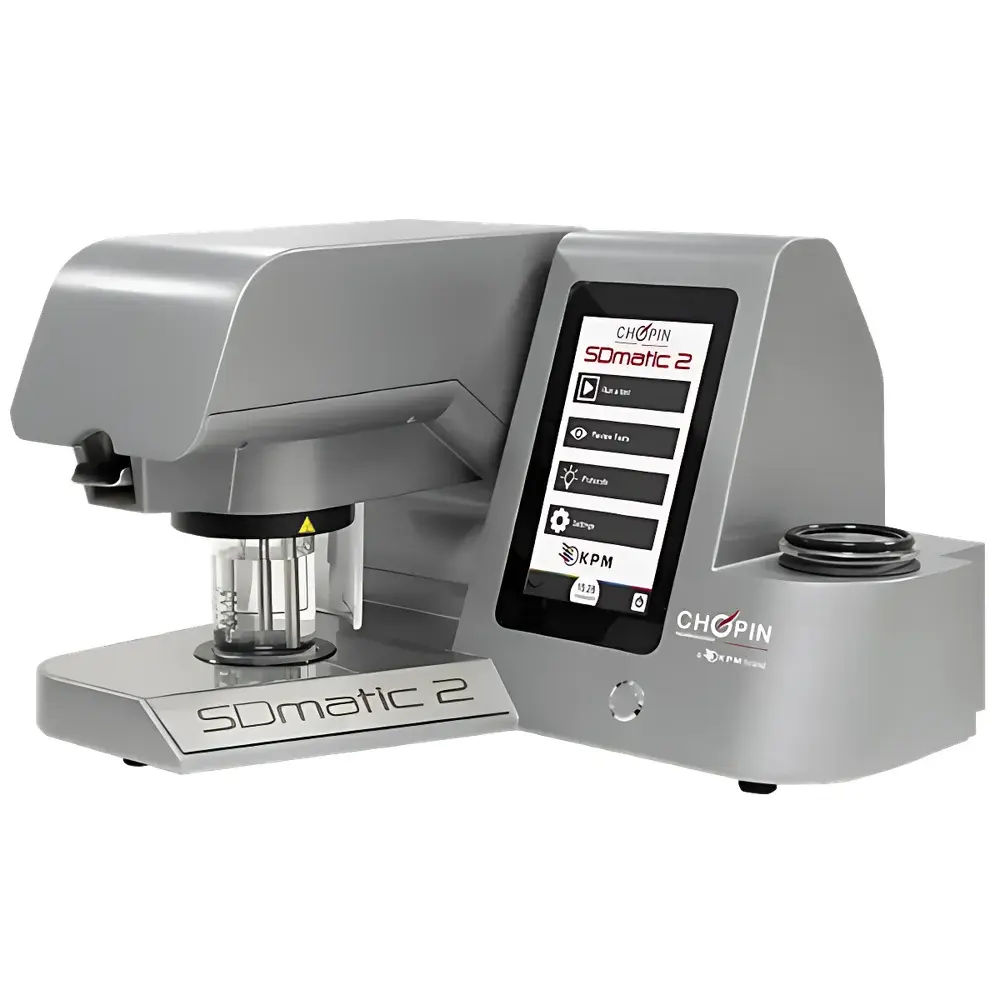
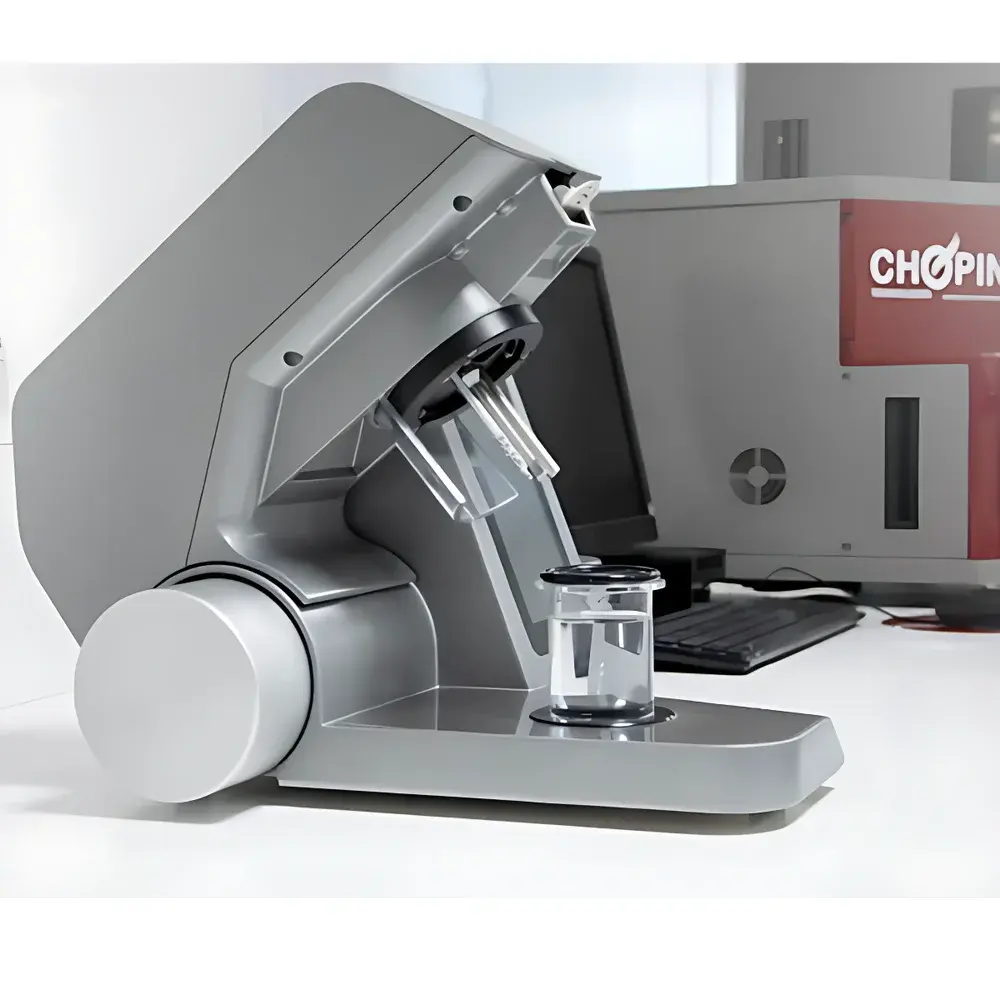
KPM CHOPIN SDmatic 2 Damaged Starch Analyzer
| Brand | KPM CHOPIN |
|---|---|
| Origin | France |
| Model | SDmatic 2 |
| Measurement Principle | Amperometric iodine binding assay (Medcalf & Gilles method) |
| Compliance | NF EN ISO 17715:2015, ICC 172, AACC 76-33.01, GB/T 31577-2015 |
| Sample Requirement | 1 g flour |
| Analysis Time | <10 min per test |
| Display | 7-inch color touchscreen |
| Data Storage | Internal database + USB export |
| Connectivity | Ethernet/LAN for LIMS integration |
| Electrode Maintenance | User-replaceable |
| Firmware Update | Online (via network) or offline (via USB drive) |
| Software Features | Protocol customization (flour mass, iodine reaction time, measurement duration), unit selection, guided workflow, learning mode, timer |
Overview
The KPM CHOPIN SDmatic 2 Damaged Starch Analyzer is a dedicated, fully automated benchtop instrument engineered for precise, reproducible quantification of damaged starch in wheat and alternative cereal flours. It operates on the internationally validated amperometric iodine binding principle described by Medcalf & Gilles — a physicochemical method that measures the electrochemical reduction current generated when iodine complexes with amylose and exposed amylopectin chains in mechanically damaged starch granules. Unlike enzymatic or chromatographic alternatives, the SDmatic 2 delivers rapid, reagent-stable results without requiring calibration curves, enzyme stock solutions, or complex sample derivatization. Its design targets routine quality control laboratories in flour milling facilities, industrial bakeries, and R&D centers developing whole-grain, ancient grain, or gluten-free formulations where starch integrity directly governs dough rheology, water absorption, fermentation behavior, and final product texture.
Key Features
- 7-inch high-resolution color touchscreen interface with intuitive, icon-driven navigation and multilingual support (English, French, German, Spanish, Chinese)
- Guided workflow software that walks users through each step — from sample weighing to result validation — eliminating dependency on specialized training
- Customizable analytical protocols: adjustable flour mass (default 1.0 g ±0.01 g), iodine reaction time (1–5 min), and electrochemical measurement duration (10–60 s)
- User-serviceable iodine-selective electrode assembly; no field engineer required for routine replacement or cleaning
- Embedded firmware architecture supporting over-the-air updates via Ethernet connection or offline installation via USB flash drive
- Integrated audit trail functionality compliant with GLP and GMP documentation requirements — timestamps, operator ID, protocol version, and raw current data are automatically logged
- Native compatibility with laboratory information management systems (LIMS) via TCP/IP and standard CSV/Excel export formats
Sample Compatibility & Compliance
The SDmatic 2 is validated for use with refined wheat flour, whole-wheat flour, rye, spelt, barley, and composite blends containing up to 40% non-wheat cereals. It accommodates variations in particle size distribution and ash content typical of artisanal and industrial milling streams. All measurements adhere strictly to the normative methodology defined in NF EN ISO 17715:2015, which supersedes ICC Standard No. 172 and aligns with AACC Method 76-33.01 and China’s GB/T 31577-2015. The instrument undergoes factory calibration traceable to NIST-certified reference materials, and daily verification is performed using a proprietary certified control flour provided with each system shipment. Regulatory documentation includes full CE marking under Directive 2014/30/EU (EMC) and 2014/35/EU (LVD), as well as conformity to IEC 61010-1 for laboratory electrical safety.
Software & Data Management
The embedded SDmatic Suite v3.2 provides comprehensive data governance tools suitable for regulated environments. Each test generates a structured metadata record including date/time stamp, operator login, selected protocol ID, raw amperometric signal curve, integrated current value, and calculated damaged starch percentage (expressed as %DS on 14% moisture basis). Data are stored in an encrypted local SQLite database with write-protection against unauthorized modification. Export options include timestamped .csv files for statistical process control (SPC) analysis in Minitab or JMP, PDF reports with digital signature fields, and direct push to network shares or LIMS endpoints via configurable FTP/SFTP credentials. Audit logs retain all user actions — method edits, result overrides, and firmware update events — satisfying FDA 21 CFR Part 11 requirements for electronic records and signatures when deployed with enterprise authentication integration.
Applications
- Flour mill QC: Monitoring roller mill gap settings, heat generation, and tempering consistency to maintain target damaged starch levels across production batches
- Bakery incoming inspection: Verifying supplier compliance with contractual DS specifications prior to dough formulation
- Whole-grain product development: Quantifying starch damage introduced during bran reintroduction or ultra-fine grinding of intact kernels
- Enzyme dosing optimization: Correlating DS content with α-amylase activity requirements to prevent over-fermentation or gumminess
- Process troubleshooting: Diagnosing unexpected dough stickiness, poor gas retention, or inconsistent crumb structure through retrospective DS trend analysis
- Research applications: Supporting studies on starch-lipid interactions, retrogradation kinetics, and hydration dynamics in novel cereal matrices
FAQ
What is the measurement range for damaged starch using the SDmatic 2?
The instrument reports damaged starch content from 0.5% to 12.0% (dry basis), covering the full operational spectrum observed in commercial soft, hard, and durum wheat flours.
Does the SDmatic 2 require daily recalibration?
No. The system uses a stable iodine-selective electrode and fixed reagent chemistry. Daily verification with the supplied control flour is recommended, but full recalibration is only necessary after electrode replacement or if verification fails consecutively across three runs.
Can the SDmatic 2 analyze gluten-free flours such as rice or buckwheat?
Yes — provided the starch granule morphology permits iodine complexation. Validation data are available for rice, oat, sorghum, and teff flours; users should conduct initial correlation studies against reference methods for novel substrates.
Is method validation support available for regulatory submissions?
KPM CHOPIN provides IQ/OQ documentation templates, method transfer protocols, and on-site qualification support (optional) to assist customers in meeting ISO/IEC 17025, BRCGS, or SQF certification requirements.
How is data security ensured during network transmission?
All Ethernet communications use TLS 1.2 encryption; LIMS integration follows RFC 5424 syslog standards with configurable message signing and role-based access controls enforced at the application layer.






