
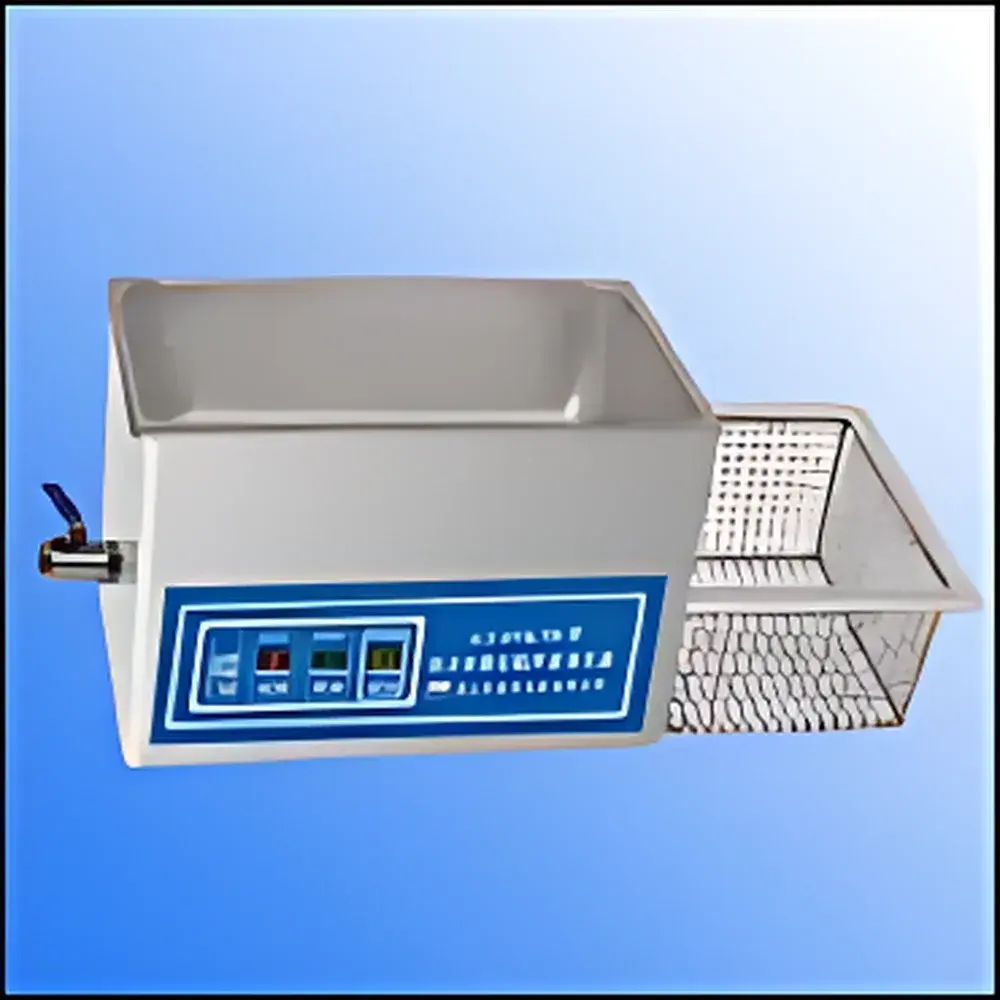
KQ-300DE / KQ-300DB / KQ-300DA Benchtop Digital Ultrasonic Cleaner
| Origin | Shanghai, China |
|---|---|
| Manufacturer Type | Authorized Distributor |
| Origin Category | Domestic (PRC) |
| Model | KQ-300DE / KQ-300DB / KQ-300DA |
| Price | USD 920 (FOB Shanghai, ex. VAT & shipping) |
| Dimensions (W×D×H) | 320×264×340 mm (KQ-300DE) / 320×264×320 mm (KQ-300DB/DA) |
| Tank Internal Dimensions (L×W×H) | 300×240×150 mm |
| Tank Capacity | 10 L |
| Ultrasonic Frequency | 40 kHz |
| Ultrasonic Power Output | 300 W (adjustable 40–100%) |
| Heating Power | 600 W (KQ-300DB/DE only) |
| Temperature Range | 20–80 °C (adjustable in 1 °C increments) |
| Timer Range | 1–480 min (adjustable in 1 min increments) |
| Heating & Ultrasonic Dual Control | Independent on/off switching |
| Safety Features | Low-level liquid detection, over-temperature, over-voltage, and over-current protection |
| Construction | 304 Stainless steel tank and outer housing (except KQ-50 series) |
Overview
The KQ-300DE, KQ-300DB, and KQ-300DA are benchtop digital ultrasonic cleaners engineered for precision cleaning, degassing, dispersion, emulsification, and cell disruption in academic laboratories, R&D centers, and quality control environments. These units operate on the principle of piezoelectrically generated cavitation at a fixed frequency of 40 kHz—optimized for broad compatibility with aqueous and mild solvent-based cleaning solutions while minimizing sample degradation. Unlike analog predecessors, each model integrates a microprocessor-controlled system that enables repeatable, traceable, and auditable operational parameters—critical for GLP-compliant workflows and method validation under ISO/IEC 17025 or ASTM D2603-20 guidelines. The transducer array delivers uniform acoustic energy distribution across the 10 L stainless steel tank (300 × 240 × 150 mm internal), with total ultrasonic output rated at 300 W and digitally adjustable from 40% to 100% power—ensuring optimal energy delivery for delicate optics, microfluidic components, or robust metal parts without manual recalibration.
Key Features
- Dual independent digital control of ultrasonic power (40–100%) and heating (20–80 °C, 1 °C resolution), enabling simultaneous or isolated operation for multi-step protocols
- Real-time digital display of set values and actual readings for time, temperature, power level, and cumulative operating hours (up to 999,999 h)
- Integrated safety interlocks: automatic shutdown on low liquid level detection, thermal runaway prevention (>85 °C cutoff), and electrical fault monitoring (over-voltage/current)
- 304 stainless steel tank and structural housing (excluding legacy KQ-50 models), resistant to corrosion from alkaline detergents, ethanol, and isopropanol
- Precision-welded stainless steel mesh basket (argon arc welded) ensuring mechanical stability during high-intensity cycles and long-term dimensional integrity
- Acoustic attenuation lid (standard on KQ-300DE; optional on KQ-300DB) reducing ambient noise to ≤55 dB(A) at 1 m—meeting OSHA 29 CFR 1910.95 workplace exposure limits
- Non-volatile memory retains user-defined settings across power cycles, supporting SOP-driven operation in regulated environments
- Single-chip microcontroller architecture with firmware upgradability via RS232 interface (optional accessory kit available)
Sample Compatibility & Compliance
The KQ-300 series accommodates a wide range of sample formats—including glassware (vials, cuvettes, pipette tips), metallic components (surgical instruments, calibration standards), polymer substrates (microtiter plates, PDMS chips), and biological specimens (tissue sections, cell culture inserts). Its 40 kHz frequency balances penetration depth and cavitation intensity, making it suitable for removing particulate contaminants, organic residues, and adsorbed proteins without damaging micron-scale surface features. All models comply with IEC 61000-6-3 (EMC emission limits) and IEC 61010-1 (safety requirements for laboratory equipment). For regulated applications, the digital logging capability supports audit trails required under FDA 21 CFR Part 11 when paired with validated data capture software—enabling electronic signatures, change control, and retention of parameter history per ALCOA+ principles.
Software & Data Management
While the base unit operates as a standalone instrument, optional RS232 connectivity allows integration into centralized lab management systems. Third-party SCADA or LIMS platforms can poll real-time status (temperature, elapsed time, power %) and trigger event logs via ASCII command protocol. Firmware supports timestamped storage of up to 100 user-defined programs—including ramp-and-hold heating profiles, pulsed ultrasonication sequences, and multi-stage cleaning cycles. Data export is compatible with CSV format for post-processing in MATLAB, Python (Pandas), or Excel—facilitating statistical process control (SPC) analysis of cleaning efficacy across batches. No proprietary software installation is required for basic operation, minimizing IT overhead in shared-core facilities.
Applications
- Pre-analytical sample preparation: removal of oils and fingerprints from HPLC vials and GC autosampler trays
- Electronics manufacturing: flux residue cleaning from PCBs and semiconductor wafers prior to AOI inspection
- Pharmaceutical QC: cleaning of dissolution apparatus baskets and sinkers per USP
- Materials science: dispersion of nanomaterials (e.g., graphene oxide, TiO₂ nanoparticles) in aqueous suspensions
- Life sciences: gentle lysis of cultured mammalian cells for protein extraction without sonication-induced denaturation
- Forensics: recovery of trace DNA from metal casings and firearm components using enzymatic detergent formulations
FAQ
What is the difference between KQ-300DA, KQ-300DB, and KQ-300DE models?
The KQ-300DA lacks heating and a lid; the KQ-300DB adds 600 W heating and temperature control but no lid; the KQ-300DE includes both heating and a sound-dampening lid, plus optional drain valve.
Can this unit be used with flammable solvents such as acetone or hexane?
No. These models are not explosion-proof and are certified only for aqueous or water-miscible solutions (e.g., 1–5% Alconox®, Tergazyme®). Solvent use requires Class I Division 1 certified equipment.
Is the ultrasonic power output calibrated per transducer or total system?
Total nominal output is 300 W. Each of six transducers contributes nominally 50 W, distributed uniformly along the tank bottom per manufacturer specification.
Does the timer support intermittent (pulse) mode?
No. The timer controls continuous operation only. Pulse-mode ultrasonication requires external programmable relay controllers.
What maintenance is required to ensure long-term performance?
Monthly descaling with 5% citric acid solution (40 °C, 30 min), biannual inspection of transducer adhesion integrity, and replacement of the mesh basket if deformation exceeds 0.5 mm deviation from flatness.



