
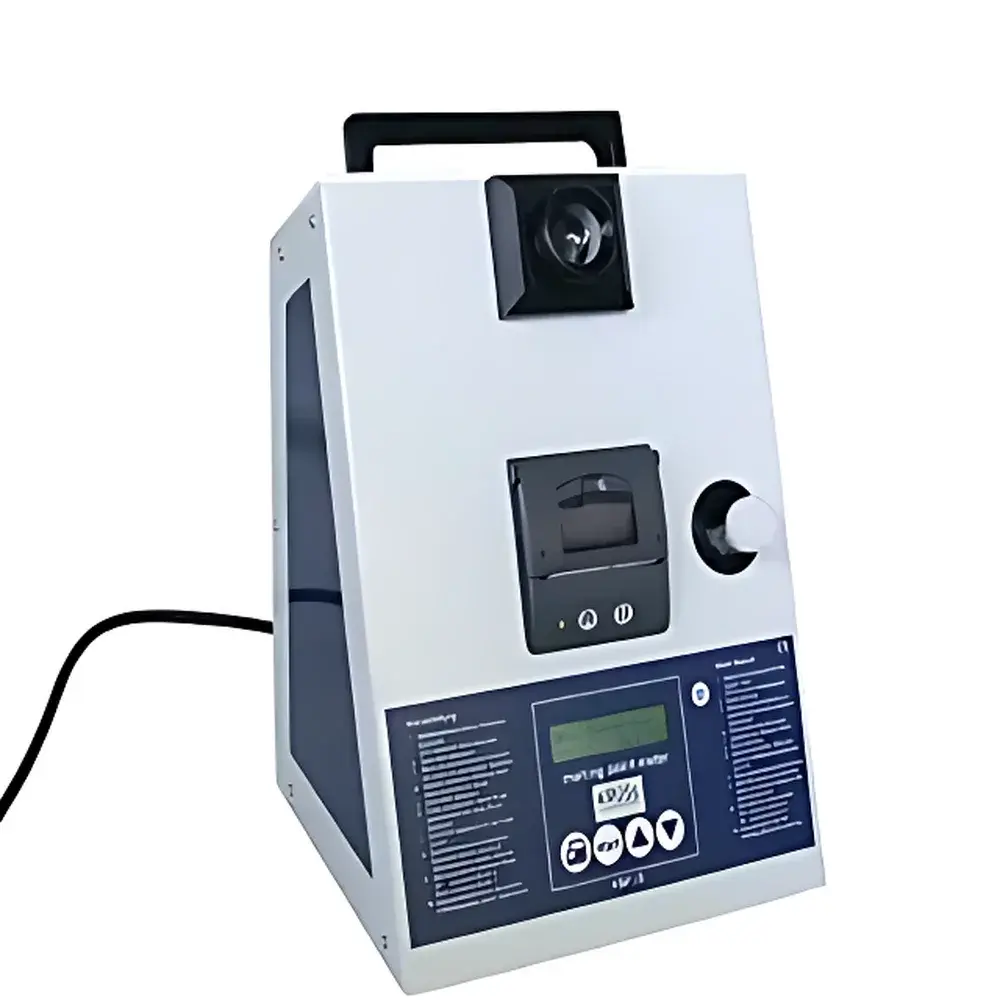
KRUESS M5000 Automated Melting Point Apparatus
| Brand | KRUESS |
|---|---|
| Origin | Germany |
| Model | M5000 |
| Temperature Range | 25–400 °C |
| Accuracy | ±0.3 °C (25–200 °C), ±0.5 °C (200–400 °C) |
| Repeatability | ±0.2 °C |
| Temperature Resolution | 0.1 °C |
| Heating Rate | 4 min to 300 °C, 7.5 min to 400 °C |
| Capillary Diameter | 1.4 mm |
| Sample Capacity | 1 capillary per measurement |
| Cooling | Integrated fan-assisted cooling |
| Safety Rating | IP20 |
| Dimensions | 230 × 210 × 110 mm |
| Weight | 1.8 kg |
| Power Supply | 85–264 V AC, 47–440 Hz |
| Interface | RS-232 |
Overview
The KRUESS M5000 Automated Melting Point Apparatus is a benchtop thermal analysis instrument engineered for precise, reproducible determination of melting points in crystalline organic and pharmaceutical compounds. It operates on the classical capillary tube method standardized in pharmacopoeial guidelines (e.g., USP & Ph. Eur. Chapter 2.2.14, ISO 6393), where solid samples are packed into standardized glass capillaries and heated under controlled conditions while optical detection monitors phase transition onset and completion. Designed and manufactured in Hamburg, Germany, the M5000 integrates a high-stability Peltier-heated block with real-time digital temperature feedback, enabling accurate thermal profiling across a broad operational range from ambient (25 °C) up to 400 °C. Its compact footprint and robust mechanical architecture make it suitable for routine QC laboratories, R&D environments, and teaching facilities requiring compliance-ready, operator-independent thermal characterization.
Key Features
- Automated melting point detection with optical endpoint recognition — eliminates subjective visual interpretation and reduces inter-operator variability.
- Digital temperature control with 0.1 °C resolution and verified accuracy of ±0.3 °C (25–200 °C) and ±0.5 °C (200–400 °C), traceable to NIST-calibrated reference standards.
- Integrated forced-air cooling system enables rapid cooldown between measurements — typical cycle time from 400 °C to 30 °C is under 8 minutes, improving throughput in high-volume testing.
- Sealed membrane keypad and chemically resistant housing ensure ease of decontamination and long-term reliability in regulated lab environments.
- Acoustic and visual melt-endpoint alerts, coupled with automatic data hold function upon completion, prevent missed transitions during unattended operation.
- RS-232 serial interface supports direct connection to label printers or legacy LIMS systems for audit-compliant hardcopy output without third-party software dependencies.
- Included protective cover and 100 pre-sized capillaries (1.4 mm OD) facilitate immediate deployment and adherence to standardized sample preparation protocols.
Sample Compatibility & Compliance
The M5000 accommodates standard thin-walled glass capillaries (1.4 mm outer diameter) filled with 1–3 mg of dry, finely powdered, homogeneous sample — ideal for APIs, excipients, polymers, and fine chemicals. Its measurement methodology conforms to internationally recognized monographs including USP , EP 2.2.14, JP 2.60, and ASTM E324. The instrument’s thermal performance meets GLP documentation requirements when used with procedural SOPs; its fixed heating profile and deterministic endpoint algorithm support 21 CFR Part 11 readiness when paired with compliant data recording practices (e.g., timestamped printouts or external validated logging). IP20-rated enclosure ensures safe operation in non-hazardous laboratory spaces per IEC 60529.
Software & Data Management
The M5000 operates as a standalone instrument with embedded firmware — no PC or proprietary software is required for basic operation. All critical parameters (setpoint, actual temperature, ramp status, melt onset/offset, duration) are displayed in real time on the high-contrast LCD. RS-232 output delivers ASCII-formatted measurement reports (including date/time stamp, sample ID placeholder, and result in °C) directly to serial printers or ASCII-capable data acquisition terminals. For labs integrating into electronic lab notebooks (ELN) or LIMS, the device supports configurable baud rates (9600 default) and line-ending protocols compatible with common middleware parsers. While not natively network-enabled, its deterministic serial output allows inclusion in automated QA workflows governed by ISO/IEC 17025 calibration management systems.
Applications
- Pharmaceutical quality control: Identity verification and purity assessment of active pharmaceutical ingredients (APIs) and intermediates per ICH Q5 and Q6A guidelines.
- Chemical synthesis validation: Monitoring reaction completeness and detecting polymorphic forms during process development.
- Materials science: Characterization of low-molecular-weight organic crystals, metal-organic frameworks (MOFs), and eutectic mixtures.
- Educational laboratories: Teaching fundamental thermal behavior concepts including solid–liquid phase equilibria, depression of freezing point, and kinetic vs. thermodynamic melting.
- Regulatory submissions: Generating GMP-aligned melting point data for dossier packages submitted to EMA, FDA, or PMDA.
FAQ
Does the M5000 support programmable heating rate profiles?
No — the M5000 uses a fixed, factory-optimized heating schedule (e.g., ~4 min to 300 °C) designed to balance speed, resolution, and reproducibility per pharmacopoeial recommendations. It does not offer user-adjustable ramp rates.
Can multiple samples be measured simultaneously?
No — the M5000 processes one capillary per measurement cycle. High-throughput labs may deploy multiple units or consider KRUESS’s higher-capacity models (e.g., M5600) for parallel analysis.
Is calibration certificate included with shipment?
A factory calibration report is supplied; however, users must perform periodic verification using certified reference standards (e.g., NIST SRM 742b, 1507a) as part of their internal quality system.
What maintenance is required?
Routine cleaning of the optical path and heating block with lint-free swabs and isopropanol; annual verification of temperature sensor drift and optical alignment is recommended for GLP-compliant use.
Is the instrument compatible with modern LIMS via USB or Ethernet?
No — only RS-232 serial connectivity is provided. Integration with modern networks requires external serial-to-USB/Ethernet converters validated under the lab’s IT security policy.



