
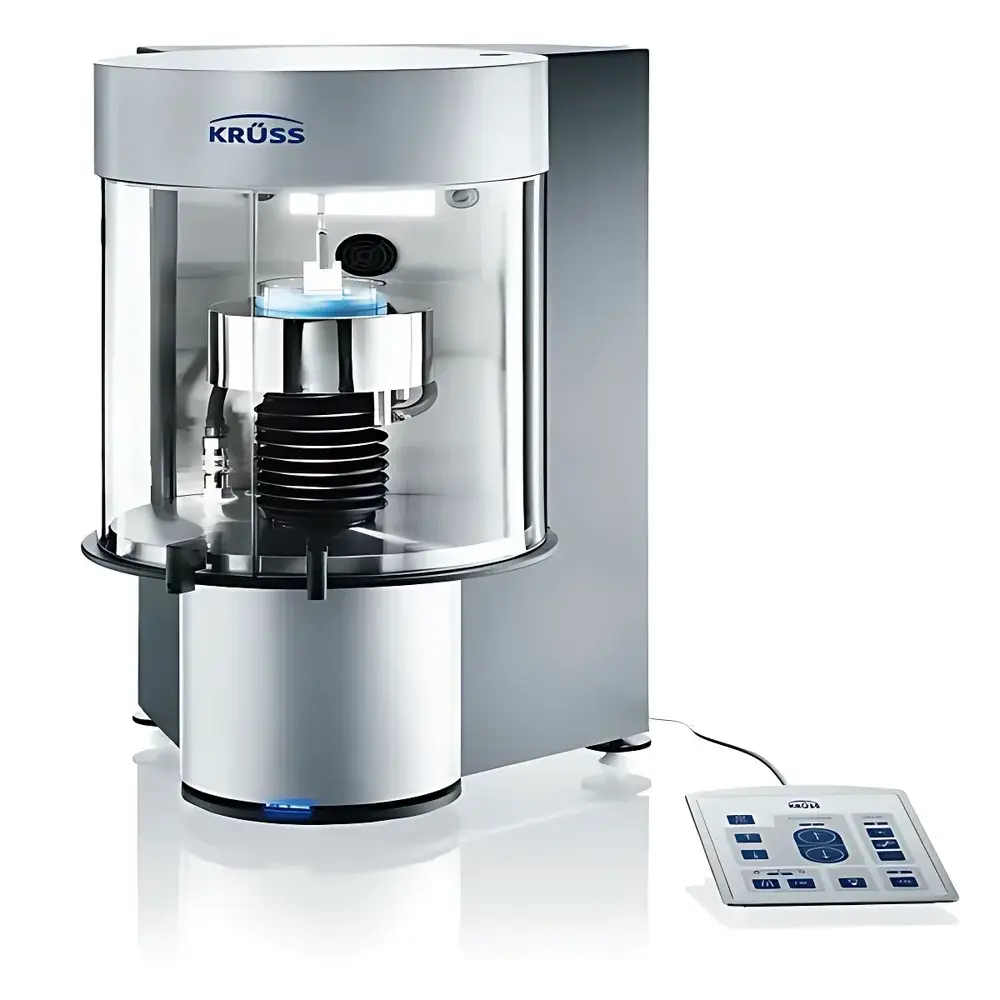
Krüss K100C Automatic Surface and Interfacial Tensiometer
| Origin | Germany |
|---|---|
| Manufacturer Type | Authorized Distributor |
| Origin Category | Imported |
| Model | K100C |
| Price Range | USD 27,000–68,000 (est.) |
| Measurement Range | 1–2000 mN/m |
| Resolution | 0.01 mN/m |
| Accuracy | ±0.01 mN/m |
| Temperature Display Range | −10 to +130 °C |
| Temperature Display Precision | ±0.1 °C |
| Measurement Methods | Du Noüy Ring Method, Wilhelmy Plate Method |
Overview
The Krüss K100C is a high-precision, fully automated force-based surface and interfacial tensiometer engineered for rigorous R&D and quality control environments. It operates on the fundamental principle of measuring the force exerted on a calibrated solid probe—either a platinum-iridium ring (Du Noüy method) or a precision-machined Wilhelmy plate—as it interfaces with the liquid surface or liquid–liquid interface. This force is directly related to surface or interfacial tension via established physical models (e.g., Harkins–Jordan correction for ring geometry, or exact wetted perimeter calculation for plate geometry). The instrument integrates a high-stability microbalance (120 g capacity, 100 µg resolution) with active damping and mechanical locking to suppress environmental vibrations and airflow disturbances. Its non-magnetic, motor-driven stirring system ensures homogeneous dispersion without introducing magnetic interference—critical for analyzing ferrofluids, magnetic nanoparticles, or paramagnetic formulations. Temperature control is facilitated via an integrated jacketed measurement cell compatible with external circulators, enabling thermally resolved studies from sub-zero to 130 °C.
Key Features
- High-resolution force detection: 0.01 mN/m resolution and ±0.01 mN/m accuracy across full 1–2000 mN/m range
- Modular probe system: Quick-swap, plug-in Du Noüy rings and Wilhelmy plates with certified geometries and surface cleanliness protocols
- Motorized, non-magnetic stirrer: Programmable agitation prior to each measurement cycle to ensure reproducible dispersion state
- Illuminated measurement chamber: LED-lit viewing area with adjustable intensity for precise probe positioning and meniscus visualization
- Motorized Z-stage: 110 mm vertical travel, speed range 0.1–500 mm/min, pressure-sensitive jog control for ultra-fine positioning
- Robust mechanical architecture: Stainless steel frame and tempered glass enclosure for chemical resistance and long-term dimensional stability
- Integrated leveling system: Embedded spirit level with fine-adjustment feet for gravimetric alignment essential to force metrology
- Low-voltage internal electronics: External 12 V DC power supply minimizes electromagnetic noise and enhances signal integrity
Sample Compatibility & Compliance
The K100C supports diverse sample types—including clear and opaque liquids, emulsions, micellar solutions, polymer melts, molten salts, and suspensions of nanoparticles or pigments. Solid-phase analysis includes contact angle determination on flat substrates, fiber bundles, and compressed powders using dynamic sessile drop or Wilhelmy immersion techniques. For regulatory compliance, the system supports audit-trail-enabled operation when paired with Krüss ADVANCE software configured under 21 CFR Part 11 guidelines (electronic signatures, user access control, change logging). Measurement protocols align with ISO 1409 (plastics—determination of surface tension), ASTM D971 (oil—interfacial tension), and ISO 6295 (detergents—surface tension). All force calibration procedures follow traceable standards (e.g., NIST-traceable weights), and temperature verification is performed using calibrated Pt100 sensors per ISO/IEC 17025 requirements.
Software & Data Management
Krüss ADVANCE software provides a menu-free, workflow-driven interface with real-time force and temperature trend plots. Users define measurement sequences via drag-and-drop step templates—e.g., “CMC Titration,” “Dynamic Contact Angle Ramp,” or “Density by Sinking Body”—each configurable with dwell times, stirring intervals, and auto-zero triggers. All parameters are saved with metadata (operator ID, timestamp, environmental conditions) in encrypted .krs binary files. Export options include CSV, PDF reports, and XML for LIMS integration. The software supports multilingual UI (English, German, Chinese, Japanese), GLP-compliant electronic lab notebook (ELN) export, and customizable report generation with embedded calibration certificates. Raw force vs. time data is accessible for post-acquisition reprocessing using user-defined correction algorithms.
Applications
- Determination of critical micelle concentration (CMC) and surfactant efficiency (γCMC) in pharmaceutical excipients and agrochemical formulations
- Wettability assessment of tablets, API crystals, and porous excipients using advancing/receding contact angle analysis
- Coating adhesion and substrate wetting kinetics in automotive clearcoats and industrial paints
- Interfacial tension profiling during crude oil fractionation and enhanced oil recovery (EOR) screening
- CIP validation in food and beverage processing lines via surface tension decay monitoring
- Dispersion stability evaluation of pigment pastes and battery electrode slurries through sedimentation force tracking
- Surface energy component analysis (Lifshitz–van der Waals, acid–base) of functionalized textiles and medical device polymers
- Density measurement of low-viscosity solvents and ionic liquids via sinker method integration
FAQ
What standard test methods does the K100C support?
It complies with ASTM D971, ISO 1409, ISO 6295, DIN 53914, and EN 14370 for surface and interfacial tension, and supports contact angle methods per ISO 19403 series.
Can the K100C measure dynamic surface tension?
Yes—via automated time-resolved Wilhelmy plate immersion or pendant drop analysis when combined with optional high-speed imaging modules.
Is the instrument suitable for corrosive or high-temperature samples?
The stainless steel/glass construction and optional Hastelloy-coated probes enable use with aggressive media; temperature-controlled measurements up to 130 °C are supported with external circulation.
How is data integrity ensured for regulated environments?
ADVANCE software offers 21 CFR Part 11 mode with role-based access, electronic signatures, immutable audit trails, and secure data encryption.
What maintenance is required for long-term accuracy?
Annual calibration of the microbalance and temperature sensor is recommended; probe cleaning follows Krüss-certified protocols using ethanol, piranha solution (for organics), or plasma treatment.



