
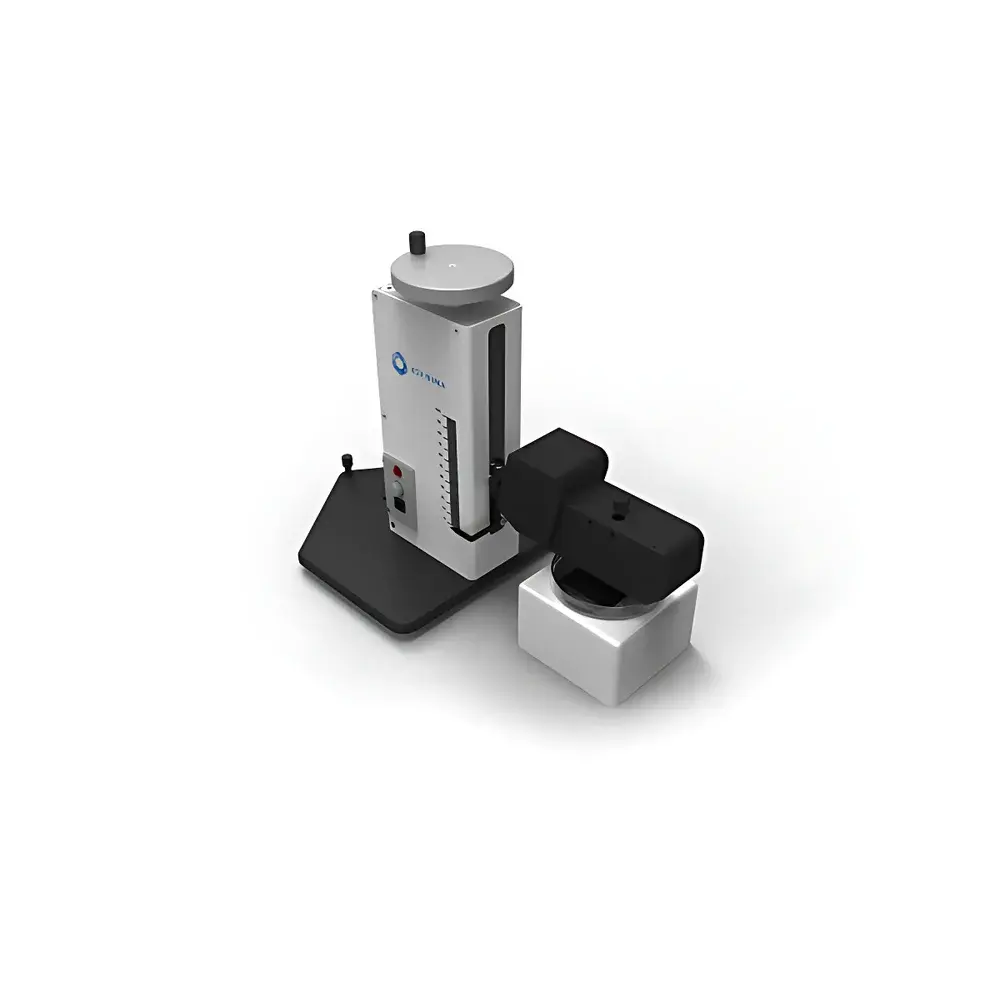
KSV NIMA Brewster Angle Microscope (BAM)
| Brand | KSV NIMA |
|---|---|
| Origin | Finland |
| Manufacturer Type | Original Equipment Manufacturer (OEM) |
| Origin Category | Imported Instrument |
| Model | KSV NIMA Brewster Angle Microscope |
| Pricing | Available Upon Request |
Overview
The KSV NIMA Brewster Angle Microscope (BAM) is a precision optical surface characterization instrument engineered for non-invasive, label-free visualization of monolayer films at the air–water interface. Operating on the principle of Brewster angle reflectivity—where p-polarized light exhibits near-zero reflectance at a specific incident angle dependent on the refractive index mismatch between air and the subphase—the BAM enables high-contrast imaging of molecularly thin films without perturbing their structural integrity. Unlike fluorescence or dye-based techniques, this method imposes no chemical modification or photobleaching risk, making it ideal for quantitative studies of native lipid, polymer, or surfactant monolayers during Langmuir trough compression, transfer, or phase transition events. The system delivers real-time, diffraction-limited lateral resolution down to ~1.5 µm across a field of view optimized for standard 30 × 30 cm Langmuir troughs, supporting both static morphology analysis and time-resolved kinetic monitoring with frame rates up to 30 fps.
Key Features
- Standalone optical design compatible with all major Langmuir and Langmuir–Blodgett troughs—including models from KSV NIMA, Nima Technology, KBIO, and custom-built systems—without requiring proprietary integration hardware.
- Fixed-angle, high-stability optical path aligned precisely to the Brewster angle of water (≈53.1° at 633 nm), ensuring optimal contrast and signal-to-noise ratio for interfacial film detection.
- Integrated CMOS imaging sensor with USB 3.0 interface, enabling plug-and-play connection to Windows-based acquisition workstations; no external frame grabbers or driver installations required.
- Collimated LED illumination source with adjustable intensity and spectral filtering options (optional 532 nm or 633 nm modules) to minimize thermal drift and enhance monolayer contrast under varying surface pressure conditions.
- Rigid aluminum-alloy optical housing with kinematic mirror mounts and vibration-damped base plate, engineered for long-duration experiments in shared laboratory environments.
Sample Compatibility & Compliance
The KSV NIMA BAM supports a broad range of amphiphilic monolayer systems, including phospholipids (e.g., DPPC, DMPC), fatty acids (e.g., stearic acid), block copolymers, graphene oxide dispersions, and protein–lipid complexes. It is routinely deployed in ISO/IEC 17025-accredited surface science laboratories for method development aligned with ASTM D1388 (Standard Test Method for Stiffness of Fabrics) and ISO 9073-11 (Nonwovens — Test Methods — Part 11: Determination of Surface Tension Effects). While the instrument itself does not carry CE or FDA clearance as a medical device, its optical architecture conforms to IEC 61000-6-3 (EMC emission standards) and IEC 61000-6-2 (immunity requirements), facilitating integration into GLP-compliant QC workflows where audit-trail documentation of interfacial behavior is mandated.
Software & Data Management
Acquisition and analysis are managed via KSV’s proprietary BAM Studio software (v4.2+), a Windows-native application supporting synchronized timestamping, multi-channel video logging (AVI/MKV), and lossless TIFF export. The software includes built-in tools for grayscale thresholding, domain area quantification, perimeter measurement, and time-series intensity profiling across user-defined ROIs. Exported datasets comply with FAIR principles (Findable, Accessible, Interoperable, Reusable) through CSV and HDF5 formats, enabling direct ingestion into MATLAB, Python (via h5py/pandas), or commercial statistical platforms. Audit trail functionality records operator ID, acquisition parameters, calibration timestamps, and file modification history—fully compliant with FDA 21 CFR Part 11 requirements when deployed with validated electronic signature modules.
Applications
- Quantitative assessment of monolayer homogeneity, domain nucleation, and collapse onset during π–A isotherm acquisition.
- In situ observation of phase separation dynamics in mixed lipid systems relevant to membrane biophysics and drug delivery vesicle design.
- Real-time tracking of nanoparticle adsorption kinetics and monolayer penetration depth in environmental colloid studies.
- Validation of LB transfer fidelity by correlating air–water interface morphology with transferred film quality on solid substrates (e.g., Si wafers, mica).
- Teaching and methodology training in advanced surface chemistry courses, where visual reinforcement of Gibbs adsorption, Marangoni effects, and 2D phase equilibria is essential.
FAQ
Can the KSV NIMA BAM be used with non-KSV Langmuir troughs?
Yes—the standalone configuration features universal mounting brackets and adjustable height/tilt mechanisms, allowing mechanical integration with troughs from Nima, Kibron, and custom fabrication sources.
Does the system require laser illumination?
No—standard operation uses stabilized broadband LED illumination; optional HeNe or diode lasers are available only for specialized polarization-sensitive configurations.
What is the minimum detectable surface pressure change observable via BAM imaging?
While BAM does not directly measure surface pressure, morphological transitions (e.g., liquid-expanded to condensed phase) correlate reliably with pressure changes ≥0.5 mN/m under controlled temperature and subphase ionic strength conditions.
Is remote operation supported?
Yes—BAM Studio supports networked acquisition via TCP/IP, enabling control and monitoring from off-site workstations within institutional intranets, subject to local IT security policies.
How often does the optical alignment require recalibration?
Under normal lab conditions, factory alignment remains stable for ≥12 months; annual verification using the included reference calibration slide is recommended per ISO/IEC 17025 internal audit protocols.




