
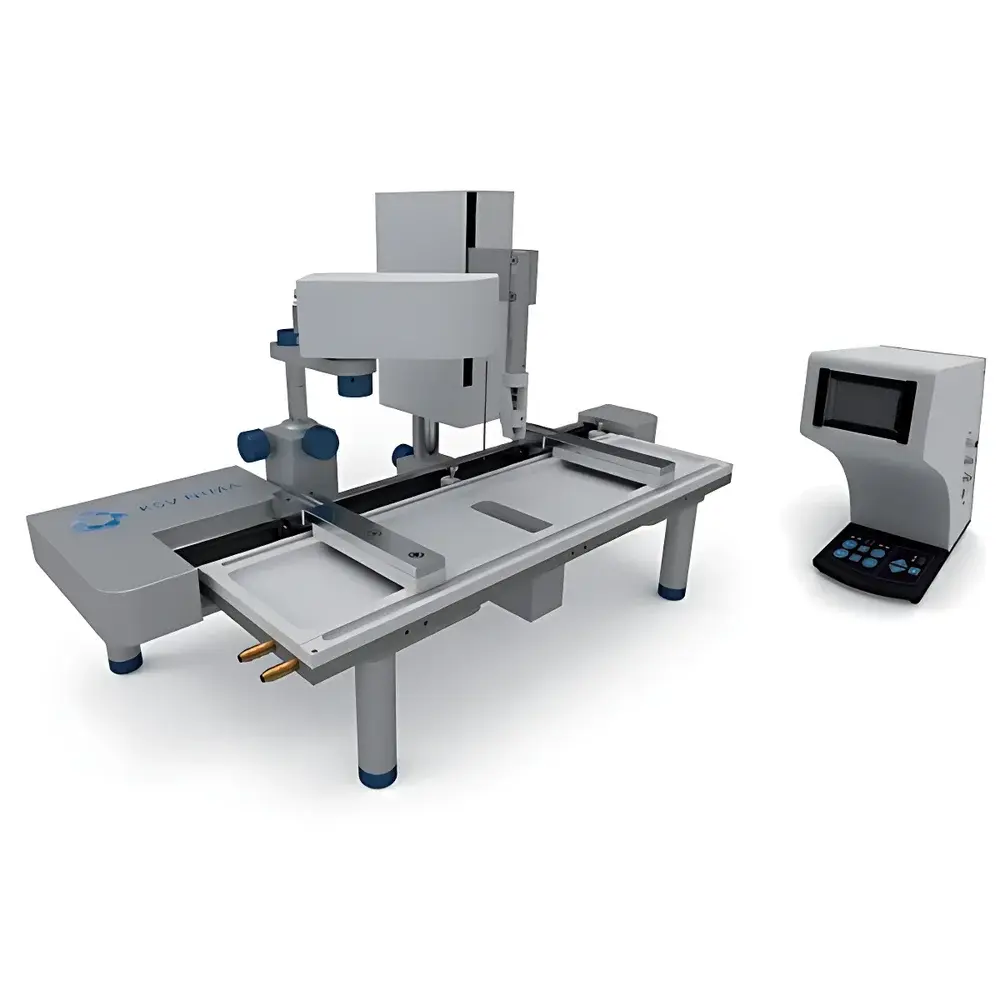
KSV NIMA Schaefer Langmuir-Schaefer Trough Analyzer
| Brand | KSV NIMA |
|---|---|
| Origin | Finland |
| Manufacturer Type | Manufacturer |
| Origin Category | Imported |
| Model | Schaefer |
| Price Range | USD 25,000 – 63,000 |
Overview
The KSV NIMA Schaefer Langmuir-Schaefer Trough Analyzer is a precision-engineered surface science instrument designed for the controlled formation, compression, and horizontal transfer of monolayers at air–water or liquid–liquid interfaces. Based on the Langmuir–Schaefer (LS) deposition principle—distinct from vertical Langmuir–Blodgett (LB) transfer—the system enables reproducible, density-preserving transfer of amphiphilic or colloidal monolayers onto solid substrates in a horizontal orientation. This capability is critical for fabricating multilayer architectures with preserved molecular packing, thickness uniformity, and interfacial integrity—particularly valuable in nanomaterials assembly, biomimetic membrane studies, and functional thin-film device fabrication. The instrument operates by first forming a Langmuir monolayer on an aqueous subphase within a PTFE trough; barrier-controlled lateral compression modulates surface pressure (π) to tune molecular packing states (gas → liquid-expanded → liquid-condensed → solid-like), which are quantified via Wilhelmy plate tensiometry compliant with EN 14370:2004. LS deposition then proceeds by horizontally immersing and withdrawing a substrate through the compressed monolayer, retaining its structural fidelity without vertical shear-induced disruption.
Key Features
- Modular, open-frame architecture supporting rapid interchange of three standardized trough sizes (KN 2001: 98 cm²; KN 2002: 273 cm²; KN 2003: 841 cm²), all constructed from solid-sintered, non-porous PTFE to eliminate leaching, swelling, or adhesive contamination.
- High-precision symmetric barrier drive with speed range 0.1–270 mm/min and resolution of ±0.1 mm/min, ensuring isothermal, homogeneous monolayer compression across the entire interface.
- Ultra-sensitive Wilhelmy plate tensiometry system with 4 μN/m detection limit, 0–150 mN/m measurement range, and 1 g load capacity; includes standard W19.62 × H10 mm platinum plate (EN 14370:2004 compliant), plus optional variants for liquid/liquid or high-viscosity subphases.
- Three-axis (360° rotation + 110 mm X + 45 mm Y/Z) micro-adjustable balance mount enabling precise probe alignment and optimal meniscus contact geometry.
- Dedicated LS deposition module featuring centered dipping well (up to 110 × 110 mm), programmable withdrawal speed (0.1–108 mm/min), 80 mm stroke, and compatibility with substrates up to 4-inch format (106 × 106 mm).
- Integrated auxiliary interfaces for pH monitoring, subphase stirring, sample injection, and external water bath coupling (temperature control via aluminum baseplate, sold separately).
- Robust aluminum frame with height-adjustable feet (±33 mm), built-in safety limit switches, and tool-free trough mounting for rapid cleaning, recalibration, or configuration changes.
Sample Compatibility & Compliance
The Schaefer Trough Analyzer accommodates a broad spectrum of interfacially active materials—including synthetic amphiphiles (e.g., fatty acids, phospholipids), biopolymers (peptides, DNA), nanoparticles (graphene oxide, quantum dots), nanowires, and hybrid colloids—on aqueous or non-aqueous subphases. Its PTFE construction ensures chemical inertness toward aggressive solvents (chloroform, chlorobenzene, THF) and biological buffers. All tensiometric measurements adhere to ISO 9073-10 (surface tension of monolayers) and EN 14370:2004 (Wilhelmy plate calibration). The system supports GLP-compliant operation when integrated with audit-trail-enabled software (see Software section) and meets mechanical safety requirements per IEC 61010-1. Subphase temperature control (via external recirculating bath) enables thermodynamic studies aligned with ASTM D1331 and ISO 6889 protocols.
Software & Data Management
Control and analysis are executed via KSV NIMA’s proprietary TroughMaster™ software, a Windows-based platform supporting real-time surface pressure–area (π–A) isotherm acquisition, dynamic compression/expansion cycles, and LS deposition scripting. Data files are saved in ASCII-compatible .txt format with embedded metadata (timestamp, user ID, calibration parameters, environmental conditions) to satisfy FDA 21 CFR Part 11 requirements for electronic records. The software provides automated collapse point detection, phase transition analysis (using derivative dπ/dA), and export-ready plotting (linear/log scale, multi-curve overlay). Optional modules include batch processing for high-throughput screening and API integration for LIMS synchronization. Raw data integrity is preserved via checksum validation and write-protected archive folders.
Applications
- Biomimetic Membrane Research: Construction of asymmetric lipid bilayers, protein–lipid interaction mapping, and drug–membrane partitioning kinetics using cholesterol or sphingolipid monolayers.
- Nanomaterial Assembly: Controlled stacking of graphene, MoS₂, or metal–organic framework (MOF) monolayers for optoelectronic heterostructures and gas-sensing films.
- Functional Coatings: Deposition of stimuli-responsive polymer brushes, antimicrobial peptide arrays, and anti-fouling zwitterionic layers for biomedical devices.
- Interfacial Reaction Kinetics: In situ monitoring of surface-confined polymerization, enzyme–substrate binding, and antigen–antibody recognition via π–A hysteresis and compressibility modulus (Cs⁻¹) profiling.
- Colloidal Stability Assessment: Quantification of Pickering emulsion stabilization efficiency and nanoparticle adsorption isotherms at oil–water interfaces.
FAQ
What distinguishes Langmuir–Schaefer (LS) from Langmuir–Blodgett (LB) deposition?
LS transfer occurs horizontally, preserving monolayer density and minimizing vertical shear stress—ideal for fragile or anisotropic nanostructures. LB employs vertical withdrawal, inducing capillary forces that may distort packing.
Can the same trough be used for both Langmuir compression and LS deposition?
Yes. All KSV NIMA Schaefer troughs integrate dual functionality: barrier-driven compression for π–A characterization and a dedicated dipping well for LS transfer—no hardware reconfiguration required.
Is temperature control included as standard equipment?
Subphase temperature regulation is achieved via external recirculating water bath connected to the aluminum baseplate; the bath itself is an optional accessory.
Which analytical techniques can be coupled in situ with this system?
The open modular design supports simultaneous integration of PM-IRRAS, BAM, ISR, QCM-D, and surface potential (SPOT) modules—all mounted directly onto the frame without obstructing optical access.
Does the system comply with regulatory documentation standards for pharmaceutical R&D?
When operated with TroughMaster™’s audit trail and electronic signature modules enabled, it fulfills 21 CFR Part 11 and EU Annex 11 requirements for data integrity and traceability in GMP environments.



