
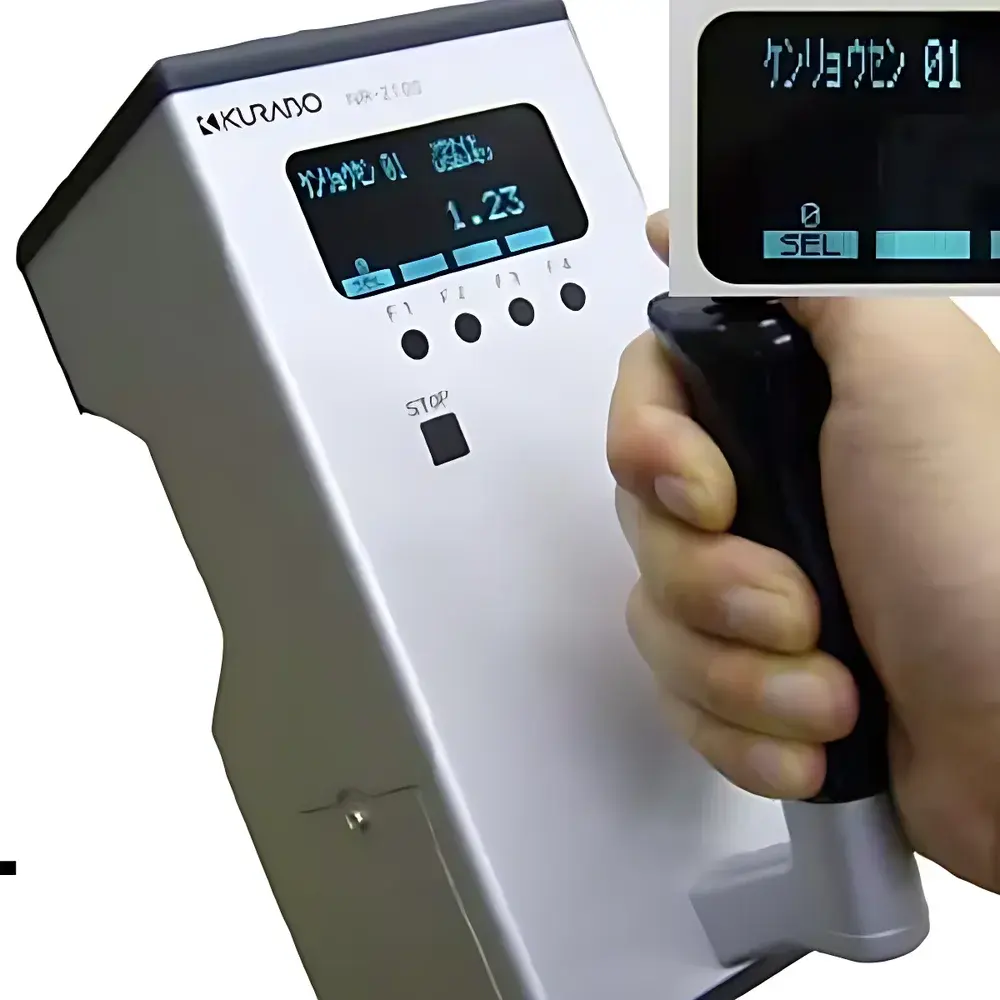
Kurabo 2100IB White Light Interferometric & Infrared Reflectance Thickness Analyzer for Organic Oil Films on Metallic Substrates
| Brand | Kurabo |
|---|---|
| Origin | Japan |
| Model | 2100IB |
| Measurement Principle | Infrared Reflectance Absorption (Rotating Filter Method) |
| Thickness Range | 0.1–10 µm |
| Repeatability | <0.01 µm |
| Measured Area | 518 × 36 mm (elliptical) |
| Dimensions | 100(W) × 210(D) × 145(H) mm |
| Weight | ~1.5 kg |
Overview
The Kurabo 2100IB is a dual-mode thickness analyzer engineered for non-contact, quantitative measurement of ultra-thin organic coatings on conductive metallic substrates—specifically optimized for industrial process control in continuous steel and aluminum production lines. Unlike conventional eddy-current or beta-backscatter gauges, the 2100IB employs infrared reflectance absorption spectroscopy based on the Beer–Lambert law, targeting characteristic C–H and C=O vibrational absorption bands (typically within the 3.4–3.5 µm mid-IR region) to determine mass-based coating weight (g/m²), which is then converted to equivalent film thickness (µm) using substrate-specific calibration curves. Its optical architecture integrates a proprietary P-polarized incident beam path with a rotating interference filter wheel, minimizing spurious contributions from surface specular reflection and subsurface multiple reflections—critical for high-fidelity measurements on mill-finished, textured, or pre-passivated metal surfaces such as cold-rolled steel, electrolytic tinplate, and aluminum beverage can stock.
Key Features
- Polarization-optimized infrared optics: P-wave incidence geometry suppresses Fresnel reflection artifacts, enabling stable signal acquisition on highly reflective metallic substrates without mechanical contact or surface preparation.
- Rotating filter-based spectral selectivity: Eliminates need for broadband IR sources or cooled detectors; delivers high signal-to-noise ratio at target absorption wavelengths with long-term thermal and mechanical stability.
- Elliptical measurement footprint (518 × 36 mm): Matches standard strip width sampling zones in hot-dip galvanizing and coil coating lines—enabling representative area-averaged quantification rather than point measurement.
- Integrated thermal printer: Provides immediate hard-copy output of measurement date/time, operator ID, location tag, raw absorbance values, calibrated thickness, and pass/fail status per ASTM E2792–21 guidelines for in-line QC documentation.
- Portable benchtop form factor (1.5 kg): Designed for both fixed-line integration and mobile verification—operable directly on production floor without external power conditioning or vibration isolation.
Sample Compatibility & Compliance
The 2100IB is validated for use on ferrous and non-ferrous rolled metal products including cold-rolled carbon steel, galvanized steel (GI/GA), electrogalvanized steel, aluminum alloy sheets (e.g., AA3004, AA5182), and tinplate. It supports measurement of hydrocarbon-based rust preventives (e.g., mineral oil, synthetic ester blends), fingerprint-resistant organic topcoats (e.g., acrylic–melamine hybrids), roll lubricants (e.g., polyol esters), and internal lacquers on two-piece beverage cans. All factory calibrations are traceable to NIST-traceable reference standards and comply with ISO 2808:2019 (paints and varnishes — determination of film thickness), ASTM D7091–22 (nondestructive measurement of dry film thickness), and JIS Z 2249:2020 (measurement methods for oil film thickness on steel sheets). Data logging and audit trails meet GLP/GMP requirements under FDA 21 CFR Part 11 when used with optional secure network interface modules.
Software & Data Management
The instrument operates via embedded firmware with configurable measurement protocols—including single-shot mode, continuous scanning (1 Hz update rate), and batch-averaging across up to 99 positions. Raw absorbance spectra and derived thickness values are timestamped and stored internally (up to 10,000 records). USB-C export enables direct transfer to LIMS or MES platforms in CSV/Excel-compatible format. Optional PC software (Kurabo Thickness Manager v4.x) provides statistical process control (SPC) charting, trend analysis against rolling speed/temperature parameters, and automated report generation compliant with IATF 16949 clause 8.5.1.2 (control of production process).
Applications
- Real-time monitoring of oil film uniformity during skin-pass rolling and final annealing of automotive-grade CR coils.
- Verification of anti-fingerprint coating dosage post-curing on prepainted building panels (PPGI/PPGL).
- In-process validation of internal lacquer thickness on drawn-and-ironed (D&I) aluminum can bodies prior to sterilization.
- QC screening of backside lubricant residuals on color-coated roofing sheets to prevent interleaf staining.
- Root-cause analysis of corrosion initiation sites on zinc-aluminum alloy coated steels via localized thickness mapping.
FAQ
Does the 2100IB require substrate-specific calibration?
Yes—calibration must be performed using certified reference samples matching the base metal composition, surface roughness (Ra), and typical coating chemistry. Kurabo provides application-specific calibration kits traceable to JIS Z 2249 Annex B.
Can it measure through transparent overcoats (e.g., clear acrylic topcoats)?
No—the instrument requires direct optical access to the organic film/metal interface. Overcoats absorbing in the same IR band will interfere with quantification unless spectrally deconvoluted via multi-wavelength modeling (not supported in standard firmware).
Is the elliptical measurement area adjustable?
No—the 518 × 36 mm aperture is fixed to align with industry-standard strip inspection zones; however, optional motorized XY stages enable programmable raster scanning across wider widths.
What maintenance is required for long-term accuracy?
Annual verification using NIST-traceable IR transmission standards and optical alignment checks per Kurabo Service Bulletin TB-2100IB-03; no consumables or lamp replacements needed due to solid-state IR source design.



