
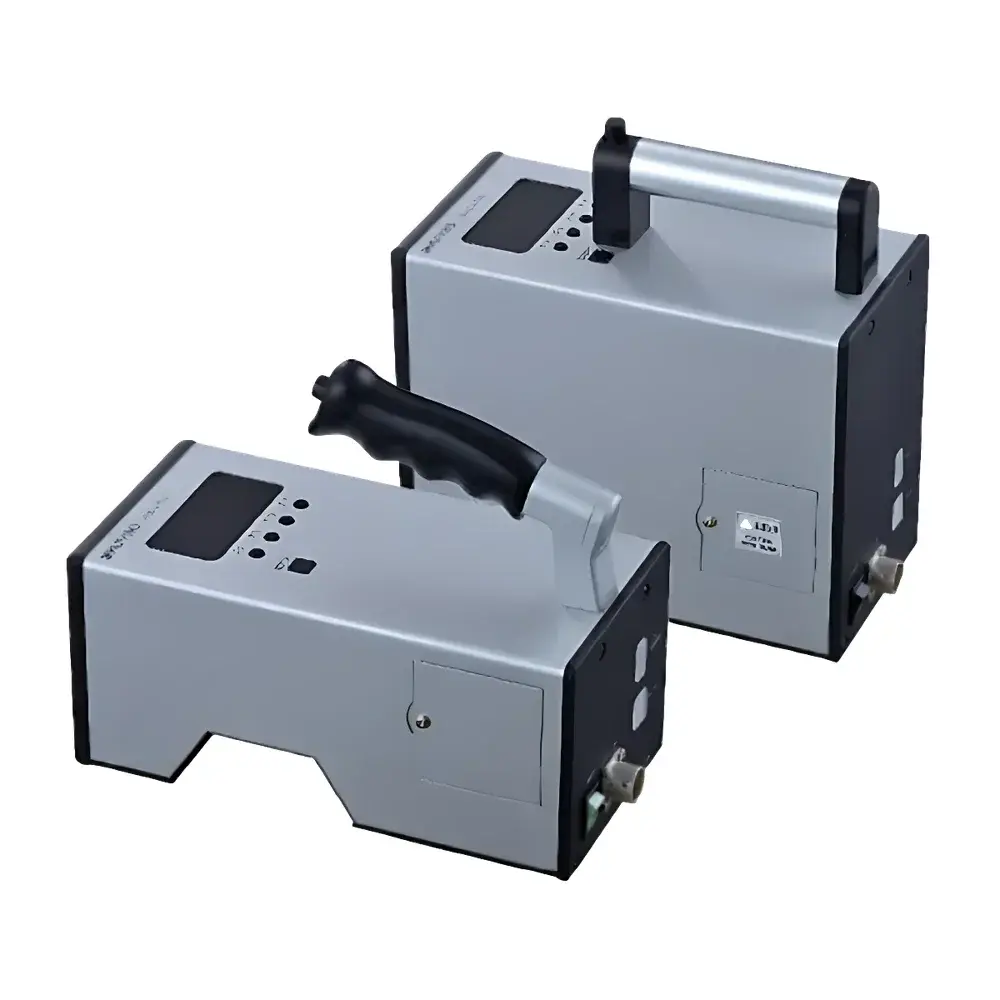
Kurabo NR-2100IB Infrared Oil Film and Passivation Layer Thickness Analyzer
| Brand | Kurabo |
|---|---|
| Origin | Japan |
| Manufacturer Type | Authorized Distributor |
| Origin Category | Imported |
| Model | NR-2100IB |
| Pricing | Available Upon Request |
| Measurement Principle | Infrared Reflectance Absorption (Rotating Filter Method) |
| Thickness Range | 0.1–10 µm |
| Repeatability | <0.01 µm |
| Measured Area | 518 × 36 mm (elliptical footprint) |
| Dimensions (W×D×H) | 100 × 210 × 145 mm |
| Weight | ~1.5 kg |
| Optical Configuration | P-polarized Incident Light |
| Integrated Thermal Printer | Yes |
Overview
The Kurabo NR-2100IB is a precision infrared reflectance absorption thickness analyzer engineered for non-destructive, quantitative measurement of ultra-thin organic coatings on conductive metallic substrates. Unlike white light interferometry or eddy current systems, the NR-2100IB operates on the fundamental principle of wavelength-specific infrared absorption—where hydrocarbon-based films (e.g., rust-preventive oils, rolling lubricants, passivation layers, and primer coatings) exhibit characteristic vibrational absorption bands in the mid-infrared region (~3.4–3.5 µm). By employing a rotating optical filter to isolate these diagnostic wavelengths and measuring the intensity attenuation of P-polarized reflected IR radiation, the instrument correlates absorbance to film mass per unit area with traceable calibration against NIST-traceable reference standards. Its design targets high-volume industrial QA/QC environments—including cold-rolled steel lines, aluminum can manufacturing facilities, and color-coated metal coil processing plants—where rapid, operator-independent verification of coating uniformity and compliance with ASTM D7829 (Standard Test Method for Determining Oil Content on Steel Surfaces) or JIS G 3302 Annex B is required.
Key Features
- P-polarized incident optics minimize interference from specular surface reflection and substrate-induced multiple reflections—critical for accurate measurement on highly reflective metals such as galvanized steel and aluminum alloys.
- Elliptical measurement footprint (518 × 36 mm) enables rapid scanning across wide strip widths without mechanical translation, supporting inline process monitoring at line speeds up to 120 m/min.
- Integrated thermal printer provides immediate hardcopy output with timestamp, sample ID, and measured thickness value—supporting GLP-compliant record retention without external data logging hardware.
- Compact form factor (100 × 210 × 145 mm, ~1.5 kg) and battery-compatible operation allow handheld deployment at any point along production lines, including roll stands, tension levelers, and packaging stations.
- Factory-calibrated using certified oil-coated reference panels traceable to JIS Z 8015 and ISO/IEC 17025-accredited laboratories; user calibration verification protocols are included in firmware.
Sample Compatibility & Compliance
The NR-2100IB is validated for use on ferrous and non-ferrous metallic substrates including cold-rolled carbon steel, electrogalvanized (EG), hot-dip galvanized (HDG), aluminum sheet (AA3003, AA5182), and pre-painted metal coils. It measures hydrocarbon-based films only—such as mineral oils, ester-based lubricants, silane passivations, and acrylic primers—with no sensitivity to inorganic oxides (e.g., Al₂O₃, Fe₂O₃) or water-based emulsions. The system complies with electromagnetic compatibility requirements per IEC 61326-1 and meets functional safety guidelines for industrial instrumentation under IEC 61000-6-2/-4. Measurement data integrity aligns with FDA 21 CFR Part 11 expectations when paired with Kurabo’s optional audit trail-enabled software module (NR-Soft v3.2+), which logs user actions, calibration events, and raw spectral records with digital signature capability.
Software & Data Management
While the NR-2100IB operates autonomously via its front-panel interface, optional PC connectivity (RS-232 or USB-to-serial) enables integration with Kurabo’s NR-DataLink software. This application supports batch export of measurement series in CSV and XML formats, statistical process control (SPC) charting (X̄–R, Cpk), and automated report generation compliant with ISO 9001 clause 8.5.2. Raw absorbance spectra are stored onboard for retrospective analysis, and firmware updates—delivered via SD card—maintain alignment with evolving industry test methods including updated versions of ASTM E1711 and ISO 2812-4.
Applications
- Quantification of mill oil residuals on cold-rolled steel prior to annealing or coating—ensuring optimal adhesion and minimizing furnace carbon buildup.
- In-process verification of lubricant dosage on aluminum beverage can stock to prevent draw-wall scoring during deep drawing operations.
- Validation of chromate-free passivation layer thickness on stainless steel components used in automotive fuel systems.
- Backside coating weight assessment on prepainted metal used in architectural cladding—confirming coverage consistency across coil width.
- Quality gate inspection of organic primer thickness on galvalume substrates prior to coil coating line entry.
FAQ
Can the NR-2100IB measure thickness on painted or powder-coated surfaces?
No. It is calibrated exclusively for sub-micron to 10 µm hydrocarbon films on bare or metallized metallic substrates. Paints, epoxies, and powder coatings exhibit broad IR absorption and lack the sharp C–H stretch signatures required for quantitative analysis.
Is operator training required to achieve specified repeatability?
Minimal training is needed due to fixed-focus optics and automatic baseline compensation; however, proper placement within the elliptical measurement zone and consistent normal incidence alignment are essential for <0.01 µm repeatability.
Does the instrument require annual recalibration?
Kurabo recommends biannual verification using certified reference panels; full recalibration by an authorized service center is advised every 24 months or after physical shock or environmental exposure beyond IP20 specifications.
Can measurement data be exported to LIMS or MES platforms?
Yes—via ASCII serial protocol or optional Modbus RTU implementation, enabling direct integration with Siemens SIMATIC IT, Rockwell FactoryTalk, or custom SCADA architectures.
What maintenance does the NR-2100IB require?
Routine cleaning of the optical window with spectroscopic-grade methanol and lint-free wipes; no consumables or moving parts beyond the rotating filter assembly, rated for >50,000 operational cycles.



