
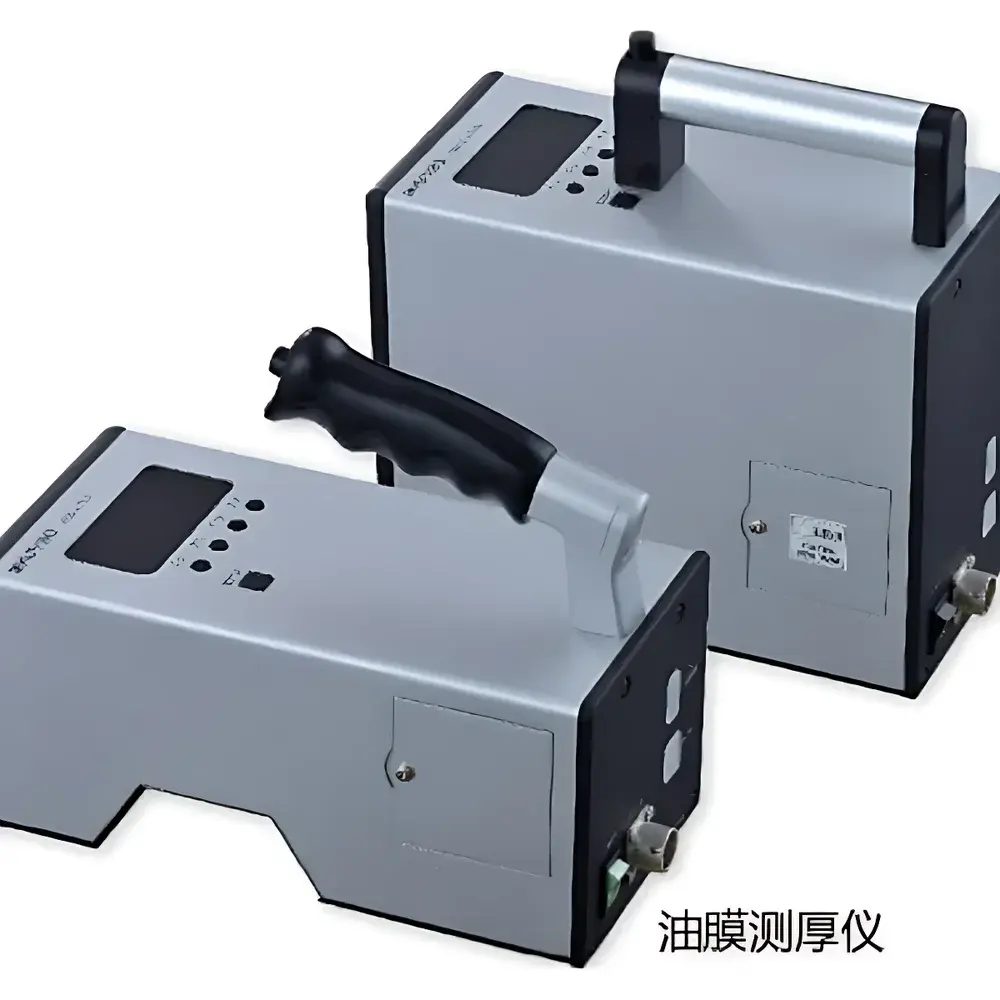
Kurabo NR-2100IB Infrared Oil Film Thickness Analyzer
| Brand | Kurabo |
|---|---|
| Origin | Japan |
| Manufacturer Type | Authorized Distributor |
| Origin Category | Imported |
| Model | NR-2100IB |
| Measurement Principle | Infrared Reflectance Absorption (Rotating Filter Method) |
| Measurement Range | 0.1–10 µm |
| Repeatability | <0.01 µm |
| Measured Area | 518 × 36 mm (elliptical spot) |
| Dimensions | 100(W) × 210(D) × 145(H) mm |
| Weight | ~1.5 kg |
| Polarization Method | P-polarized Incident Light |
| Integrated Thermal Printer | Yes |
Overview
The Kurabo NR-2100IB Infrared Oil Film Thickness Analyzer is a precision-engineered, non-contact metrology instrument designed for quantitative determination of organic coating mass and thickness on metallic substrates—primarily cold-rolled steel, galvanized steel, aluminum sheets, and pre-painted metal coils. It operates on the fundamental principle of infrared reflectance absorption spectroscopy: when P-polarized near-infrared radiation (NIR) is incident at a defined angle onto a conductive substrate coated with a hydrocarbon-based film (e.g., rust preventive oil, rolling lubricant, or organic passivation layer), characteristic vibrational absorption bands—particularly the C–H stretching mode near 3.4 µm—are selectively attenuated in the reflected beam. The magnitude of absorption correlates linearly with areal mass density (g/m²), which is then converted to equivalent film thickness (µm) using material-specific calibration curves derived from gravimetric reference standards. Unlike destructive gravimetric or solvent extraction methods, the NR-2100IB delivers real-time, in-line-capable measurements without sample preparation, solvent use, or surface contact—making it indispensable for process control in continuous annealing lines, temper mills, and coil coating facilities.
Key Features
- P-polarized incident optical configuration minimizes interference from specular reflection and subsurface scattering, ensuring high signal-to-noise ratio and measurement stability on glossy, textured, or slightly oxidized metal surfaces.
- Rotating interference filter system enables rapid, wavelength-selective detection at the optimal absorption band (typically 3.39–3.43 µm), eliminating need for broadband spectrometers or cryogenic detectors.
- Elliptical measurement footprint (518 × 36 mm) accommodates wide-strip production environments while maintaining uniform illumination intensity across the field—critical for detecting edge-to-edge coating uniformity deviations.
- Built-in thermal printer provides immediate hardcopy output of measurement values, timestamps, and operator IDs—supporting traceability requirements under ISO 9001 and IATF 16949 quality management systems.
- Compact form factor (100 × 210 × 145 mm; ~1.5 kg) and battery-compatible operation enable handheld use at multiple line locations—including entry/exit sections of cleaning units, oil applicators, and skin-pass mills—without fixed mounting infrastructure.
- Factory-calibrated for common industrial oils (e.g., mineral-based rust preventives, ester-based rolling oils, acrylic passivators); user-defined calibration routines support custom formulations via reference standards traceable to NIST SRM-certified coated foils.
Sample Compatibility & Compliance
The NR-2100IB is validated for use on electrically conductive, mirror-finish or matte-finish metallic substrates including cold-rolled carbon steel (CRCA), hot-dip galvanized (HDG), electrolytic tinplate (ETP), aluminum alloys (e.g., AA3003, AA5182), and prepainted metal (PCM) with polyester, PVDF, or epoxy-based primers. It does not require substrate homogeneity beyond typical mill tolerances and remains insensitive to minor surface roughness (Ra < 1.6 µm) or ambient lighting conditions. Instrument compliance includes adherence to IEC 61326-1 (EMC for industrial environments), JIS Z 8401 (numerical rounding for measurement reporting), and alignment with ASTM D7865–22 “Standard Practice for Determination of Oil Coating Mass on Steel Sheet Using Infrared Absorption.” Data integrity meets GLP audit requirements through timestamped internal logging and printer-generated records.
Software & Data Management
While the NR-2100IB operates as a standalone analyzer with embedded firmware, optional RS-232/USB interface enables integration into factory MES or SCADA platforms. Exported ASCII data files include measurement ID, date/time stamp, raw absorbance value, calibrated thickness (µm), and confidence index. All internal memory logs retain full audit trail per ISO/IEC 17025 clause 7.9. No proprietary software installation is required for basic operation; however, Kurabo-supplied PC utility (Windows-compatible) supports batch calibration curve generation, statistical process control (SPC) charting (X̄–R, Cpk), and export to CSV/Excel formats compliant with FDA 21 CFR Part 11 electronic record requirements when paired with user-defined electronic signatures.
Applications
- Quantitative verification of rust preventive oil application weight (g/m²) on automotive body panels prior to stamping—ensuring corrosion resistance without compromising weldability or paint adhesion.
- In-process monitoring of rolling oil carryover on tandem mill exit strips to optimize oil recovery systems and reduce emissions.
- Verification of organic passivation layer thickness on beverage can stock (DRD aluminum) to ensure lacquer compatibility and barrier performance.
- Backside coating mass control on color-coated steel used in architectural cladding—preventing interlamination sticking during slitting and packaging.
- QC release testing of electro-galvanized steel with chromate-free organic sealants, where traditional hexavalent chromium assays are prohibited under RoHS and REACH regulations.
FAQ
Does the NR-2100IB require daily recalibration?
No—factory calibration remains stable for ≥6 months under normal operating conditions. A quarterly verification using certified reference standards (e.g., Kurabo KRS-01 series) is recommended per ISO/IEC 17025 Clause 6.6.
Can it measure silicone-based or fluoropolymer coatings?
Not directly—the instrument’s 3.4 µm band targets C–H bonds. Silicone (Si–O–Si) and fluoropolymers (C–F) exhibit minimal absorption here; alternative NIR bands or FTIR correlation models would be required.
Is surface temperature compensation available?
Yes—built-in thermistor monitors substrate temperature (0–60°C range) and applies empirically derived correction coefficients to maintain ±0.02 µm accuracy across typical mill ambient variations.
What is the minimum detectable oil mass on steel?
0.05 g/m² (equivalent to ~0.07 µm for typical mineral oil density), limited by photon shot noise and detector dynamic range—not by electronics or software.
Does it comply with automotive OEM coating specifications (e.g., GMW14872, Ford WSS-M2P175-B)?
Yes—its measurement uncertainty (<0.01 µm repeatability) and traceability to NIST-traceable standards satisfy the Type B uncertainty requirements specified in those documents for Class II organic film verification.



