
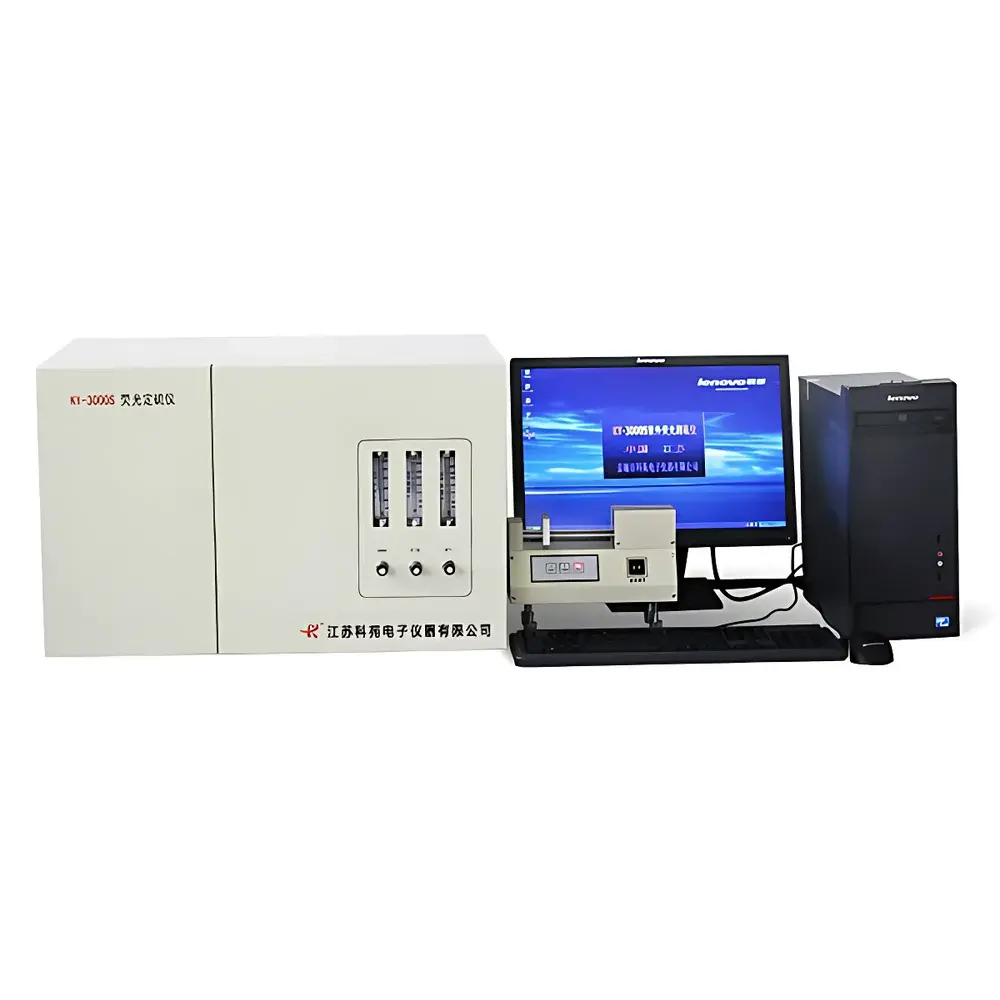
KY-3000S UV Fluorescence Sulfur Analyzer by Keyuan Instruments
| Brand | Keyuan Instruments |
|---|---|
| Origin | Jiangsu, China |
| Manufacturer Type | Direct Manufacturer |
| Country of Origin | China |
| Model | KY-3000S |
| Compliance Standards | GB/T 34100–2017, SH/T 0689, ASTM D5453 |
| Detection Method | UV Fluorescence (S) |
| Detection Range | 0.2 mg/L to 5000 ppm (up to % level) |
| LOD (S) | 0.2 mg/L |
| Repeatability | ±0.2 mg/L at ≤1.0 mg/L |
| Sample Types | Liquid, Solid, Gas (with optional injectors) |
| Furnace Temp Range | Ambient to 1300 °C |
| Temp Control Accuracy | ±1 °C |
| Gas Requirements | High-purity O₂ (≥99.98%), High-purity Ar (≥99.98%) |
| Power Rating | 2 kW |
| Data Acquisition | 24-bit ADC, USB Interface |
| PMT Voltage | Adjustable |
| Calibration Options | Single-point or multi-point calibration |
| Software Compatibility | Windows 7/10/11, macOS (via Wine-compatible runtime), Linux (CLI support) |
Overview
The KY-3000S UV Fluorescence Sulfur Analyzer is a high-performance elemental analyzer engineered for precise, trace-level total sulfur quantification in hydrocarbon-based matrices. It operates on the principle of ultraviolet fluorescence detection: samples are combusted in a high-temperature quartz furnace under controlled oxygen/argon atmosphere, converting all sulfur species into excited SO2 molecules. Upon relaxation, these emit characteristic UV photons (λ ≈ 320–390 nm), which are detected by a low-noise photomultiplier tube (PMT). Signal intensity is linearly proportional to sulfur concentration across five orders of magnitude — enabling accurate measurement from sub-ppm to percent-level concentrations. Designed to meet stringent regulatory requirements, the KY-3000S complies with GB/T 34100–2017, SH/T 0689, and ASTM D5453, making it suitable for quality control laboratories in refineries, petrochemical plants, fuel testing centers, and R&D institutions requiring GLP-aligned sulfur analysis.
Key Features
- High-sensitivity UV fluorescence detection system with adjustable PMT voltage and optimized optical path geometry for enhanced signal-to-noise ratio
- 24-bit analog-to-digital conversion with USB 2.0 interface, supporting real-time data streaming and high-fidelity signal capture (minimum detectable signal <1 µV)
- Programmable high-temperature combustion furnace (ambient to 1300 °C) with ±1 °C thermal stability, ensuring complete oxidation of refractory sulfur compounds
- Modular sample introduction architecture: compatible with liquid autosamplers (for fuels, oils), solid sample boats (for polymers, catalysts), and gas sampling valves (for LPG, natural gas)
- Robust gas delivery system with dual high-purity gas channels (O2 ≥99.98%, Ar ≥99.98%), integrated pressure regulators and mass flow controllers
- Flexible calibration protocol supporting single-point verification or multi-point linear/nonlinear curve fitting, traceable to NIST-certified SRMs
- Self-diagnostic firmware with real-time status monitoring of furnace temperature, gas flow, PMT gain, and detector baseline stability
Sample Compatibility & Compliance
The KY-3000S accommodates a broad spectrum of sample types without matrix-specific hardware modification. Liquid samples include gasoline, diesel, jet fuel, crude oil, and biodiesel blends; solids encompass polymeric materials, rubber compounds, lubricant additives, and catalyst supports; gaseous matrices include liquefied petroleum gas (LPG), refinery off-gas, and syngas streams. All analyses adhere to internationally recognized test methods: ASTM D5453 for light hydrocarbons and engine fuels, SH/T 0689 for petroleum products, and GB/T 34100–2017 for domestic Chinese regulatory reporting. The instrument’s design supports audit-ready operation — full electronic records, user-access logs, calibration history, and raw signal archives are retained per FDA 21 CFR Part 11 guidelines when configured with compliant software modules.
Software & Data Management
Bundled analytical software provides comprehensive instrument control, method development, and quantitative reporting. It runs natively on Windows 7/10/11 and supports cross-platform deployment via standardized APIs. Key capabilities include automated sequence execution, dynamic range switching, peak integration with baseline correction algorithms, and customizable report templates (PDF, CSV, Excel). All raw chromatographic-like fluorescence traces are stored with metadata (operator ID, timestamp, method name, calibration ID), enabling retrospective reprocessing and statistical trending (e.g., control charts, ANOVA). Data integrity safeguards include write-protected archives, electronic signatures, and configurable audit trails — essential for ISO/IEC 17025-accredited laboratories and GMP-regulated environments.
Applications
- Refinery QC: Monitoring sulfur content in finished gasoline and diesel to comply with Euro 5/6, Tier 3, and China VI specifications
- Petrochemical R&D: Quantifying sulfur in feedstocks, intermediates, and catalyst poisons during process optimization
- Aviation fuel certification: Verifying ultra-low sulfur levels (<10 mg/kg) per ASTM D1655 Annex A1
- Plastics & elastomers: Measuring residual sulfur from vulcanization agents or stabilizers affecting thermal stability
- Environmental compliance: Analyzing sulfur emissions precursors in synthetic fuels and alternative energy carriers
- Contract testing labs: Delivering accredited results for third-party certification under CNAS or ILAC-MRA frameworks
FAQ
What sample preparation is required prior to analysis?
Minimal preparation is needed for liquids (filtration only); solids require homogenization and precise weighing into quartz boats; gases require pressure regulation and flow calibration.
Can the KY-3000S measure nitrogen simultaneously?
No — the KY-3000S is dedicated to sulfur analysis via UV fluorescence. For combined S/N determination, a separate chemiluminescence module or dual-detector configuration is required.
Is routine maintenance complex or vendor-dependent?
Routine tasks — including quartz reactor cleaning, PMT window inspection, and gas filter replacement — are operator-performed using documented procedures; no proprietary tools or service contracts are mandatory.
How does the instrument handle high-sulfur samples that may cause memory effects?
The combustion chamber features active purge cycles between injections, and software includes memory-effect correction algorithms based on post-run baseline decay kinetics.
Does the system support remote diagnostics or networked deployment?
Yes — optional Ethernet connectivity enables centralized instrument monitoring, firmware updates, and secure remote troubleshooting via TLS-encrypted protocols.



