
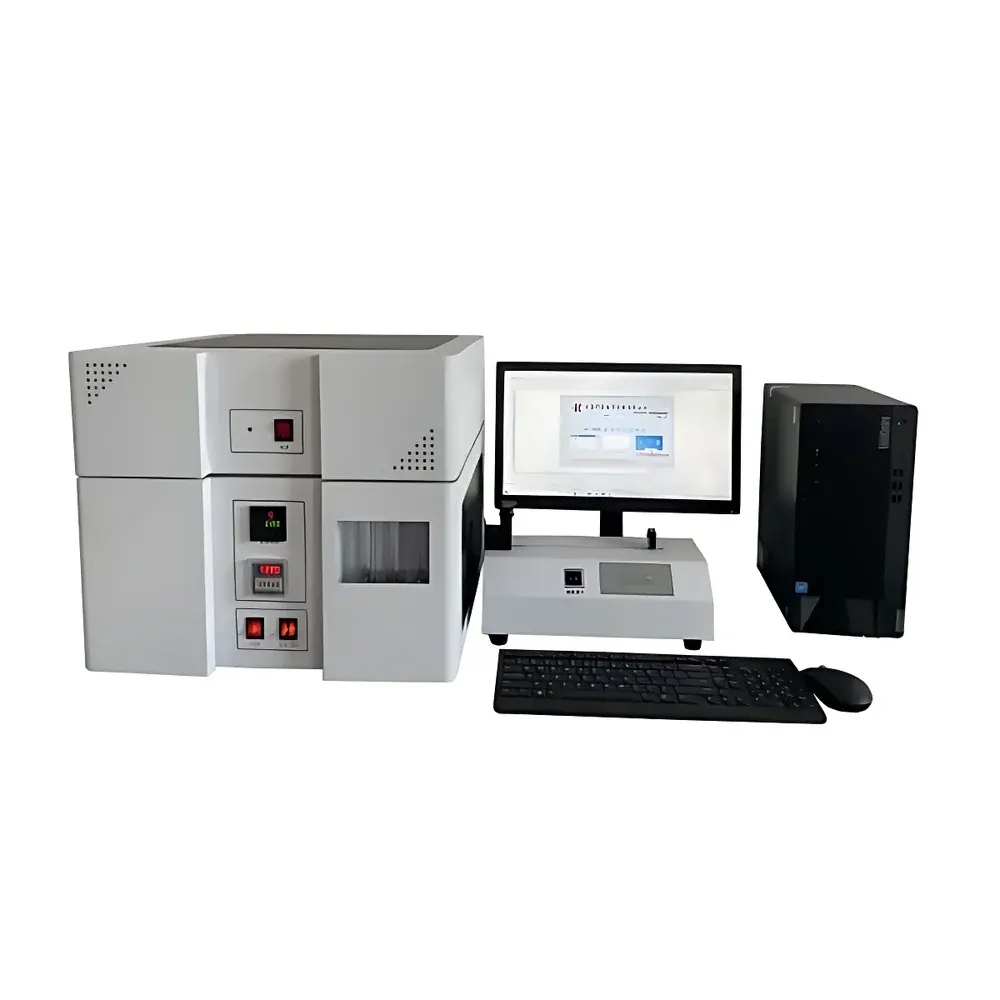
KY-3000S UV Fluorescence Sulfur Analyzer by Keyuan Instruments
| Brand | Keyuan Instruments |
|---|---|
| Origin | Jiangsu, China |
| Manufacturer Type | Direct Manufacturer |
| Country of Origin | China |
| Model | KY-3000S |
| Detection Principle | UV Fluorescence (for Total Sulfur) |
| Applicable Standards | SH/T 0689, ASTM D5453 |
| Sample Forms | Liquid, Solid, Gas (with optional injectors) |
| Detection Range | 0.2 mg/L to 5000 ppm (as S) |
| LOD | 0.2 mg/L (S) |
| Oxygen Purity | ≥99.98% |
| Argon Purity | ≥99.98% |
| Furnace Temperature Range | Ambient to 1100 °C |
| Temperature Control Accuracy | ±3 °C |
| Power Consumption | 2 kW |
| Dimensions (W×D×H) | 680 × 480 × 400 mm |
| Data Acquisition | 24-bit ADC, USB Interface |
| PMT High Voltage | Adjustable |
| Calibration Options | Single-point or multi-point curve calibration |
| Software Compatibility | Windows 7/10/11, macOS (via virtualization), Linux (CLI support) |
Overview
The KY-3000S UV Fluorescence Sulfur Analyzer is a dedicated elemental analyzer engineered for precise, trace-level quantification of total sulfur in hydrocarbon-based matrices. It operates on the well-established ultraviolet fluorescence detection principle: samples are combusted in a high-temperature quartz furnace under controlled oxygen/argon atmosphere, converting all sulfur species to SO₂; the resulting SO₂ is excited by pulsed UV light and emits characteristic fluorescence at ~350 nm, which is measured by a photomultiplier tube (PMT). This method delivers high specificity for sulfur without interference from nitrogen, halogens, or hydrocarbon background—making it ideal for regulatory compliance testing in refining, petrochemical, and fuel certification laboratories. The instrument meets the technical requirements of SH/T 0689 (Chinese national standard) and ASTM D5453 (Standard Test Method for Determination of Total Sulfur in Light Hydrocarbons, Motor Fuels and Oils by Ultraviolet Fluorescence), and is routinely deployed in environments requiring adherence to ISO/IEC 17025, EPA Method 1664B (sulfur variant), and refinery internal QA/QC protocols.
Key Features
- High-fidelity 24-bit analog-to-digital conversion with USB 2.0 interface ensures stable signal transmission and minimal noise floor—capable of resolving fluorescence signals below 1 µV.
- Adjustable high-voltage supply for the photomultiplier tube enables dynamic optimization across wide concentration ranges, enhancing linearity and extending dynamic range.
- Modular thermal design supports programmable temperature ramping from ambient to 1100 °C with ±3 °C stability, ensuring complete oxidative decomposition of refractory sulfur compounds (e.g., dibenzothiophenes, sulfoxides).
- Full hardware integration of critical components—including imported quartz combustion tubes, high-purity gas manifolds, and low-dead-volume optical path—minimizes carryover and improves measurement reproducibility (RSD < 1.5% at 10 ppm S).
- Flexible calibration architecture supports both single-point verification and multi-point linear/nonlinear curve fitting, compatible with certified reference materials traceable to NIST SRM 2724b or equivalent.
Sample Compatibility & Compliance
The KY-3000S accommodates liquid fuels (gasoline, diesel, jet fuel, biodiesel), crude oils, distillates, liquefied petroleum gas (LPG), and solid samples including polymers and catalysts—when paired with optional solid or gas injection modules. All configurations maintain full compliance with ASTM D5453 Annex A1 (liquid injection), Annex A2 (gas injection), and Annex A3 (solid sampling). The system’s gas delivery subsystem employs dual high-purity mass flow controllers (O₂ and Ar), each calibrated against NIST-traceable standards. Instrument validation documentation includes IQ/OQ protocols aligned with GLP and refinery-specific 21 CFR Part 11 readiness (audit trail, electronic signature, data integrity controls via optional software module).
Software & Data Management
The embedded acquisition and analysis software runs natively on Windows OS (7 through 11) and supports cross-platform deployment via containerized virtualization for macOS and Linux environments. Core functions include real-time fluorescence intensity monitoring, automatic peak integration, baseline correction algorithms, and ISO 17025-compliant report generation (PDF/CSV/XLSX). Raw data files (.kyd) are stored in open binary format with embedded metadata (operator ID, timestamp, method version, calibration history), enabling long-term archival and third-party reprocessing. Audit logs record all user actions—including method edits, calibration updates, and result overrides—with time-stamped digital signatures.
Applications
- Refinery process control: Monitoring sulfur content in hydrotreater feed and product streams per API RP 936.
- Fuel certification: Verification of ultra-low-sulfur diesel (ULSD, ≤15 ppm S) and gasoline (≤10 ppm S) per EN 228, ASTM D4814, and China VI standards.
- Research & development: Quantitative sulfur speciation support (when coupled with GC front-end), catalyst deactivation studies, and oxidation kinetics modeling.
- Environmental compliance: Analysis of sulfur in marine fuels (IMO 2020), biofuel blends, and waste-derived oils per MARPOL Annex VI and EU RED II.
- Quality assurance: Incoming inspection of crude slates, additive packages, and lubricant base stocks per ASTM D2622 (XRF cross-validation).
FAQ
What sample types can be analyzed without modification?
Liquid hydrocarbons (e.g., gasoline, kerosene, diesel) using the standard liquid autosampler.
Is ASTM D5453 compliance verified during factory acceptance testing?
Yes—each unit undergoes full method validation using NIST SRM 2724b (dibutyl sulfide in toluene) and Chevron-certified reference fuels prior to shipment.
Can the instrument be integrated into a LIMS environment?
Yes—via configurable ASCII output mode or OPC UA server interface (optional add-on module) supporting ASTM E1384 and ISO/IEC 17025 data exchange requirements.
What maintenance intervals are recommended for routine operation?
Quartz combustion tube replacement every 500–800 analyses; PMT voltage recalibration quarterly; gas filter replacement every 6 months under continuous use.
Does the system support remote diagnostics and firmware updates?
Yes—secure SSH-enabled remote access is available with customer-configurable firewall rules and TLS 1.2 encrypted update channels.




