
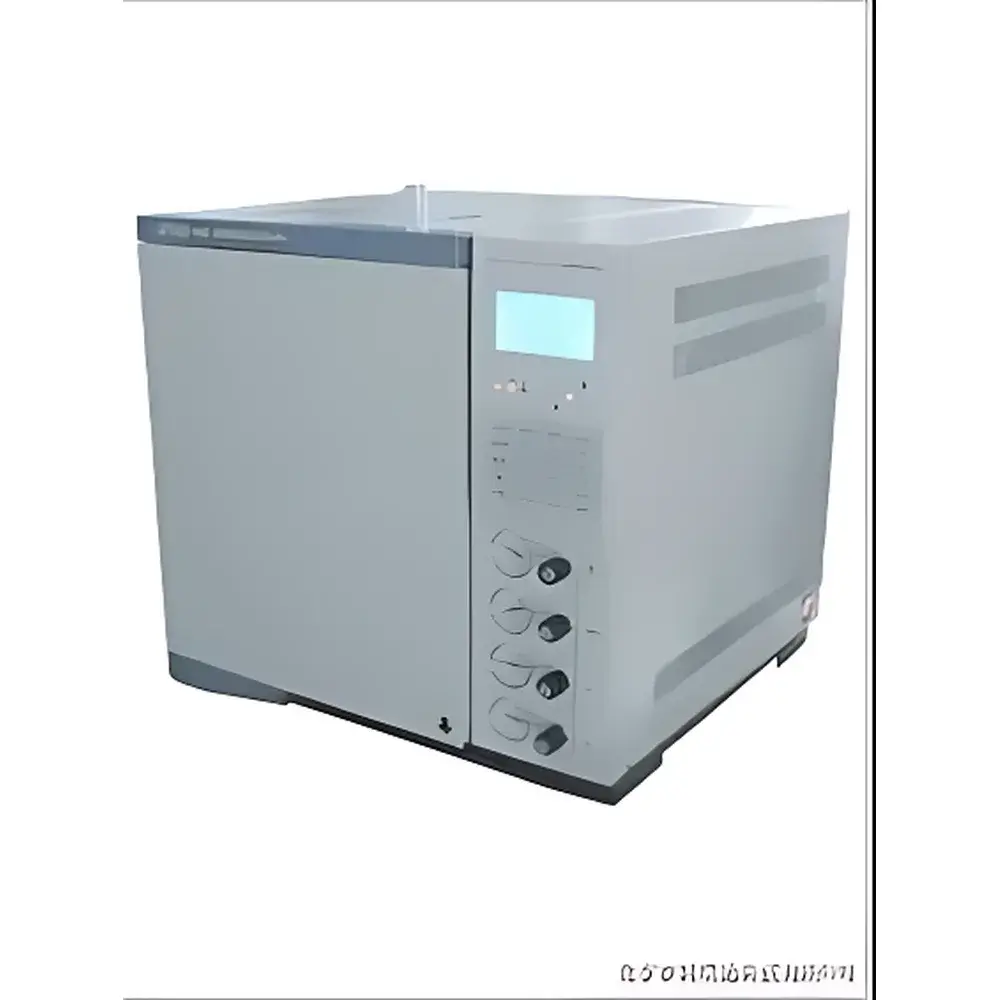
Kyocera SP690 Laboratory Gas Chromatograph
| Brand | Kyocera |
|---|---|
| Origin | Beijing, China |
| Manufacturer Type | Authorized Distributor |
| Country of Origin | China |
| Model | SP690 |
| Price | USD 2,100 (FOB Beijing) |
| Standard Compliance | JB/T 6244–1992, JJG 700–1990 |
| Temperature Control Zones | Column Oven, TCD Detector, FID Detector, Methanizer |
| Temperature Range | 7 °C above ambient to 399 °C |
| Temperature Stability | ±0.1 °C at 200 °C |
| Detection Modes | TCD, FID (with optional methanizer) |
| Sample Introduction | Split/splitless injector, compatible with headspace, purge-and-trap, vacuum degassing, and shaking degassing systems |
| Analytical Capability | Simultaneous quantification of C₁–C₂ hydrocarbon gases (H₂, O₂, N₂, CH₄, CO, CO₂, C₂H₄, C₂H₆, C₂H₂) in transformer oil per IEC 60599 and ASTM D3612 |
| Data Acquisition | Dual-channel auto-switching, baseline correction, peak integration, retention time locking |
Overview
The Kyocera SP690 is a benchtop laboratory gas chromatograph engineered for routine and regulatory-compliant analysis of dissolved gases in electrical insulating oils—particularly transformer oil—as specified in IEC 60599, ASTM D3612, and GB/T 17623. It operates on the fundamental principle of gas-liquid partition chromatography, where volatile analytes are separated based on differential partitioning between a mobile gas phase (carrier gas: He, H₂, or N₂) and a stationary liquid phase coated inside a fused-silica capillary or packed column. The instrument integrates a thermally stabilized column oven, dual independent detector control modules (TCD and FID), and a dedicated methanizer for enhanced C₁–C₂ hydrocarbon detection. Its architecture prioritizes thermal homogeneity, flow precision, and signal integrity—critical for achieving reproducible retention times (<0.02 min RSD) and quantitative accuracy (<2% RSD for 10 ppm level standards) across extended operational cycles.
Key Features
- Thermally optimized column oven with forced-air convection and dual-zone insulation, delivering ±0.1 °C stability at 200 °C—validated per JJG 700–1990 calibration protocol
- Dual independent temperature-controlled detector compartments: one for TCD (with constant-current bridge circuitry) and one for FID (with high-gain, low-noise microcurrent amplifier; baseline noise <0.05 pA)
- Integrated methanizer module (Ni catalyst, 360 °C) enabling full conversion of CO and CO₂ to CH₄ prior to FID detection—eliminating need for separate GC-FID/GC-TCD parallel runs
- Microprocessor-based pneumatic control system with digital mass flow sensors for carrier, make-up, and hydrogen/air gases—ensuring consistent linear velocity and retention time reproducibility
- Modular inlet design supporting split, splitless, and on-column injection; fully compatible with external sample introduction systems including DP-100 degassers, vacuum extraction units, and purge-and-trap concentrators
- Front-panel keypad + LCD interface with real-time parameter monitoring; optional RS-232/USB connectivity for remote operation and data export
Sample Compatibility & Compliance
The SP690 is validated for direct analysis of gas extracts from mineral oil, synthetic ester, and silicone-based insulating fluids following standardized degassing protocols (IEC 60567, ASTM D3612 Method A/B). It accommodates headspace vials (22 mL crimp-top), gas-tight syringes (10 µL–1 mL), and pressurized loop injectors (0.25–2.0 mL). All hardware materials comply with ISO 8573-1 Class 2 purity requirements for carrier gas lines. The system meets Chinese national metrological verification regulations (JJG 700–1990) and mechanical design standards (JB/T 6244–1992). While not pre-certified for FDA 21 CFR Part 11, its data acquisition architecture supports audit-trail-ready configurations when deployed with compliant third-party LIMS or ELN platforms under GLP/GMP environments.
Software & Data Management
The SP690 operates with Kyocera’s GC-Link™ workstation software (v3.2+), a Windows-based application supporting dual-channel acquisition, automatic peak detection, retention time alignment, and multi-point calibration curve generation (linear, quadratic, or weighted least-squares). Raw data (.raw) and processed reports (.pdf/.xlsx) are timestamped and user-ID tagged. The software enables method cloning, sequence queuing, and QC flagging (e.g., retention time drift >0.03 min, peak area RSD >3%). Export formats include ASTM E1319-compliant .cdf files and CSV-compatible quantitation tables. For regulated labs, optional 21 CFR Part 11 add-on modules provide electronic signatures, role-based access control, and immutable audit logs—fully traceable to instrument boot cycle and firmware revision.
Applications
- Dissolved gas analysis (DGA) of power transformer oil for predictive maintenance and fault diagnosis (partial discharge, thermal faults, arcing)
- Environmental monitoring of VOCs in soil vapor, landfill gas, and ambient air using EPA Method TO-17 (with appropriate column and trap configuration)
- Quality control of industrial solvents (e.g., hexane, toluene, xylene isomers) per ASTM D5508
- Residual solvent testing in pharmaceutical excipients (ICH Q3C guidelines) when coupled with headspace autosampler
- Calibration gas verification and cylinder certification support in metrology laboratories
FAQ
What carrier gases are supported, and what are the recommended flow rates for optimal resolution?
Helium (1.0–2.5 mL/min), hydrogen (1.5–3.0 mL/min), and nitrogen (2.0–4.0 mL/min) are supported. Optimal linear velocity for standard 30 m × 0.32 mm ID columns is 25–35 cm/sec—automatically calculated by GC-Link™ during method setup.
Can the SP690 be upgraded to support an autosampler or electronic pressure control (EPC)?
Yes—model-specific retrofit kits are available: AS-690 for 16-position liquid autosampler integration, and EPC-690 for digital pressure regulation across all gas lines (accuracy ±0.01 psi, repeatability ±0.005 psi).
Is firmware update capability built-in, and how is version control managed?
Firmware updates are delivered via USB drive with SHA-256 checksum verification. Each update includes full changelog, backward-compatible method file handling, and automatic backup of current configuration prior to installation.
Does the system meet electromagnetic compatibility (EMC) requirements for laboratory environments?
Yes—the SP690 conforms to GB/T 18268.1–2010 (equivalent to IEC 61326-1:2012) for immunity and emissions in professional laboratory settings, including electrostatic discharge (±8 kV contact), radiated RF fields (10 V/m), and fast transient bursts (±2 kV).







