
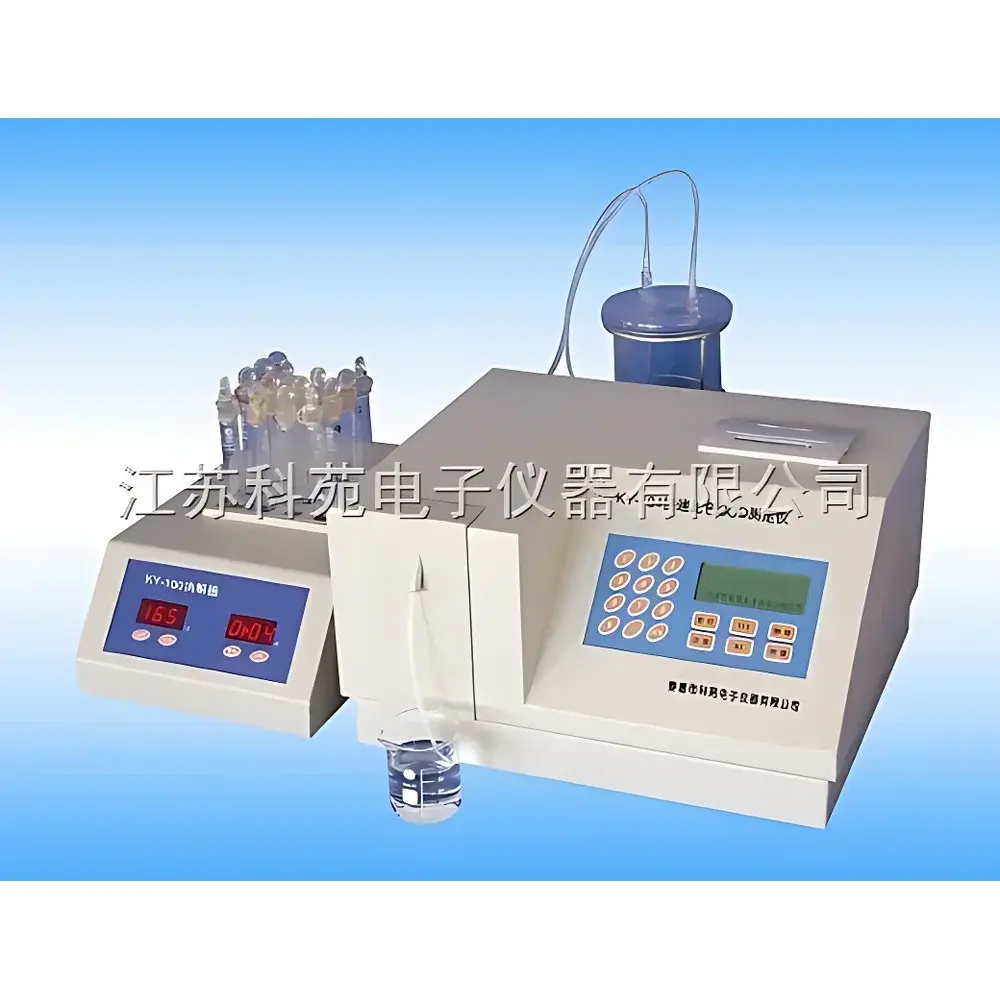
Kyoyuan KY-104 Rapid Colorimetric COD Analyzer
| Brand | Kyoyuan |
|---|---|
| Origin | Jiangsu, China |
| Manufacturer Type | OEM Manufacturer |
| Country of Origin | China |
| Model | KY-104 |
| Price | USD 2,100 (FOB) |
| Measurement Range | 5–1000 mg/L COD (dilution required above 1000 mg/L) |
| Accuracy | ±5 mg/L (5–100 mg/L), ±5% RSD (100–1000 mg/L) |
| Chloride Interference Tolerance | <1000 mg/L Cl⁻ |
| Digestion Time | 10–120 min |
| Compliant Standards | APHA Standard Method 5220D, US EPA Method 410.4 |
| Light Source | Monochromatic Cold LED |
| Detection Principle | Fixed-Wavelength Colorimetry (610 nm typical) |
| Data Processing | Embedded MCU with Linear Regression Algorithm |
| Sample Introduction | Pneumatic Pressure-Driven Auto-Sampling |
| Temperature Control | PID-Regulated Heating Block (±0.5 °C) |
| Output | Thermal Printer Integration, USB Data Export |
Overview
The Kyoyuan KY-104 Rapid Colorimetric COD Analyzer is a benchtop laboratory instrument engineered for precise, high-throughput determination of chemical oxygen demand (COD) in aqueous samples using the standardized catalytic digestion–colorimetric method. It operates on the principle of spectrophotometric quantification following acidic dichromate oxidation under reflux conditions—aligned with APHA Standard Method 5220D and US EPA Method 410.4. The analyzer employs a stable monochromatic cold LED light source (center wavelength 610 nm) to measure absorbance changes in the Cr³⁺-containing digestate, enabling direct correlation between color intensity and oxidizable organic content. Unlike open-reflux titrimetric systems, the KY-104 integrates fully automated thermal control, pneumatic sample handling, and embedded microcontroller-based data processing—eliminating manual timing, visual endpoint judgment, and operator-induced variability. Its design prioritizes repeatability (RSD <3.2% at 200 mg/L COD, n=6), robustness in routine QC/QA workflows, and compatibility with GLP-compliant environmental testing laboratories.
Key Features
- PID-regulated heating block with ±0.5 °C temperature stability across 10–120 min programmable digestion cycles
- Pneumatically actuated sample introduction system—prevents acid vapor corrosion of internal components and ensures consistent 2.5 mL sample/reagent delivery
- Auto-zero calibration and real-time baseline correction prior to each measurement cycle
- Onboard linear regression engine that computes concentration from pre-stored or user-defined calibration curves (up to 10 curves)
- Integrated thermal printer with timestamped report generation including sample ID, digestion time, measured absorbance, and calculated COD value
- USB interface supporting CSV export of raw absorbance data, calibration parameters, and audit logs for traceability
Sample Compatibility & Compliance
The KY-104 accommodates standard 16 mm × 100 mm borosilicate glass digestion tubes and accepts liquid samples with total suspended solids ≤50 mg/L (pre-filtration recommended). It demonstrates validated performance for municipal wastewater, industrial effluents (textile, food processing, pharmaceutical), surface water, and treated leachate—provided chloride concentrations remain below 1000 mg/L. For higher-chloride matrices, users may apply mercury sulfate masking per EPA 410.4 protocol. The instrument’s hardware architecture, firmware logic, and data output structure support alignment with ISO/IEC 17025:2017 requirements for test method validation. While not FDA 21 CFR Part 11-certified out-of-the-box, its audit trail functionality (time-stamped calibration events, curve edits, and measurement records) provides foundational infrastructure for GxP environments undergoing internal validation.
Software & Data Management
No external PC software is required for basic operation; all calibration, measurement, and reporting functions execute within the device’s embedded MCU firmware. Calibration curves are stored non-volatile memory with version tagging and date stamping. Each measurement record includes: sample identifier (alphanumeric, up to 12 chars), digestion duration, measured absorbance (4-digit resolution), computed COD value (mg/L, 1-decimal), and pass/fail flag against user-defined QC limits. USB data dumps retain full metadata—including operator ID (if entered), ambient temperature, and block temperature history over the digestion cycle. For LIMS integration, the exported CSV file conforms to ASTM D5116-21 Annex A1 schema conventions for environmental instrument data exchange.
Applications
- Routine compliance monitoring of discharge permits (NPDES, EU Urban Wastewater Directive)
- Process control in activated sludge, MBR, and anaerobic digester operations
- Validation of advanced oxidation process (AOP) efficiency in pilot-scale studies
- Method comparison studies between closed-reflux colorimetry and open-reflux titration
- Educational laboratory instruction in environmental chemistry and water quality analysis
FAQ
Does the KY-104 require daily recalibration?
No—calibration stability is verified weekly using NIST-traceable potassium hydrogen phthalate (KHP) standards; drift exceeding ±2% absorbance units triggers automatic alert.
Can the instrument store custom digestion protocols?
Yes—up to eight user-defined temperature/time profiles (e.g., 150 °C/120 min for high-COD sludge, 120 °C/30 min for clean surface water) can be saved and recalled by name.
Is the pneumatic sampling system compatible with viscous or particulate-laden samples?
It is designed for clarified or filtered liquids; undissolved solids >50 µm or viscosity >15 cP may cause incomplete aspiration and require centrifugation or membrane filtration prior to analysis.
How is measurement uncertainty reported in exported data files?
Each CSV row includes expanded uncertainty (k=2) derived from combined Type A (repeatability) and Type B (calibration curve RMSE, pipetting tolerance) components per GUM (JCGM 100:2008) methodology.
What maintenance intervals are recommended for long-term reliability?
Quarterly optical path cleaning (LED lens and photodiode window), biannual verification of heating block uniformity (using calibrated PT100 probe array), and annual firmware update via USB.




