
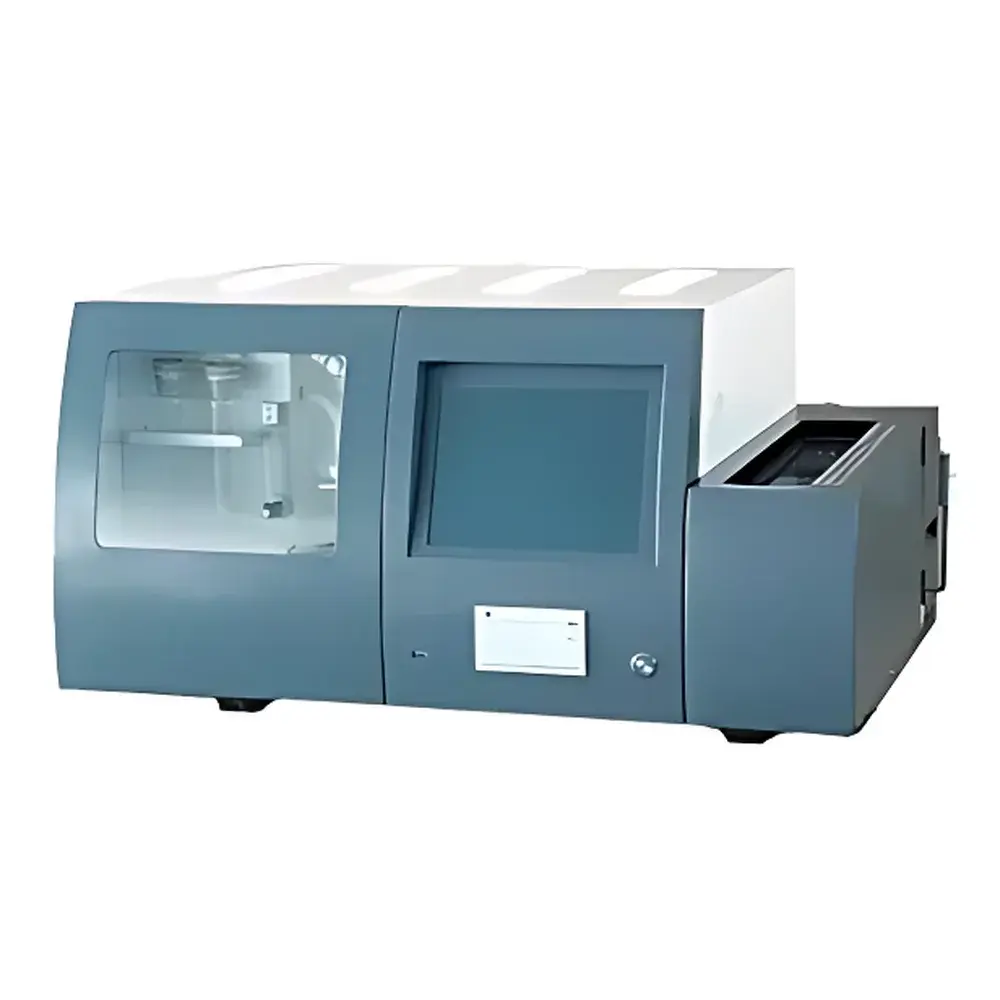
Kyoyuan KY-214A Microcomputer-Controlled Coulometric Sulfur Analyzer (24-Position)
| Brand | Kyoyuan |
|---|---|
| Origin | Jiangsu, China |
| Manufacturer Type | Direct Manufacturer |
| Origin Category | Domestic (China) |
| Model | KY-214A |
| Price | Upon Request |
| Sulfur Range | 0.01–60 wt% |
| Resolution | 0.01 wt% |
| Max Sample Capacity | 24 positions |
| Avg. Analysis Time | ~5 min per sample |
| Furnace Ramp Time | 15–25 min (from ambient to setpoint) |
| Temperature Range | 700–1300 °C (user-selectable) |
| Temp. Control Accuracy | ±2.5 °C |
| Sample Mass Range | 10–999.9 mg |
| Automatic Powder Dispensing | 300 cycles per reagent box |
| Power Supply | 220 V ±20 V, 50 Hz |
| Max Instantaneous Power (Furnace) | ≤3.5 kW |
| Repeatability (St ≤1.5%) | <0.05 wt% |
| Reproducibility (St ≤1.5%) | <0.10 wt% |
| Compliance | Fully conforms to GB/T 214–2007 for total sulfur determination in coal by coulometric titration |
Overview
The Kyoyuan KY-214A Microcomputer-Controlled Coulometric Sulfur Analyzer is an automated elemental analyzer engineered for precise, high-throughput quantification of total sulfur content in solid combustible materials—primarily coal, coke, petroleum coke, biomass, and industrial feedstocks. It operates on the principle of coulometric titration as specified in GB/T 214–2007, wherein samples are combusted at controlled high temperatures (700–1300 °C) in a purified oxygen stream, converting all sulfur species to SO2. The evolved SO2 is carried into an electrolytic cell containing an iodide–triiodide redox system; real-time coulometric current integration measures the exact charge required to regenerate iodine consumed during SO2 oxidation, enabling direct mass-based sulfur calculation with trace-level sensitivity and metrological traceability.
Key Features
- 24-position fully automated sample carousel: Enables unattended batch analysis; supports continuous loading and replacement during operation without interrupting ongoing assays.
- Intelligent endpoint detection: Real-time electrochemical signal monitoring eliminates fixed-time assumptions—each analysis terminates precisely at stoichiometric completion, optimizing throughput and reproducibility.
- Dual-Hall sensor positioning system: Ensures repeatable, wear-resistant sample transport across variable crucible geometries and sulfur concentration ranges (low-S and high-S matrices).
- Dedicated hardware integrator circuit: A standalone microcontroller performs analog current integration during electrolysis—bypassing software latency and preventing data loss under transient signal conditions.
- Optimized moisture management: Proprietary furnace gas-flow geometry minimizes water vapor entrainment into the drying tube; combined with a high-capacity desiccant column, this extends reagent service life and reduces maintenance frequency.
- Horizontal tubular furnace architecture: Promotes uniform thermal gradient development and stable isothermal zone formation across the combustion zone—critical for complete pyrolysis and quantitative SO2 release.
- Self-adapting silicon carbide tube control: Dynamically compensates for resistance drift over extended service life, maintaining consistent heating performance without manual recalibration.
- Triple-layer safety architecture: Includes hardware interlocks, thermal runaway monitoring, and full enclosure of the 1300 °C furnace chamber—ensuring operator safety and GLP-compliant laboratory operation.
Sample Compatibility & Compliance
The KY-214A is validated for use with heterogeneous solid matrices including bituminous and anthracite coals, lignite, char, fly ash, limestone-based sorbents, and select mineralogical standards. Its design meets the mechanical, thermal, and electrochemical requirements of GB/T 214–2007, with demonstrated repeatability and reproducibility within the standard’s tolerance limits across the full 0.01–60 wt% sulfur range. While primarily aligned with Chinese national standards, its coulometric methodology is fundamentally compatible with ASTM D3177, ISO 4293, and ISO 8787 methodologies for sulfur determination—enabling cross-laboratory data correlation where instrument calibration and reference material traceability are maintained. The system supports audit-ready operation under GLP and internal QA/QC frameworks, with full parameter logging and user-accessible raw signal archives.
Software & Data Management
Control and data acquisition are managed via Kyoyuan’s proprietary Windows-based application featuring bilingual (Chinese/English) UI, role-based access control, and timestamped event logging. All analytical parameters—including furnace setpoint, sample mass, electrolyte status, gas flow rate, and real-time current/voltage traces—are recorded automatically per run. The software generates compliant reports with embedded metadata (operator ID, calibration certificate numbers, reference material IDs), supports CSV export for LIMS integration, and maintains full audit trails for method changes or system interventions. Optional 21 CFR Part 11 compliance packages include electronic signatures, password-protected configuration locks, and immutable raw-data archiving—suitable for regulated environments requiring FDA or ISO/IEC 17025 documentation rigor.
Applications
- Quality control and specification verification in coal procurement, blending, and power generation facilities
- Sulfur compliance testing for cement kiln feedstocks and flue gas desulfurization (FGD) byproducts
- R&D support in clean coal technology, low-sulfur fuel development, and emission modeling
- Environmental monitoring of industrial slag, boiler ash, and waste-derived fuels
- Academic and governmental laboratories conducting standardized fuel characterization per national regulatory protocols
FAQ
What standards does the KY-214A comply with?
It is fully compliant with GB/T 214–2007 for total sulfur in coal. Its coulometric methodology is technically aligned with ASTM D3177, ISO 4293, and ISO 8787 for comparative applications.
Can the instrument analyze samples other than coal?
Yes—provided the matrix is thermally stable below 1300 °C and yields quantitative SO2 evolution under oxidative combustion (e.g., coke, char, certain ores, and certified reference materials). Method validation is recommended for non-coal matrices.
Is remote monitoring or network connectivity supported?
The base configuration includes USB and RS-232 interfaces. Ethernet-enabled versions with TCP/IP protocol support and OPC UA compatibility are available upon request for factory automation integration.
How often must the drying agent be replaced?
Under typical coal analysis conditions (24 samples/day), the large-capacity desiccant column requires replacement every 7–10 days—significantly extending intervals compared to conventional designs due to optimized gas-path hydrophobicity.
Does the system require routine calibration with certified standards?
Yes. Daily verification using NIST-traceable sulfur standards (e.g., SRM 1632e, 1633c) is recommended to maintain measurement integrity and satisfy ISO/IEC 17025 accreditation requirements.




