
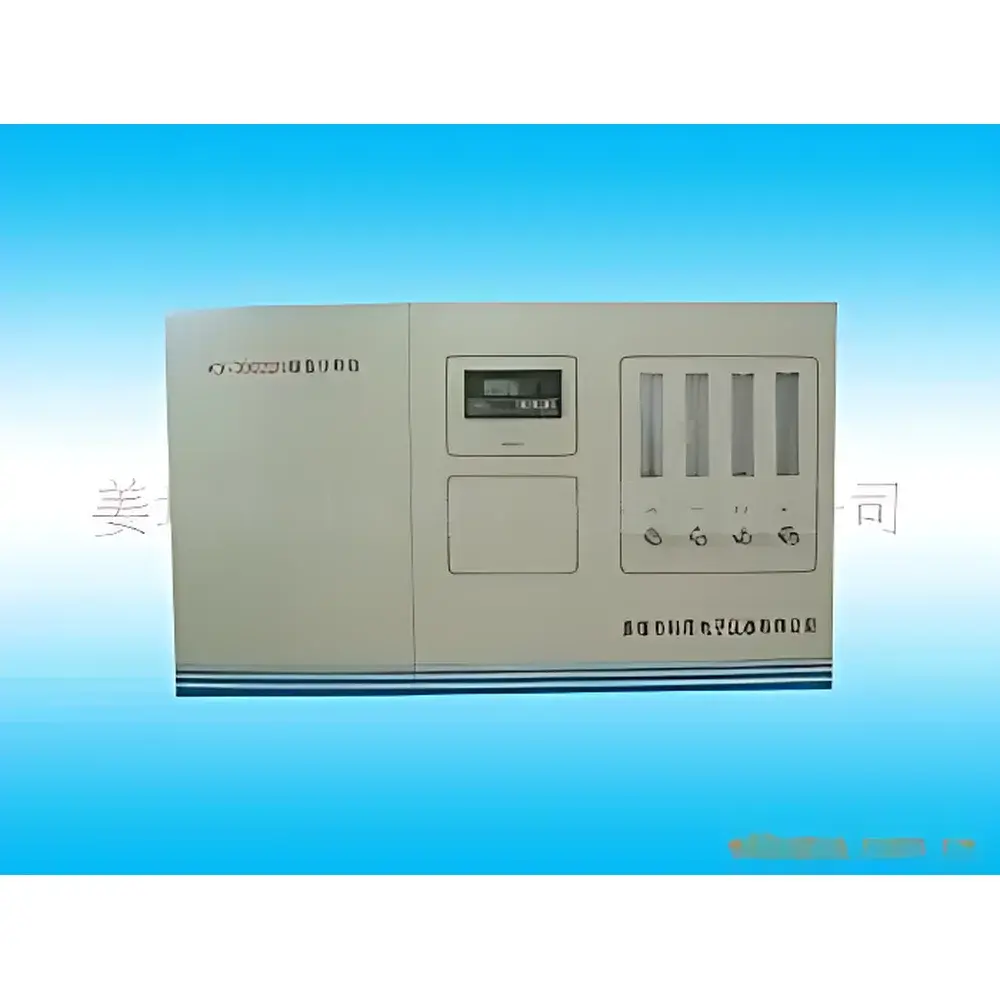
Kyoyuan KY-3000SN Sulfur and Nitrogen Analyzer
| Brand | Kyoyuan |
|---|---|
| Origin | Jiangsu, China |
| Manufacturer Type | Direct Manufacturer |
| Model | KY-3000SN |
| Detection Method (S) | UV Fluorescence |
| Detection Method (N) | Chemiluminescence |
| Sample Types | Liquid, Solid, Gas (with optional injectors) |
| Sulfur Range | 0.2 mg/L to 100% w/w |
| Nitrogen Range | 0.1 mg/L to 100% w/w |
| LOD (S) | 0.2 mg/L |
| LOD (N) | 0.1 mg/L |
| Oxygen Purity | ≥99.98% |
| Argon Purity | ≥99.98% |
| Furnace Temp Range | Ambient to 1100 °C |
| Temp Control Accuracy | ±3 °C |
| Power Supply | AC 220 V ±10%, 50 Hz ±0.5 Hz |
| Power Consumption | 2 kW |
| Dimensions (W×D×H) | 680 × 480 × 400 mm |
| Compliance Standards | SH/T 0689, ASTM D5453 (S) |
Overview
The Kyoyuan KY-3000SN Sulfur and Nitrogen Analyzer is a dual-detection elemental analyzer engineered for precise quantification of total sulfur and total nitrogen in hydrocarbon-based matrices. It operates on two complementary, standardized physicochemical principles: ultraviolet fluorescence (UVF) for sulfur detection and chemiluminescence (CLD) for nitrogen determination. In the UVF mode, sample-derived SO2 is excited by UV radiation at 190–230 nm; emitted fluorescence at ~340 nm is measured proportionally to sulfur concentration. In CLD mode, nitrogen oxides (NOx) generated from high-temperature oxidative pyrolysis react with ozone to produce excited NO2*, which emits near-infrared photons (~600–3000 nm) upon relaxation—intensity correlates linearly with nitrogen content. This orthogonal detection architecture ensures independence between S and N measurements, eliminating cross-talk and supporting simultaneous or sequential analysis without reconfiguration.
Key Features
- Modular high-temperature combustion furnace (ambient to 1100 °C) with PID-controlled heating zones and ±3 °C thermal stability—optimized for complete oxidation of refractory organosulfur/nitrogen compounds in heavy feedstocks.
- 24-bit analog-to-digital conversion with USB 2.0 interface enabling sub-microvolt signal resolution and real-time spectral acquisition—critical for low-level trace detection down to 0.1 mg/L (N) and 0.2 mg/L (S).
- Adjustable photomultiplier tube (PMT) high-voltage supply (0–1000 V) allows dynamic gain optimization across wide concentration ranges, preserving linearity from trace ppm to percent-level compositions.
- Multi-point calibration support with automated curve fitting (linear, quadratic, or polynomial), reference standard tracking, and drift correction algorithms compliant with ASTM D5453 Annex A3 requirements.
- Robust hardware architecture featuring imported quartz combustion tubes (light/heavy variants), corrosion-resistant reaction chambers, and dual-gas mass flow controllers for O2 and Ar—ensuring long-term operational reproducibility (>99.5% RSD over 72 h).
Sample Compatibility & Compliance
The KY-3000SN accommodates liquid samples (e.g., gasoline, diesel, jet fuel, naphtha), solid materials (polyolefins, catalysts, lubricant additives), and gaseous streams (LPG, refinery off-gas) via interchangeable autosamplers and specialized injection modules. All measurement protocols strictly adhere to internationally recognized standards: SH/T 0689 and ASTM D5453 for total sulfur in light hydrocarbons; SH/T 0657 and ASTM D4629 for trace nitrogen in liquid petroleum fractions. The system meets GLP documentation requirements through audit-trail-enabled software logging—including user actions, calibration events, method parameters, and raw signal timestamps—supporting FDA 21 CFR Part 11 readiness when deployed in regulated QC environments.
Software & Data Management
Built on a platform-independent .NET framework, the proprietary acquisition and analysis software runs natively on Windows 10/11, Windows Server 2016+, and Linux (via Wine compatibility layer). It provides full I/O control of gas flows, temperature ramps, detector gain, and data acquisition triggers. Raw chromatograms and integrated peak areas are stored in vendor-neutral CSV and XML formats; metadata includes instrument ID, operator name, sample ID, injection time, and calibration history. Reporting modules generate ASTM-compliant certificates of analysis (CoA), trend charts for QC batch monitoring, and statistical summaries (mean, SD, %RSD, recovery %) aligned with ISO/IEC 17025 clause 7.7. Data export supports LIMS integration via ODBC and HL7 interfaces.
Applications
- Refinery quality assurance: Monitoring sulfur removal efficiency in hydrotreating units and verifying product compliance with Euro 5/6, Tier 3, and IMO 2020 marine fuel specifications (≤0.50 wt% S).
- Petrochemical R&D: Quantifying nitrogen impurities in ethylene cracker feedstocks that poison acid catalysts or promote coke formation.
- Plastics & polymer manufacturing: Measuring residual nitrogen-containing stabilizers or flame retardants (e.g., melamine derivatives) per ISO 11357-3.
- Fuel certification labs: Performing accredited testing for ASTM D7042 (diesel), D4294 (lubricants), and D5291 (whole crude) under ISO/IEC 17025 scope.
- Environmental compliance: Analyzing SOx/NOx precursor content in alternative fuels (biodiesel, renewable diesel, e-fuels) per EN 14214 and ASTM D6751.
FAQ
What sample introduction options are available for solid materials?
Solid samples require the optional solid sampler module, which integrates a programmable ceramic boat feeder and controlled oxygen-rich purge atmosphere to ensure quantitative volatilization without charring.
Is the instrument compatible with third-party LIMS systems?
Yes—via ODBC drivers and configurable ASCII/CSV export templates, enabling seamless bidirectional data exchange with major LIMS platforms including LabWare, Thermo Fisher SampleManager, and STARLIMS.
How often must the PMT be recalibrated?
PMT gain calibration is performed during initial setup and after major maintenance; routine verification uses certified SRM 1633c (coal fly ash) or NIST 2781 (diesel oil) every 40 operational hours or per ASTM D5453 Section 9.3.
Can the same combustion tube be used for both sulfur and nitrogen analysis?
Yes—the standard quartz tube is chemically inert for both UVF and CLD modes; however, dedicated light- and heavy-duty tubes are recommended for extended service life when analyzing high-salt or high-ash samples.
Does the software support electronic signatures for 21 CFR Part 11 compliance?
The software includes role-based access control, electronic signature capture with biometric or token authentication, and immutable audit trails—fully deployable in validated environments when configured per organizational SOPs.






