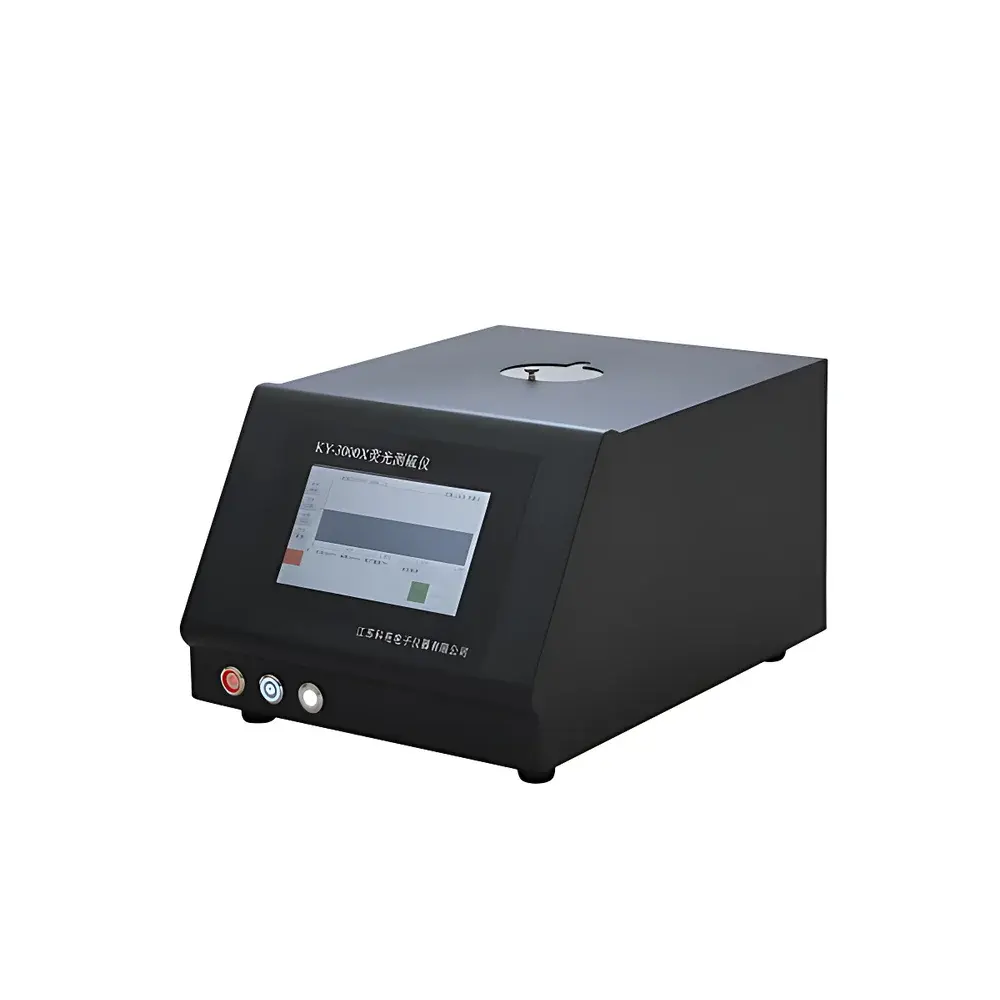
Kyoyuan KY-3000X Energy-Dispersive X-Ray Fluorescence (EDXRF) Sulfur Analyzer
| Brand | Kyoyuan Instruments |
|---|---|
| Origin | Jiangsu, China |
| Manufacturer Type | Direct Manufacturer |
| Country of Origin | China |
| Model | KY-3000X |
| Detection Principle | Energy-Dispersive X-Ray Fluorescence (EDXRF) |
| Portability | Benchtop (Non-Portable) |
| Analyte | Total Sulfur |
| Measurement Range | 7 mg/kg – 500,000 mg/kg (0.0007% – 50% w/w) |
| Analysis Time | 5 s – 1000 s (user-selectable increments) |
| Limit of Detection (LOD) | 7 mg/kg |
| Accuracy | ±3 mg/kg at 20 mg/kg |
| Sample Volume | 2–4 mL |
| Calibration Curves | Up to 999 user-defined calibration curves |
| Interface | USB 2.0 |
| Operating Environment | 5–40 °C, ≤85% RH (at 30 °C), 220 V ±20 V, 50 Hz |
| Dimensions (L×W×H) | 400 × 300 × 230 mm |
| Weight | 9.6 kg |
Overview
The Kyoyuan KY-3000X is a benchtop energy-dispersive X-ray fluorescence (EDXRF) sulfur analyzer engineered for precise, non-destructive quantification of total sulfur in crude oil, gasoline, diesel, jet fuel, lubricants, and other petroleum-based liquids. Unlike combustion-based or wet-chemical methods, the KY-3000X relies on fundamental X-ray physics: incident X-rays from a sealed-tube source excite sulfur K-shell electrons in the sample; subsequent emission of characteristic sulfur Kα photons (2.307 keV) is collected by a high-resolution silicon drift detector (SDD). The intensity of this spectral peak—normalized against background, tube output, and matrix effects—is converted into sulfur concentration via empirically validated calibration models. This physical measurement principle eliminates reagent consumption, high-temperature operation, inert gas purging, or sample derivatization, ensuring operational safety, minimal maintenance, and long-term stability across refinery QC labs, third-party testing facilities, and upstream field laboratories.
Key Features
- True EDXRF architecture with optimized X-ray tube–detector geometry for high peak-to-background ratio at the sulfur Kα line
- Automatic gain correction algorithm compensates for X-ray tube aging and voltage drift, preserving accuracy over >5 years of continuous operation
- Integrated spill containment chamber with mechanical interlock and optical sensor—prevents sample overflow during analysis and triggers immediate beam shutdown
- Dual-layer radiation shielding (lead + borosilicate glass viewport) compliant with IEC 61010-1 and national X-ray equipment safety regulations (GB 18871)
- Windows-based embedded software with intuitive touchscreen interface; supports multi-language UI (English, Spanish, Arabic, Chinese)
- Single-use polypropylene sample cups (2–4 mL volume) with peel-off film seal—eliminates cross-contamination and enables traceable sample labeling (batch ID, date, operator)
- User-configurable analysis protocols: selectable counting times (5 s to 1000 s), repeat measurements (1–99 cycles), and real-time statistical reporting (mean, SD, RSD)
- No consumables beyond sample cups—no gases, catalysts, or chemical reagents required
Sample Compatibility & Compliance
The KY-3000X accommodates a broad spectrum of liquid hydrocarbon matrices without dilution or pretreatment—including high-sulfur heavy fuel oil (up to 50% w/w), low-sulfur ultra-low-sulfur diesel (ULSD), reformulated gasoline, and crude blends. Its robust matrix correction engine accounts for density, viscosity, and light-element interference (e.g., Cl, Si, Ca) using empirical coefficients derived from ASTM D4294-16 reference materials. The instrument fully complies with key international and national standards: ASTM D4294-16, GB/T 17040-2019, GB/T 17606-2009, and SH/T 0742. All calibration and validation records—including daily system suitability checks, blank verification, and CRM traceability logs—are timestamped and stored with audit-trail capability, supporting GLP and ISO/IEC 17025 laboratory accreditation requirements.
Software & Data Management
Powered by Kyoyuan’s proprietary SulfurView™ software, the KY-3000X delivers full data governance functionality. Raw spectra, processed results, calibration curves, and QC reports are exported in CSV, PDF, or XML formats compatible with LIMS integration (via ODBC or HL7). Software enforces role-based access control (administrator, analyst, reviewer), electronic signatures per FDA 21 CFR Part 11, and immutable audit trails for all method modifications, result overrides, and instrument parameter changes. Up to 999 user-defined calibration curves can be archived locally or backed up to network drives; curve validation includes linearity assessment (r² ≥ 0.999), residual error mapping, and limit-of-quantitation confirmation per ICH Q2(R2).
Applications
- Refinery process stream monitoring: real-time sulfur tracking in hydrotreater feed, product, and recycle streams
- Fuel certification: compliance testing for Euro 5/6, Tier 3, and IMO 2020 marine fuel specifications (≤0.50% m/m)
- Crude assay laboratories: rapid screening of incoming crude lots for desalting and unit charge planning
- Independent testing labs: accredited sulfur reporting for custody transfer and regulatory submissions (EPA, CE, CNCA)
- R&D formulation support: sulfur profiling of bio-blends, synthetic fuels, and additive packages
FAQ
Is the KY-3000X suitable for solid or viscous samples such as asphalt or lubricating greases?
No—the instrument is validated exclusively for liquid petroleum products with kinematic viscosity below 15 cSt at 40 °C. Solid or semi-solid samples require homogenization, dissolution in xylene or toluene, and filtration prior to analysis.
Does the system require annual recalibration by the manufacturer?
No. Users perform routine performance verification using NIST-traceable SRM 1632e (fuel oil) or custom in-house CRMs. Factory recalibration is recommended only after detector replacement or major hardware service.
Can the KY-3000X be integrated into an automated sample handling system?
Yes—RS-232 and optional Ethernet interfaces support trigger-in/trigger-out signals for synchronization with autosamplers or PLC-controlled lab workflows.
What is the expected lifetime of the X-ray tube under typical lab usage?
Rated for ≥20,000 hours of operation (≈5 years at 10 samples/day); automatic gain correction extends functional life by mitigating output decay effects.
How does the instrument handle chlorine interference in chlorinated solvents or marine fuels?
The SulfurView™ software applies a built-in Cl–S deconvolution algorithm based on spectral library matching and iterative least-squares fitting, reducing Cl-induced bias to <±0.5 mg/kg in samples containing up to 5000 mg/kg Cl.