
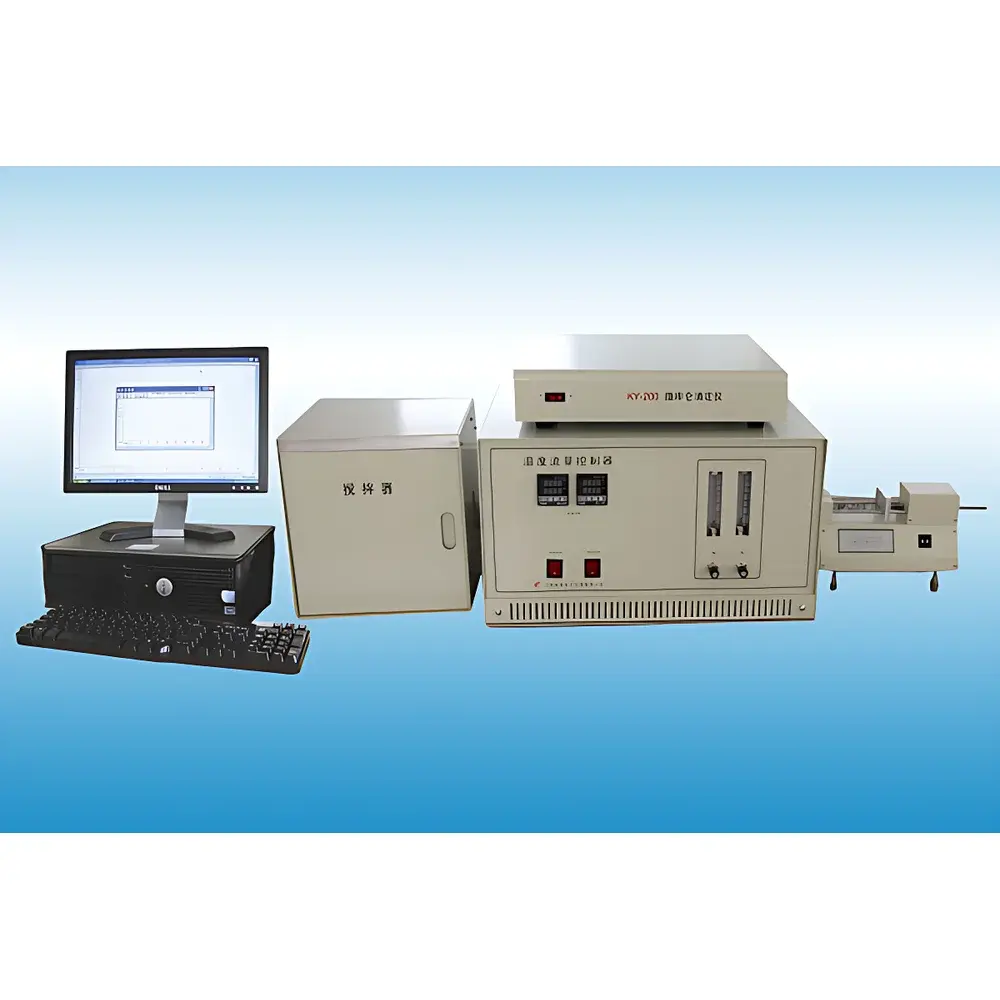
Kyuan KY-200 CL Microcoulometric Sulfur and Chlorine Analyzer
| Brand | Kyuan Instruments |
|---|---|
| Origin | Jiangsu, China |
| Manufacturer Type | Direct Manufacturer |
| Country of Origin | China |
| Model | KY-200 CL |
| Pricing | Available Upon Request |
| Measurement Principle | Microcoulometric Titration (ASTM D5808 / SH/T 0253 / GB/T 11061.4 Compliant) |
| Analyte Range | S: 0.1–10,000 mg/L |
| Cl | 0.2–10,000 mg/L |
| Detection Limit | S: 0.1 mg/L |
| Cl | 0.2 mg/L |
| Repeatability | CV ≤3% (S >10 mg/L), ±0.1 mg/L (0.5–1.0 mg/L S), CV ≤8% (1–10 mg/L S) |
| Temperature Control | Ambient to 1100 °C (±1 °C) |
| Power Consumption | 1500 W |
| Gas Requirements | Industrial-grade N₂ and O₂ |
| Sample Forms | Liquid, Solid, Gas (with optional dedicated injectors) |
Overview
The Kyuan KY-200 CL Microcoulometric Sulfur and Chlorine Analyzer is a fully automated, benchtop elemental analyzer engineered for precise quantification of total sulfur and total chlorine in hydrocarbon-based matrices using the principle of controlled-potential microcoulometric titration. Based on Faraday’s law of electrolysis, the instrument thermally cracks samples under controlled nitrogen/oxygen combustion at temperatures up to 1100 °C, converting all sulfur species to SO₂ and all chlorine species to HCl. These gaseous analytes are swept into a dual-mode titration cell where electrogenerated iodine (for sulfur) or silver ions (for chlorine) react stoichiometrically with the target species. The charge consumed during electrolysis—measured in real time by high-resolution coulometry—is directly proportional to analyte mass, enabling trace-level quantification without external calibration curves. Designed for compliance with ASTM D5808, SH/T 0253, GB/T 11061.4, SH/T 0222, GB/T 3208, and GB/T 18612, the KY-200 CL delivers metrologically traceable results suitable for regulatory reporting in refining, petrochemical QA/QC, and environmental testing laboratories.
Key Features
- Dual-analyte capability: Simultaneous or independent sulfur and chlorine determination via software-selectable titration modes (I⁻/I₂ for S; Ag⁺/Ag for Cl)
- Digitally stabilized potentiostat with <1 µA baseline drift, ensuring long-term coulometric accuracy and low detection limits (0.1 mg/L S, 0.2 mg/L Cl)
- Programmable high-temperature furnace (ambient to 1100 °C, ±1 °C stability) with intelligent fan-cooled cracking zone—no water cooling required
- Modular sample introduction: Compatible with liquid autosamplers (1–100 µL), solid boat injectors (up to 100 mg), and gas sampling loops (1–5 mL, pressure-regulated)
- Real-time status monitoring: On-screen display of cell potential, electrolysis current, temperature profile, gas flow rates, and reaction completeness indicators
- Self-diagnostic hardware architecture: Automatic cell conditioning, background current compensation, and electrode polarization validation prior to each analysis
Sample Compatibility & Compliance
The KY-200 CL accommodates a broad spectrum of sample types relevant to energy and materials industries—including gasoline, diesel, jet fuel, lubricants, crude oil, LPG, naphtha, benzene, catalysts, polymer additives, and wastewater extracts. Its robust oxidation protocol ensures complete conversion of refractory organosulfur (e.g., dibenzothiophenes) and organochlorine compounds (e.g., chlorinated paraffins, PCB congeners) without matrix-induced bias. All operational parameters adhere strictly to internationally recognized standards: SH/T 0253 (light distillates), GB/T 11061.4 (natural gas), SH/T 0222 (LPG), GB/T 3208 (aromatics), GB/T 18612 (crude organic chloride), and ASTM D5808 (chlorinated aromatics). The system supports GLP-compliant audit trails when integrated with Kyuan’s optional 21 CFR Part 11–enabled software module, including electronic signatures, user access levels, and immutable result archiving.
Software & Data Management
Controlled via Kyuan’s Windows-based KyAnalyst v3.2 software, the KY-200 CL provides full method development, sequence programming, real-time data visualization, and automated report generation. The interface supports customizable templates aligned with ISO/IEC 17025 documentation requirements—including uncertainty estimation per GUM guidelines, calibration verification logs, and daily system suitability checks (e.g., standard recovery, blank response, electrode efficiency). Raw coulometric data (current vs. time integrals) are stored in vendor-neutral CSV and XML formats. Optional database integration enables direct upload to LIMS platforms via ODBC or RESTful API. All software modules undergo annual verification against NIST-traceable reference materials (e.g., SRM 2724b for sulfur, NIST 3133 for chloride).
Applications
- Refinery process control: Monitoring sulfur removal efficiency in hydrotreaters and FCC units
- Fuel certification: Verification of ultra-low-sulfur diesel (ULSD, ≤10 mg/kg) and marine gas oil (MGO) compliance
- Corrosion mitigation: Quantifying chloride ingress in steam condensate and boiler feedwater
- Environmental forensics: Screening for halogenated contaminants in soil leachates and sediment extracts
- R&D support: Reaction pathway analysis of desulfurization catalysts and chlorine scavenger performance
- Contract testing labs: Accredited sulfur/chlorine analysis for ISO 17025 scope expansion
FAQ
What sample preparation is required for solid samples?
Minimal preparation: Solids (e.g., catalysts, polymers, soils) are weighed into quartz boats and introduced via the high-temperature solid injector. Homogenization and drying (if hygroscopic) are recommended prior to analysis.
Can the same titration cell be used for both sulfur and chlorine analyses?
Yes—the KY-200 CL employs a single, field-replaceable dual-mode cell with interchangeable working electrodes and optimized electrolyte formulations for either S or Cl mode, reducing cross-contamination risk and consumables cost.
Is carrier gas purity critical for accurate results?
Industrial-grade (99.995%) nitrogen and oxygen are sufficient; no ultra-high-purity gases are required. Built-in gas purifiers remove residual moisture and hydrocarbons that could interfere with coulometric endpoint detection.
How does the system handle high-sulfur samples (>5000 mg/L)?
Samples exceeding the linear range are automatically flagged; the software recommends dilution protocols and recalculates final concentration with propagation-of-error correction.
Does the instrument support remote diagnostics and firmware updates?
Yes—via secure TLS-encrypted Ethernet connection, authorized service engineers can perform health checks, parameter optimization, and version-controlled firmware upgrades without onsite visits.






