
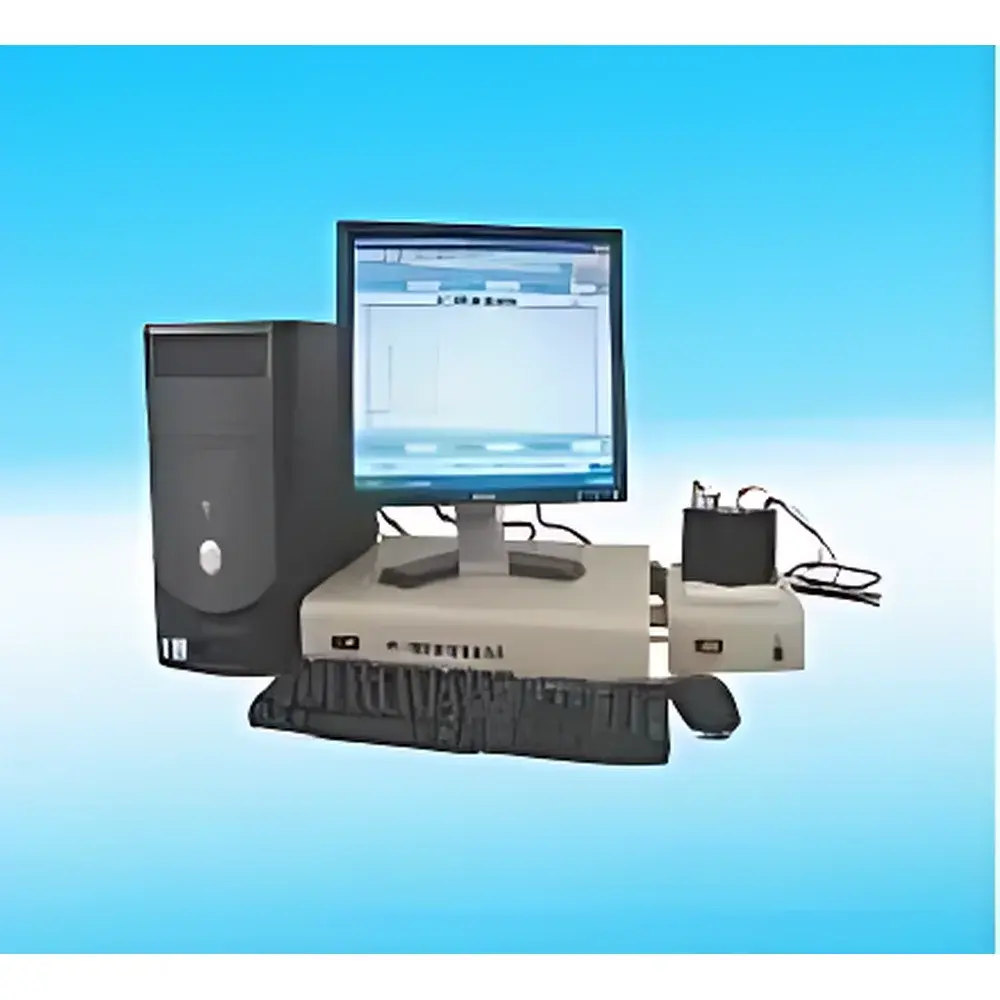
Kyuyuan KY-4As Arsenic Content Analyzer
| Brand | Kyuyuan Instruments |
|---|---|
| Origin | Jiangsu, China |
| Manufacturer Type | Direct Manufacturer |
| Regional Classification | Domestic (China) |
| Model | KY-4As |
| Pricing | Available Upon Request |
| Measurement Principle | Microcoulometric Titration |
| Sample Form | Liquid |
| Detection Method | Hydride Generation–Microcoulometric Detection |
| Bias Voltage Range | 0–500 mV |
| Measurement Range | 1 × 10⁻⁹ % (1 ppb) to % (w/w) |
| Input Impedance | ≥10⁶ Ω |
| Output Voltage | ±24 V |
| Baseline Drift | ≤5 µV / 20 min |
| Temperature Control Accuracy | ±0.5% or ±5 °C (whichever is greater) |
| Analysis Time (excluding sample prep) | 5–10 min |
| Sensitivity | 1 ppb (as As) |
| Operating Humidity | <80% RH |
| Operating Temperature | 10–40 °C |
Overview
The Kyuyuan KY-4As Arsenic Content Analyzer is a dedicated microcoulometric instrumentation system engineered for the quantitative determination of total arsenic in liquid and gaseous hydrocarbon matrices, catalysts, aqueous solutions, and food-grade samples. It operates on the principle of hydride generation coupled with microcoulometric titration — a trace-level electroanalytical method standardized for speciation-insensitive total arsenic quantification. In this process, organic arsenic compounds are first decomposed under acidic oxidative conditions (e.g., HNO₃/H₂SO₄ digestion), followed by reduction to arsine gas (AsH₃) using sodium borohydride (NaBH₄). The generated AsH₃ is swept into a titration cell containing an iodine-based electrolyte, where it reacts stoichiometrically with I₂. The resulting depletion of I₂ is replenished electrochemically via controlled current generation; the integrated charge (Q, in coulombs) required to restore baseline iodine concentration is directly proportional to the arsenic mass according to Faraday’s law (n = Q / (neF), where ne = 6 mol e⁻/mol As, F = 96,485 C/mol). This fundamental electrochemical architecture ensures high reproducibility, minimal reagent consumption, and intrinsic calibration stability without reliance on external standard curves.
Key Features
- Integrated PC-based control system with real-time monitoring of bias voltage, titration current, baseline stability, and reaction kinetics
- Dedicated thermal cracking unit with intelligent air-cooling architecture — fan activation/deactivation governed by real-time furnace temperature feedback to ensure consistent pyrolysis efficiency and extended component lifetime
- Optimized gas-handling manifold with inert flow path design to minimize AsH₃ adsorption and memory effects
- High-input-impedance potentiostatic circuitry (≥10⁶ Ω) enabling stable bias voltage application (0–500 mV range) across variable electrolyte conductivities
- Rapid analysis cycle: 5–10 minutes per injection post-sample introduction, supporting throughput of up to 6–8 determinations per hour when combined with parallel sample preparation
- Robust environmental tolerance: operational capability maintained within 10–40 °C ambient temperature and <80% relative humidity
Sample Compatibility & Compliance
The KY-4As analyzer accommodates a broad spectrum of industrial and regulatory sample types, including but not limited to: gasoline, diesel fuel, naphtha, kerosene, crude oil, vacuum residue, liquefied petroleum gas (LPG), propylene feedstock, spent hydroprocessing catalysts, boiler feedwater, drinking water, fruit juices, and edible oils. Its measurement methodology aligns with the conceptual framework of ASTM D7111 (Standard Test Method for Determination of Total Arsenic in Gasoline by Atomic Absorption Spectroscopy), ISO 8217 (Petroleum products — Fuels (class F) — Specifications), and USP / (Elemental Impurities – Procedures), though final method validation must be performed per laboratory-specific SOPs. The instrument supports GLP-compliant data integrity through timestamped audit trails, user-access logs, and non-editable result files — features essential for laboratories subject to FDA 21 CFR Part 11 or CNAS accreditation requirements.
Software & Data Management
The embedded acquisition software provides full sequence control, real-time waveform visualization (current vs. time), automatic endpoint detection, and integrated calculation engine applying Faraday-based mass conversion with configurable valence assumptions. All raw data (including baseline drift profiles, titration charge integrals, and system diagnostics) are stored in proprietary binary format with SHA-256 checksum verification. Export options include CSV (for LIMS integration), PDF analytical reports with digital signature fields, and XML metadata compliant with ASTM E1461. Software updates are delivered via secure HTTPS channel with version-controlled firmware signing to maintain traceability across instrument lifecycles.
Applications
- Refinery QC/QA: Monitoring arsenic contamination in feedstocks and finished fuels to prevent catalyst poisoning in hydrotreating units
- Petrochemical R&D: Screening arsenic levels in olefin streams and polymerization catalysts to assess deactivation mechanisms
- Environmental testing labs: Quantifying arsenic leachates from soil extracts or industrial wastewater per EPA Method 7060A analog protocols
- Food safety laboratories: Verifying compliance with Codex Alimentarius limits (e.g., 0.1 mg/kg in rice) using validated acid-digestion workflows
- Pharmaceutical excipient testing: Confirming arsenic impurity thresholds in glycerin, polysorbates, and other polyol-based raw materials
FAQ
What sample preparation is required prior to analysis?
Liquid hydrocarbons typically require no dilution; however, viscous samples (e.g., heavy fuel oil) may need pre-heating and homogenization. Aqueous and biological matrices require acid digestion (HNO₃/H₂O₂) followed by reduction with KI/ascorbic acid to ensure complete As(V)→As(III) conversion prior to NaBH₄ addition.
Is the KY-4As compatible with automated sample introduction systems?
Yes — the instrument features RS-232 and Ethernet interfaces supporting integration with third-party autosamplers (e.g., CDS 7000 series) via ASCII command protocol; custom API wrappers are available upon request.
How frequently must the titration cell electrolyte be replaced?
Under normal operation (≤20 injections/day), the iodine-based electrolyte remains stable for ≥72 hours; replacement is triggered automatically when baseline drift exceeds 5 µV/20 min or charge recovery efficiency falls below 95%.
Does the system support multi-element analysis?
No — the KY-4As is purpose-built for arsenic only. For simultaneous As/Se/Pb/Cd determination, consult Kyuyuan’s KY-6X series hydride-generation ICP-MS interface modules.
Can calibration be performed using solid standards?
Calibration must be conducted using certified liquid reference standards traceable to NIST SRM 3133 (arsenic in aqueous solution); solid standards introduce uncontrolled dissolution kinetics and are not recommended for microcoulometric validation.
Related Products





