
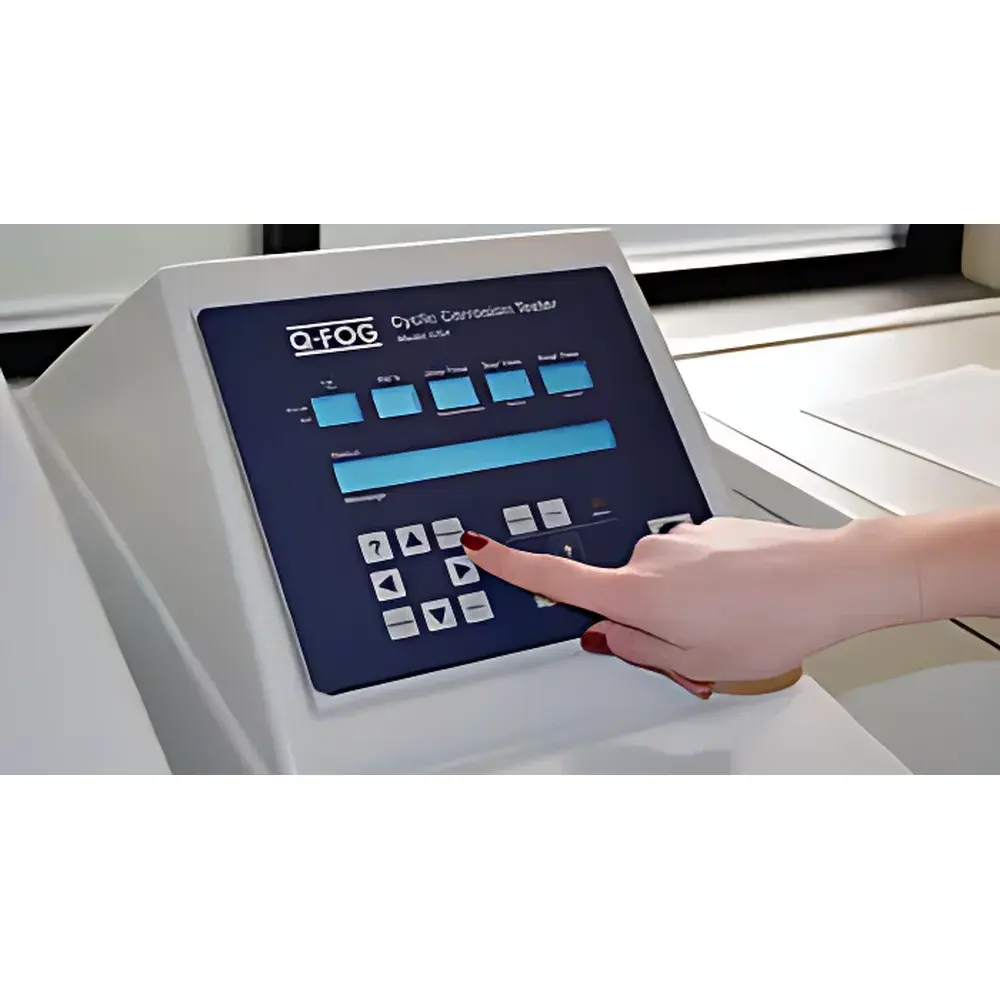
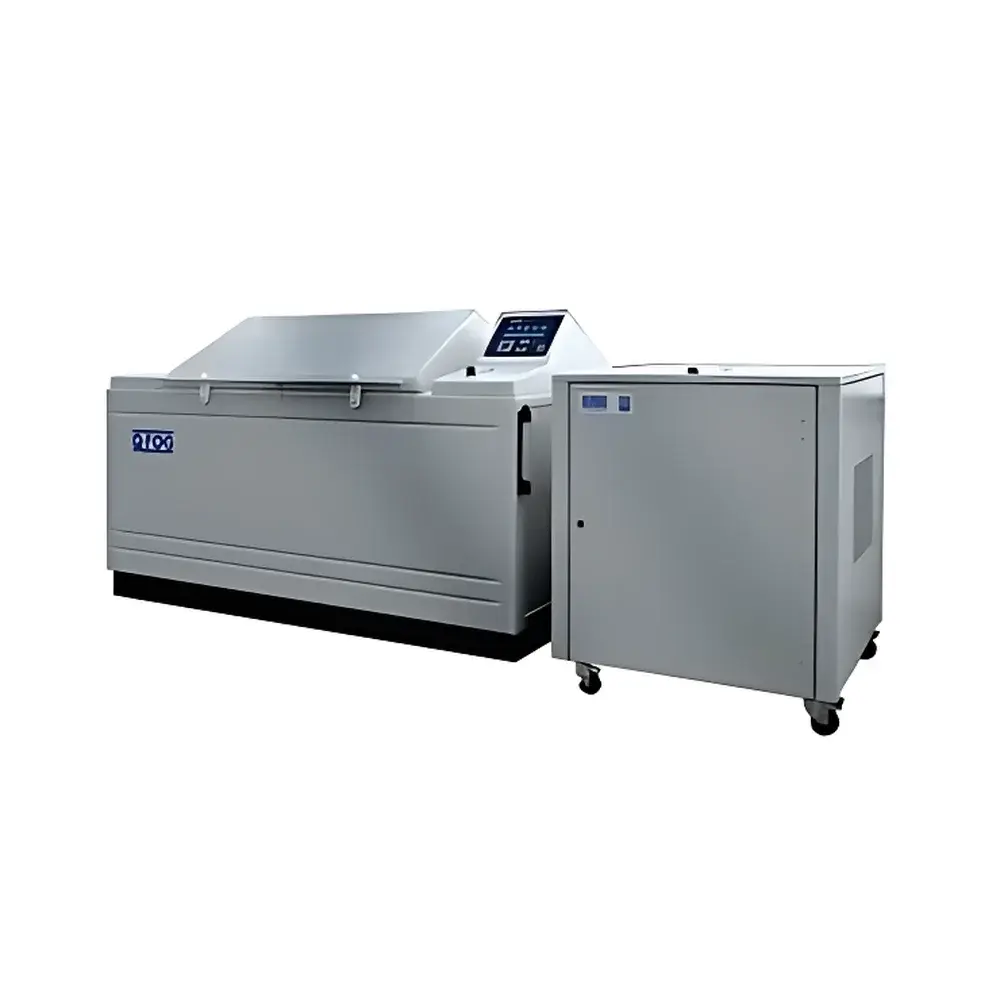
Q-Lab CRH 1100 Controlled Humidity Cyclic Corrosion Test Chamber
| Brand | Q-Lab |
|---|---|
| Origin | USA |
| Model | CRH 1100 |
| Capacity | 1100 L (internal chamber volume) |
| Humidity Control Range | 0–100% RH (programmable, pulse-fogging assisted) |
| Temperature Range | Ambient +10°C to 60°C (typical operational range per ASTM G85 Annexes and ISO 16701) |
| Spray Function | Adjustable flow rate, user-defined on/off timing, non-atomized liquid delivery |
| Compliance | Fully supports GMW 14872, SAE J2334, ISO 16701, ASTM G85 Annexes 1/2/3/5, ISO 9227, IEC 60068-2-52, MIL-STD-810G, and other cyclic corrosion standards requiring precise RH control |
Overview
The Q-Lab CRH 1100 Controlled Humidity Cyclic Corrosion Test Chamber is an advanced environmental test system engineered for high-fidelity simulation of real-world atmospheric corrosion mechanisms under programmable relative humidity (RH), temperature, and liquid exposure conditions. Unlike conventional salt spray chambers relying solely on continuous fog generation (e.g., ASTM B117), the CRH 1100 implements a fully decoupled humidity control architecture—utilizing pre-conditioned air, high-efficiency blowers, and pulse-controlled ultrasonic humidification nozzles—to achieve stable, repeatable RH profiles from 0% to 100% RH across its 1100 L internal chamber volume. This capability enables strict adherence to modern automotive and industrial cyclic corrosion protocols where humidity ramping, dwell, and transition phases are defined with metrological rigor—not approximated through passive condensation or uncontrolled evaporation.
Key Features
- Separate humidity sensing and actuation module: A dedicated RH sensor and feedback-controlled humidification system operate independently from the salt spray circuit, eliminating sensor drift and premature failure common in integrated electronic hygrometers exposed directly to corrosive aerosols.
- Programmable liquid spray function: Delivers non-atomized, gravity-assisted solution flow via calibrated nozzles mounted on removable spray manifolds—enabling precise control over spray duration, interval, and volumetric delivery rate per cycle phase.
- Full-cycle programmability: Supports multi-step test sequences combining salt fog, high-RH soak, low-RH dry-off, and ambient conditioning—all with independent setpoint control for temperature and RH, synchronized with spray activation.
- Robust chamber construction: Stainless steel interior with reinforced double-wall insulation; corrosion-resistant fan housings and sealed drive motors ensure long-term stability under aggressive chloride environments.
- Calibration-traceable operation: Integrated sensor interfaces support NIST-traceable calibration documentation per ISO/IEC 17025 requirements; humidity control accuracy maintained within ±2% RH (k=2) over full operating range when validated per Q-Lab’s factory calibration protocol.
Sample Compatibility & Compliance
The CRH 1100 accommodates up to 200 specimens of 100 mm × 300 mm or 240 specimens of 75 mm × 150 mm on angled sample racks (15° tilt), ensuring uniform exposure and natural runoff. Optional vertical hanging rods support three-dimensional components, fasteners, and irregularly shaped assemblies. The chamber meets or exceeds requirements for regulatory and industry-standard testing—including GLP-compliant audit trails (via optional Q-Lab Logger software), FDA 21 CFR Part 11-compliant electronic records (with user authentication and change logging), and full alignment with ISO/IEC 17025 laboratory accreditation criteria for environmental testing. It is explicitly qualified for use in certified test laboratories performing validation per ASTM D5894, ISO 16701, and OEM-specific specifications such as Ford CETP 00.00-L-467 and Volkswagen PV1210.
Software & Data Management
Control and monitoring are managed via Q-Lab’s Windows-based CRH Software Suite, which provides ISO 17025-aligned data integrity features: time-stamped event logging, operator ID authentication, password-protected method editing, and immutable audit trail export (CSV/XML). Real-time graphs display chamber RH, temperature, and spray status with configurable alarm thresholds. All test data—including sensor raw outputs, setpoint deviations, and cycle progression—are stored locally with automatic backup to network drives. Exported datasets comply with ASTM E2911 and ISO/IEC 17025 clause 7.5.2 for traceable measurement uncertainty reporting.
Applications
This chamber is deployed primarily in Tier 1 automotive suppliers, OEM R&D centers, and third-party certification labs conducting accelerated corrosion validation of coated steels, aluminum alloys, zinc die-cast parts, and multi-layer polymer composites. Its precision RH control makes it indispensable for evaluating electrochemical degradation pathways in battery enclosures, EV powertrain housings, and ADAS sensor housings subjected to coastal or de-icing salt exposure. Additional application domains include aerospace fastener qualification (per MIL-STD-883J Method 1001.1), marine equipment coating durability (ISO 20340), and photovoltaic module frame corrosion resistance (IEC 61701).
FAQ
Does the CRH 1100 meet ASTM B117 requirements?
Yes—it operates in standard salt fog mode compliant with ASTM B117 while also supporting enhanced cyclic modes beyond B117.
Can humidity be held at 95% RH without condensation forming on samples?
Yes—the pre-conditioned air system maintains stable RH setpoints with minimal thermal gradient, suppressing uncontrolled dew formation during soak phases.
Is the spray function compatible with non-chloride electrolytes (e.g., SO₂-acidified solutions)?
Yes—provided solution chemistry is compatible with stainless steel and fluoropolymer wetted parts; flow calibration must be verified for viscosity deviations.
What maintenance intervals are recommended for the humidity control module?
Q-Lab recommends quarterly verification of RH sensor response and annual recalibration of the humidification pulse algorithm against NIST-traceable reference hygrometers.
How is compliance with ISO 16701 verified during installation qualification (IQ)?
Q-Lab provides IQ/OQ documentation packages including chamber mapping reports (temperature/RH uniformity per ISO 16701 Annex B), spray deposition rate verification per ASTM D1654, and controller firmware version traceability.



