
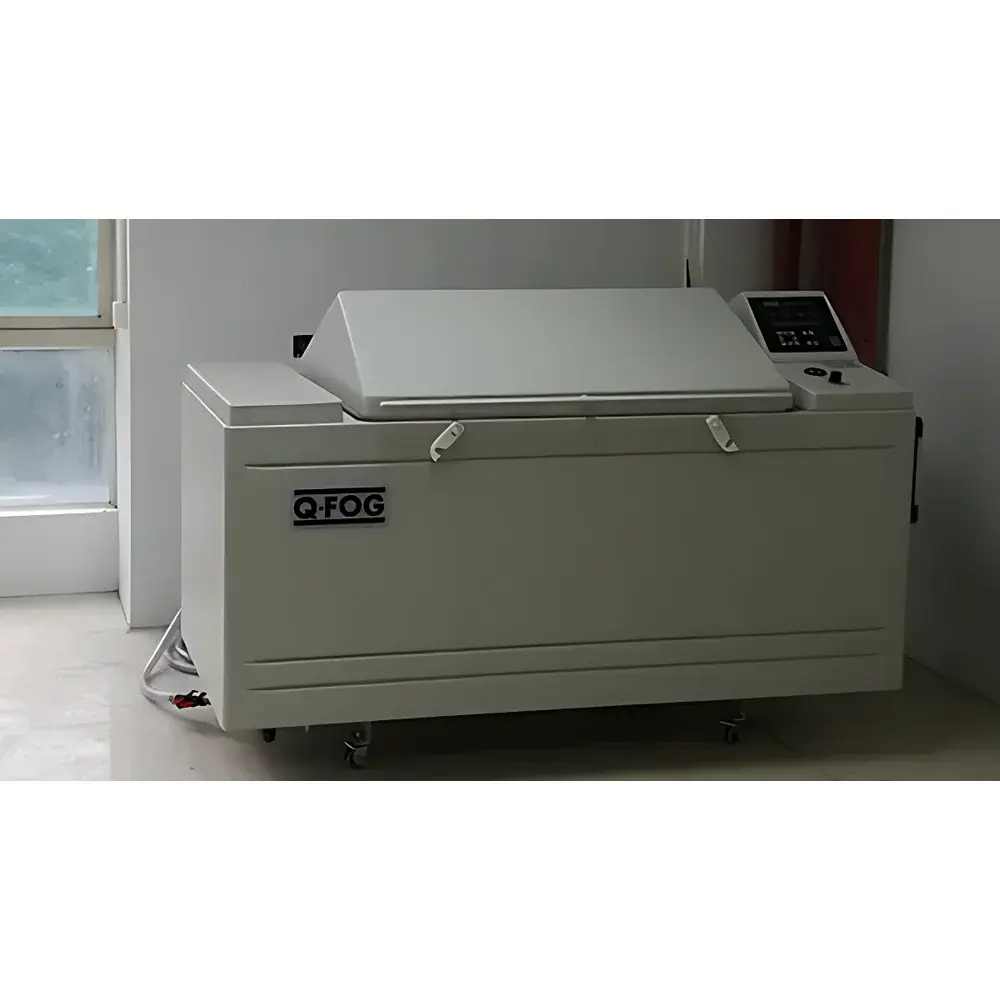
Q-LAB Q-FOG CCT1100 Cyclic Corrosion Test Chamber
| Brand | Q-LAB |
|---|---|
| Origin | USA |
| Model | Q-FOG CCT1100 |
| Chamber Capacity | 1103 L |
| Cycle Capabilities | Salt Spray, Dry, 100% RH Humidity, and Hold |
| Control System | Integrated Microprocessor-Based Q-FOG Controller with Self-Diagnostic Functions |
| Solution Delivery | Precision-Controlled Peristaltic Pump + Adjustable Air Pressure Regulator |
| Water Requirement | Deionized or Distilled Water (Resistivity >50 kΩ·cm, Particles <200 µm) |
| Power Supply | 220–240 V, 50–60 Hz, Single Phase, Max 4.2 kW |
| Exhaust Duct | 4" (102 mm) ID Required |
| Operating Ambient Temperature | 19–27 °C |
| Internal Reservoir | 120 L with Saltwater Filter & Low-Level Alarm |
| Sample Capacity | 240 test panels (75 mm × 150 mm) or custom 3D fixtures via 20 mm diameter hanging rods |
| Compliance | Designed to support ASTM B117, ISO 9227, ASTM G85 Annex A5 (Prohesion), SAE J2334, GMW 14872, Ford CETP 00.00-L-467, and other automotive cyclic corrosion standards |
Overview
The Q-LAB Q-FOG CCT1100 is a fully automated cyclic corrosion test chamber engineered for high-fidelity simulation of real-world atmospheric degradation mechanisms. Unlike traditional continuous-salt-spray systems (e.g., ASTM B117), the CCT1100 implements programmable multi-stage environmental cycles—including salt fog, dry-off, 100% relative humidity, and ambient hold—to replicate the wet/dry transitions, condensation events, and chloride deposition patterns observed in outdoor service environments. Its core architecture leverages Couette-flow spray nozzles, digitally regulated peristaltic solution delivery, and independent air-pressure control to decouple salt deposition rate from droplet trajectory—enabling precise, repeatable, and spatially uniform fog distribution across the test volume. This physical fidelity underpins strong correlation between laboratory results and field performance, particularly for coated metals, automotive components, and advanced polymer composites undergoing accelerated lifetime evaluation.
Key Features
- Triple-environment cycling capability: Salt spray (35 °C typical), forced-air drying (<10% RH achievable with optional auxiliary heater), and saturated humidity (up to 100% RH at 49 °C) — all within a single chamber
- Q-FOG microprocessor controller with intuitive touchscreen interface, preloaded test method library (including ASTM G85 Annexes A1–A5, SAE J2334, GMW 14872), and user-definable multi-step sequences (up to 999 steps per cycle)
- Integrated self-diagnostics: Real-time fault logging, predictive maintenance alerts (e.g., pump tube wear, filter clogging), automatic safety shutdown on temperature/pressure deviation
- 120-liter internal solution reservoir with built-in particulate filtration, conductivity monitoring, and audible/visual low-level warning
- Ergonomic access design: Front-hinged lid with gas-assisted lift mechanism, side-mounted observation window (CCT models only), and low-profile loading rail for rapid panel insertion
- Thermal architecture optimized for rapid transition: High-wattage inline heaters + high-CFM cooling/drying fan enable sub-15-minute transitions between 35 °C salt fog and 60 °C low-RH dry conditions
Sample Compatibility & Compliance
The CCT1100 accommodates standardized test panels (75 mm × 150 mm, up to 240 units at 15° tilt), as well as irregular 3D parts via 20 mm diameter stainless steel hanging rods. Optional fixtures include adjustable-angle mounting brackets (F-9011-K kit), extended-length rods for deep-chamber placement, and custom jigs for OEM-specific geometries. The system meets essential regulatory and industry validation requirements: its temperature uniformity (±2 °C per ASTM E742), fog collection rate stability (±0.1 mL/h/80 cm² per ISO 9227), and controller audit trail functionality align with GLP-compliant workflows. While not inherently 21 CFR Part 11 certified, the Q-FOG controller supports external electronic signature integration and full data export (CSV/Excel) for traceability in GMP-regulated corrosion qualification studies.
Software & Data Management
The embedded Q-FOG controller stores complete cycle logs—including time-stamped setpoints, actual chamber readings, alarm history, and actuator status—for minimum 30 days onboard. Data export is performed via USB port or optional Ethernet interface using Q-Lab’s free LogView software, which enables synchronized multi-chamber trending, statistical process control (SPC) charting, and PDF report generation compliant with ISO/IEC 17025 documentation standards. All parameter changes are timestamped and attributed to operator ID; revision-controlled firmware updates ensure long-term method reproducibility across instrument lifecycles.
Applications
The CCT1100 serves critical roles in R&D and quality assurance laboratories across aerospace (fastener coating durability), automotive (under-hood component validation per Ford CETP 00.00-L-467), electronics (PCB conformal coating resistance), and infrastructure (galvanized rebar passivation kinetics). It is routinely deployed for comparative benchmarking of electroplated zinc-nickel alloys, evaluation of self-healing polymer coatings, and accelerated aging of thermal barrier coatings subjected to marine-industrial atmospheres. Its ability to sustain stable 100% RH at elevated temperatures also supports ISO 6270-2 condensation testing protocols without requiring auxiliary humidification chambers.
FAQ
What standards does the Q-FOG CCT1100 support out-of-the-box?
ASTM B117 (continuous salt spray), ASTM G85 Annex A5 (Prohesion), ISO 9227, SAE J2334, GMW 14872, and Ford CETP 00.00-L-467 — with additional methods available via firmware update.
Is deionized water mandatory for operation?
Yes. Resistivity must exceed 50 kΩ·cm, and particulate content must remain below 200 µm to prevent nozzle clogging and electrode scaling in the internal reservoir.
Can the CCT1100 perform tests requiring sub-10% RH drying phases?
Yes — the integrated high-capacity drying fan combined with an optional auxiliary air heater enables controlled desiccation down to <5% RH at 60 °C.
How is fog deposition uniformity verified and maintained?
Per ISO 9227, six calibrated funnels collect fog across the working volume; Q-Lab provides the standard Salt Fog Collection Kit (Part No. F-9001-K) for routine verification every 30 days.
What maintenance intervals are recommended for routine operation?
Peristaltic pump tubing replacement every 6 months (or 1,000 hours), air filter inspection weekly, solution filter replacement monthly, and full system calibration annually by Q-Lab-certified service engineers.



