
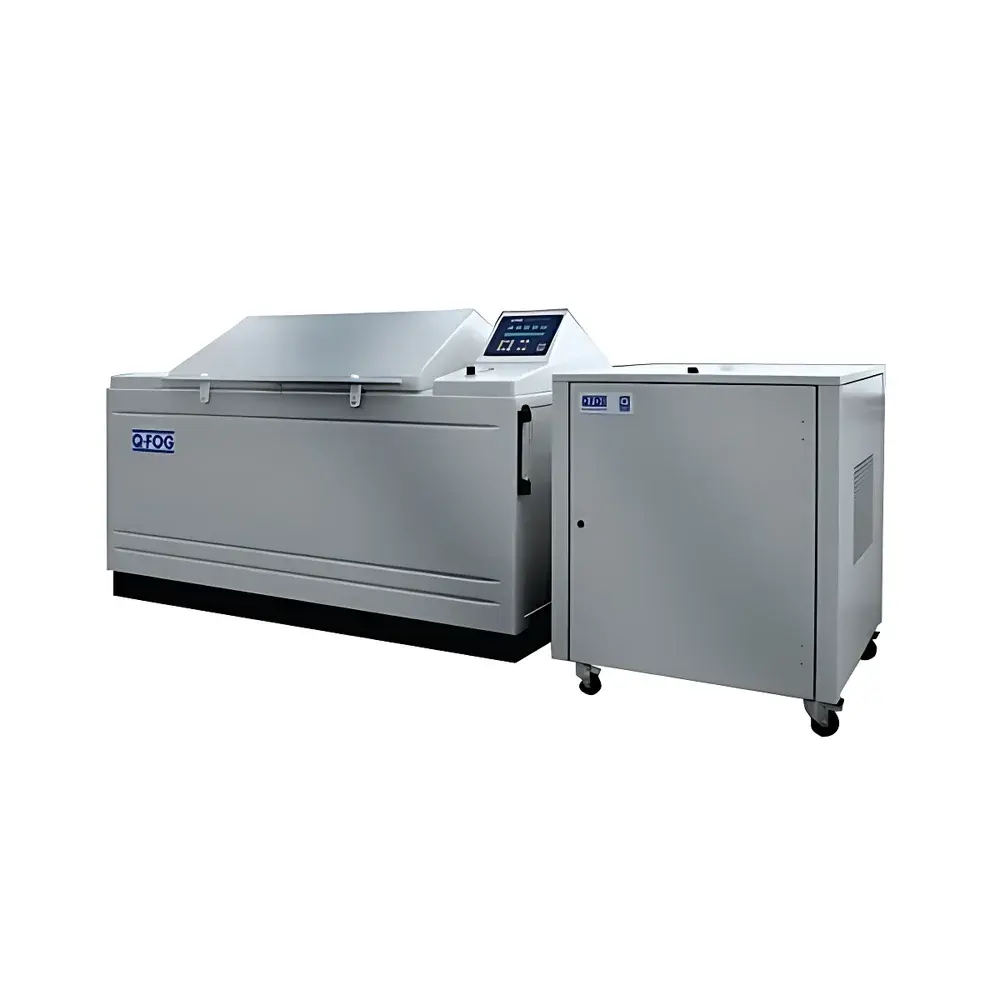
Q-LAB Q-FOG CRH 1100 Cyclic Corrosion Test Chamber
| Brand | Q-LAB |
|---|---|
| Origin | USA |
| Model | Q-FOG CRH 1100 |
| Salt Spray Deposition Rate | 0.5–3 mL/h·80 cm² |
| Temperature Range | Ambient to 70 °C |
| Chamber Capacity | 1103 L |
| RH Control | Yes (via air pre-conditioning system) |
| Optional Spray Function | Yes |
| Internal DI Water Requirement | Yes |
| Calibration Interval | Every 6 months (temperature & RH sensors) |
| Compliance | ASTM B117, ISO 9227, ISO 11997, GMW 14872, SAE J2334, Ford CETP, VW PV1210, Renault D17 2025, GB/T 10587, VDA 621-415 |
Overview
The Q-LAB Q-FOG CRH 1100 is a fully programmable cyclic corrosion test chamber engineered for high-fidelity simulation of real-world atmospheric degradation mechanisms. Unlike conventional salt spray chambers operating solely under static ASTM B117 conditions, the CRH 1100 implements dynamic multi-phase exposure cycles—including neutral salt fog (NSF), dry-off, humidity hold, and optional high-flow spray—each independently controllable in temperature, relative humidity (RH), duration, and solution delivery profile. Its core architecture integrates a patented air pre-conditioning module that precisely regulates RH from 10% to 95% at temperatures up to 70 °C, enabling compliance with modern automotive and industrial corrosion standards such as GMW 14872 (cyclic Prohesion + RH control) and ISO 11997-2 (cyclic corrosion testing with humidity conditioning). The chamber’s thermal inertia is minimized via internal resistive heaters and a high-capacity forced-air cooling/drying system—allowing transitions between wet and dry phases in under 15 minutes, a critical requirement for accelerated yet representative corrosion kinetics.
Key Features
- True cyclic operation with up to 99 programmable steps per test sequence, supporting complex multi-stage profiles (e.g., 2-h salt fog → 4-h drying at 60 °C/30% RH → 16-h humidity hold at 40 °C/93% RH)
- Integrated RH control via dual-path air pre-conditioning: heated/cooled air stream combined with precision-mist humidification using deionized water
- Dedicated high-volume spray module with user-adjustable flow rate (0.5–5 L/min), independent nozzle positioning, and programmable on/off timing—optimized for standards requiring direct liquid impingement (e.g., certain Ford CETP protocols)
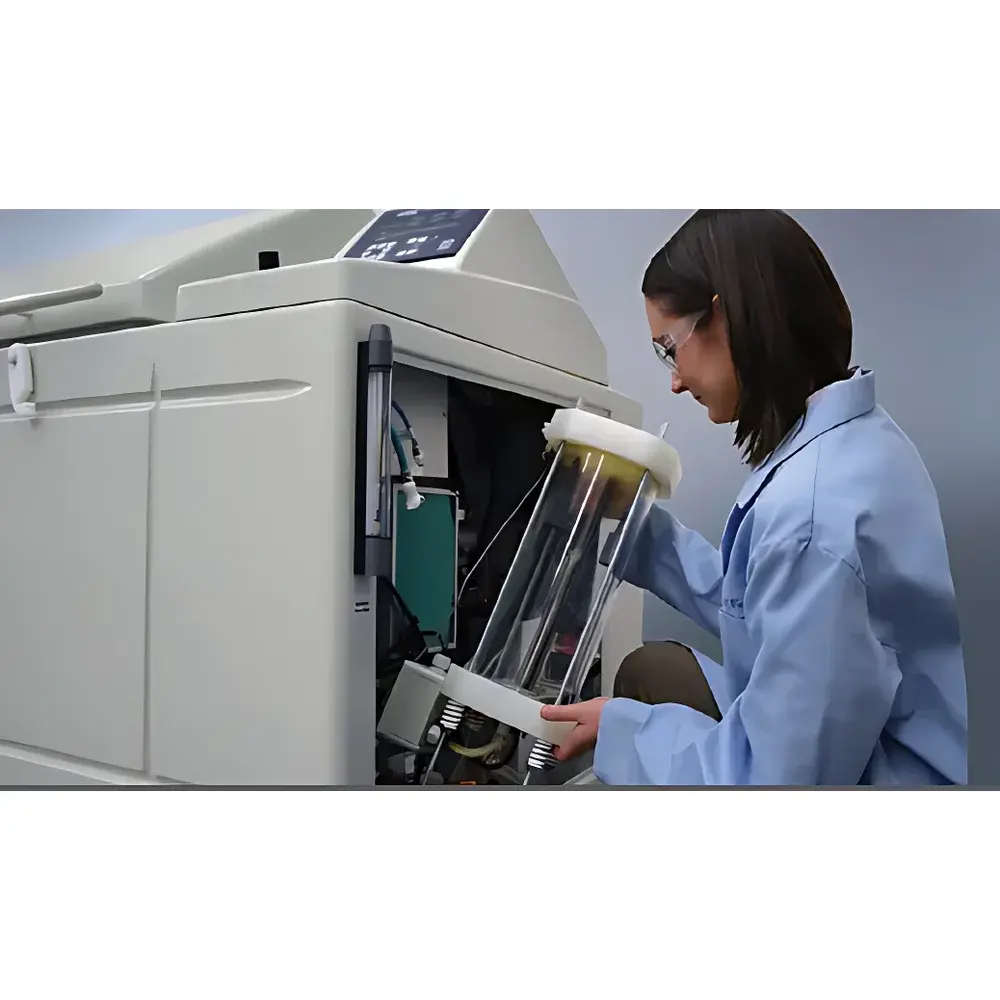
- Self-cleaning nozzle system with ultrasonic vibration and automatic purge cycles to prevent crystallization-induced clogging
- 120-L integrated solution reservoir with particulate filtration, level monitoring, and low-level audible/visual alarm
- Front-accessible chamber design with low-profile lid opening and internal LED illumination for unobstructed visual inspection during operation
- Robust structural frame rated for uniform load distribution up to 544 kg; accommodates full-size automotive components (e.g., wheel hubs, brake calipers) via adjustable 20-mm suspension rods or rack-mounted grid systems
Sample Compatibility & Compliance
The Q-FOG CRH 1100 supports flat-panel specimens (up to 240 × 75 mm × 150 mm test coupons), three-dimensional parts, and full assemblies. Standard fixtures include Q-PANEL-compatible vertical racks (10 units, 15° tilt), scatter-type and rack-type grid plates (F-8283-X / F-8284), and heavy-duty coupon holders (F-9220-X). All hardware is constructed from non-corroding, UV-stabilized polymers and 316 stainless steel. The system meets calibration traceability requirements per ISO/IEC 17025 when used with NIST-traceable reference instruments. Routine verification includes biannual calibration of PT100 temperature sensors and capacitive RH transducers using certified reference devices—a procedure documented in Q-LAB Technical Bulletin LF-8131. The chamber is validated for compliance with ASTM B117, ISO 9227 (NSS, AASS, CASS), ISO 11997-1/-2, VDA 621-415, and GB/T 10587, with full audit trails available for GLP/GMP environments.
Software & Data Management
The embedded Q-FOG Controller features a 7-inch color touchscreen interface with intuitive icon-driven navigation. Test programs are created using step-based logic with real-time parameter validation. All operational data—including chamber temperature, RH, spray status, elapsed time, and alarm history—are logged at user-defined intervals (1 s to 60 min resolution) and stored internally for ≥30 days. Export options include USB flash drive (CSV format) and optional Ethernet connectivity for integration into enterprise LIMS or MES platforms. Audit trail functionality complies with FDA 21 CFR Part 11 requirements when paired with Q-LAB’s optional Q-Support software suite, which provides electronic signature capability, role-based access control, and automated report generation (PDF/Excel). System diagnostics include predictive maintenance alerts (e.g., filter replacement, pump wear estimation) and self-test routines executed at power-up.
Applications
The Q-FOG CRH 1100 serves as a primary qualification tool in OEM and Tier-1 automotive R&D labs for evaluating coating durability, galvanized steel performance, fastener corrosion resistance, and multi-material joint integrity under simulated service conditions. It is widely deployed in aerospace (corrosion resistance of aluminum alloys per AMS 2700), electronics (conformal coating reliability under humidity cycling), and infrastructure materials (rebar-coating adhesion per ASTM G109). Its ability to replicate coastal, industrial, and de-icing salt exposures makes it indispensable for validating coatings on wind turbine blades, marine hardware, and railway rolling stock. Academic research applications include mechanistic studies of electrochemical pitting initiation, chloride ion diffusion kinetics in polymer matrices, and synergistic effects of UV preconditioning (when integrated with Q-SUN xenon-arc systems).
FAQ
What deionized water specifications are required for stable RH control?
The system requires Type II deionized water per ASTM D1193, with resistivity ≥1 MΩ·cm and total organic carbon (TOC) < 50 ppb. Use of substandard water may cause mineral buildup in humidification nozzles and sensor drift.
Can the CRH 1100 perform ASTM B117 testing without RH modulation?
Yes—B117 mode is a dedicated preset function with fixed 35 °C temperature, pH 6.5–7.2 NaCl solution, and 1.0–2.0 mL/h·80 cm² deposition rate, fully compliant with the standard’s operational requirements.
Is third-party IQ/OQ/PQ documentation available?
Q-LAB provides standardized Installation Qualification (IQ) and Operational Qualification (OQ) templates; Performance Qualification (PQ) protocols must be developed per site-specific risk assessment and product requirements, with support available from Q-LAB Field Applications Engineers.
How often must the air pre-conditioning filters be replaced?
The coalescing and particulate filters require replacement every 6 months under continuous operation; the schedule is tracked automatically by the controller and displayed in the maintenance dashboard.
Does the spray module affect salt fog deposition uniformity?
No—the spray and fog functions operate via separate fluid paths and nozzles. Fog dispersion is maintained per ISO 9227 Annex A using calibrated collection funnels, while spray coverage is verified per Ford CETP 100-00, Section 5.3.2, using dye-tracer mapping.



