
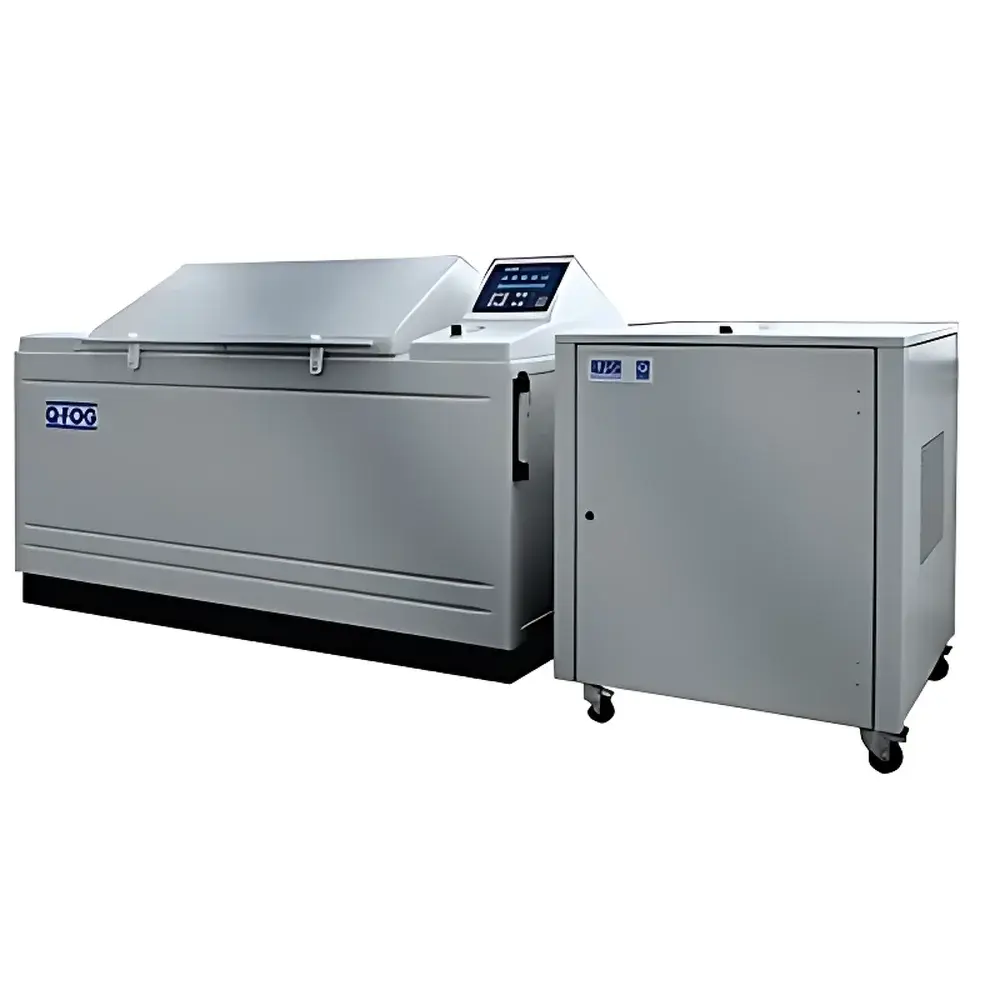
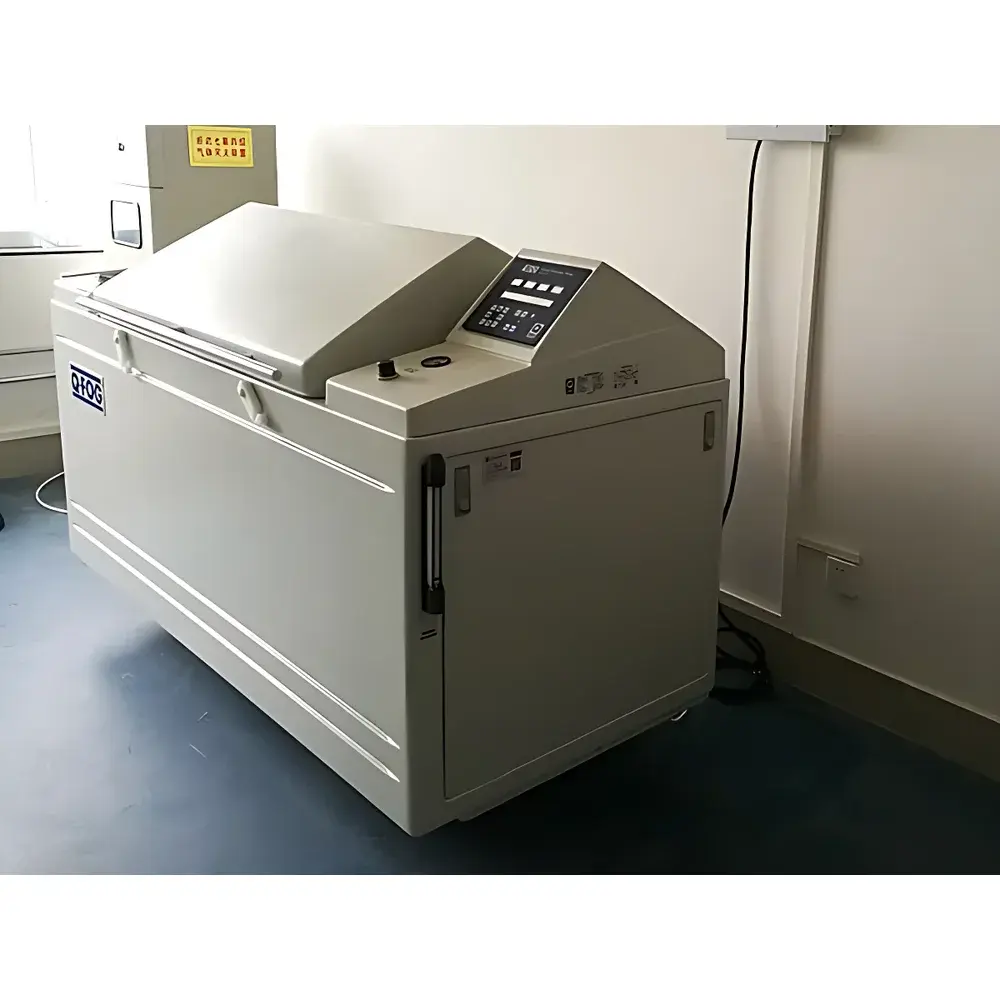
Q-Lab Q-FOG CRH Cyclic Corrosion Test Chamber
| Brand | Q-Lab |
|---|---|
| Origin | USA |
| Model | Q-FOG CRH |
| Spray Mode | Continuous Spray |
| Spray Rate | 1–5 L/h per 180 cm² |
| Nozzle Pressure | 0.7–1 kg/cm² |
| Fog Removal Method | Air-Pressure Exhaust |
| Salt Fog Deposition Rate | 1–2 mL / 80 cm²·h |
| Temperature Range | 20–60 °C |
| Humidity Control | Yes (via Air Pre-Conditioning System) |
| Optional Spray Module | Yes |
| Chamber Volumes | 640 L (CRH600), 1103 L (CRH1100) |
| Compliance | ASTM B117, ISO 9227, GMW 14872, SAE J2334, Ford CETP, VW PV1210, Renault D17 2025, GB/T 10125, ISO 16701 |
Overview
The Q-Lab Q-FOG CRH Cyclic Corrosion Test Chamber is an engineered solution for accelerated corrosion testing under dynamically controlled environmental conditions. Unlike conventional salt spray chambers limited to static saline fog exposure, the CRH series integrates precise relative humidity (RH) regulation—achieved via a dedicated air pre-conditioning system—alongside programmable temperature control, dry-off cycles, and optional high-flow liquid spray functionality. This enables full execution of automotive cyclic corrosion test (CCT) protocols requiring defined transitions between salt fog, high-humidity soak, drying, and ambient rest phases. The chamber operates on the fundamental principle of simulating real-world atmospheric degradation mechanisms—including electrochemical corrosion, hygroscopic salt deliquescence, and moisture-driven interfacial reactions—by replicating time-dependent variations in chloride ion availability, water activity, and thermal stress. Its architecture supports reproducible compliance with internationally recognized standards including ASTM B117 (neutral salt spray), ISO 9227 (accelerated corrosion tests), GMW 14872 (General Motors cyclic corrosion), SAE J2334 (automotive component corrosion), and multiple OEM specifications from Ford, Volkswagen, Renault, Volvo, and Chrysler.
Key Features
- Integrated RH control system utilizing air pre-conditioning, fan modules, and specialized humidification nozzles to maintain stable humidity setpoints across dynamic temperature transitions
- Dual-chamber volume options: CRH600 (640 L internal volume) and CRH1100 (1103 L internal volume), both supporting identical test capabilities
- Optional high-volume spray module delivering larger droplets and higher flow rates than standard atomization—enabling rapid wetting per OEM-defined spray intervals (e.g., Ford CETP)
- Self-cleaning nozzle technology preventing clogging during extended operation—a known failure mode in competitive systems
- Corrosion-resistant fiberglass-reinforced polymer (FRP) construction with structural load capacity up to 544 kg, accommodating large three-dimensional components such as wheel hubs or engine assemblies
- Intuitive touchscreen controller with five-language support (English, French, Spanish, German, Italian), real-time diagnostics, error logging, and automatic safety shutdown
- Programmable ramp rates for temperature and humidity transitions, critical for accurate simulation of natural diurnal cycles
- Onboard 120 L salt solution reservoir with variable-speed peristaltic pump for consistent fog generation
Sample Compatibility & Compliance
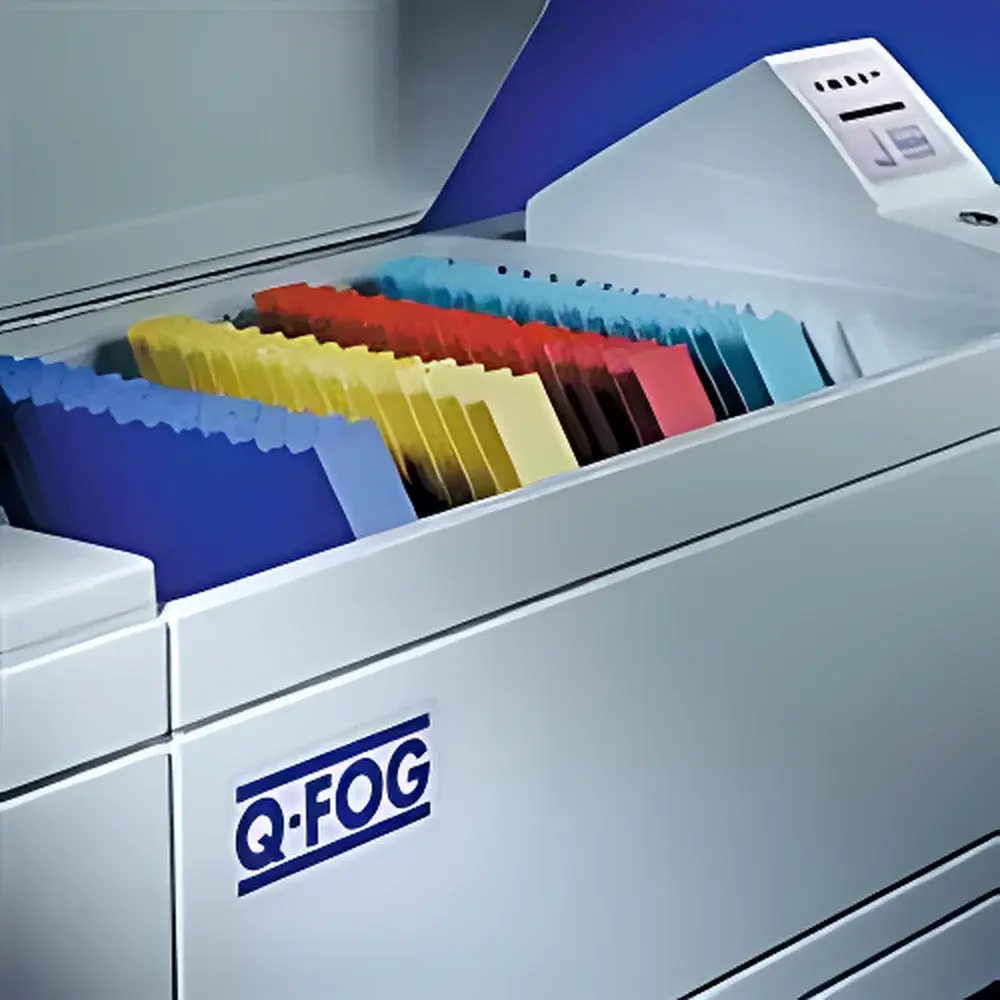
The Q-FOG CRH accommodates flat-panel specimens (e.g., Q-PANEL 75 mm × 150 mm test coupons), vertically mounted at 15° tilt, as well as complex 3D parts via adjustable 20 mm diameter suspension rods or modular grid racks. Standard configurations support up to 160 panels (CRH600) or 240 panels (CRH1100). All mechanical fixtures are designed for uniform weight distribution and long-term stability under corrosive conditions. The chamber meets stringent regulatory requirements for laboratory quality systems: its controller provides audit-trail-capable event logging compliant with GLP and GMP principles; data integrity aligns with FDA 21 CFR Part 11 expectations when paired with validated software configurations. It is routinely deployed in accredited laboratories performing testing per ISO/IEC 17025 and certified to ASTM E2658 (standard practice for qualification of environmental chambers).
Software & Data Management
The embedded Q-FOG controller firmware supports fully customizable multi-step test cycles—including up to 99 segments per program—with independent parameter definition for temperature, RH, spray duration, dry time, and rest periods. Cycle sequences may be imported/exported via USB or Ethernet connection. Optional Q-Lab’s Q-Support software enables remote monitoring, historical trend analysis, and automated report generation in PDF or CSV format. All operational events—including deviations from setpoints, alarm triggers, and maintenance alerts—are timestamped and stored internally for ≥30 days. For regulated environments, optional validation packages include IQ/OQ documentation, traceable calibration records, and electronic signature support meeting ALCOA+ data governance criteria.
Applications
The Q-FOG CRH is extensively used in R&D and quality assurance labs across the automotive, aerospace, electronics, and coating industries. Typical applications include evaluation of electroplated fasteners, painted steel substrates, aluminum alloy enclosures, galvanized sheet metal, and polymer-coated brake calipers. Its ability to replicate field-relevant CCT profiles makes it essential for validating corrosion resistance of new material systems prior to fleet trials. In supplier qualification programs, it serves as a benchmark platform for comparative testing against tier-1 OEM specifications. Academic researchers employ it for mechanistic studies of chloride-induced pitting, crevice corrosion initiation kinetics, and inhibitor performance under cyclic hygrothermal stress.
FAQ
What standards does the Q-FOG CRH support?
It fully complies with ASTM B117, ISO 9227, GMW 14872, SAE J2334, Ford CETP, VW PV1210, Renault D17 2025, GB/T 10125, and ISO 16701.
Is deionized water required for operation?
Yes—deionized water (resistivity ≥1 MΩ·cm) is mandatory for RH control and spray generation to prevent mineral deposition and nozzle fouling.
Can the CRH perform Prohesion testing?
Yes—the CRH executes Prohesion cycles (alternating NaCl fog and UV-free drying) without hardware modification.
How is fog deposition verified?
Using the optional F-9001-K salt fog collection kit (6 calibrated funnels + graduated cylinders), users verify deposition rate per ISO 9227 Annex A.
What maintenance intervals are recommended?
Q-Lab recommends preventive maintenance every 12 months using the F-9125-K CRH Maintenance Kit, which includes replacement nozzles, O-rings, and filtration elements.



