
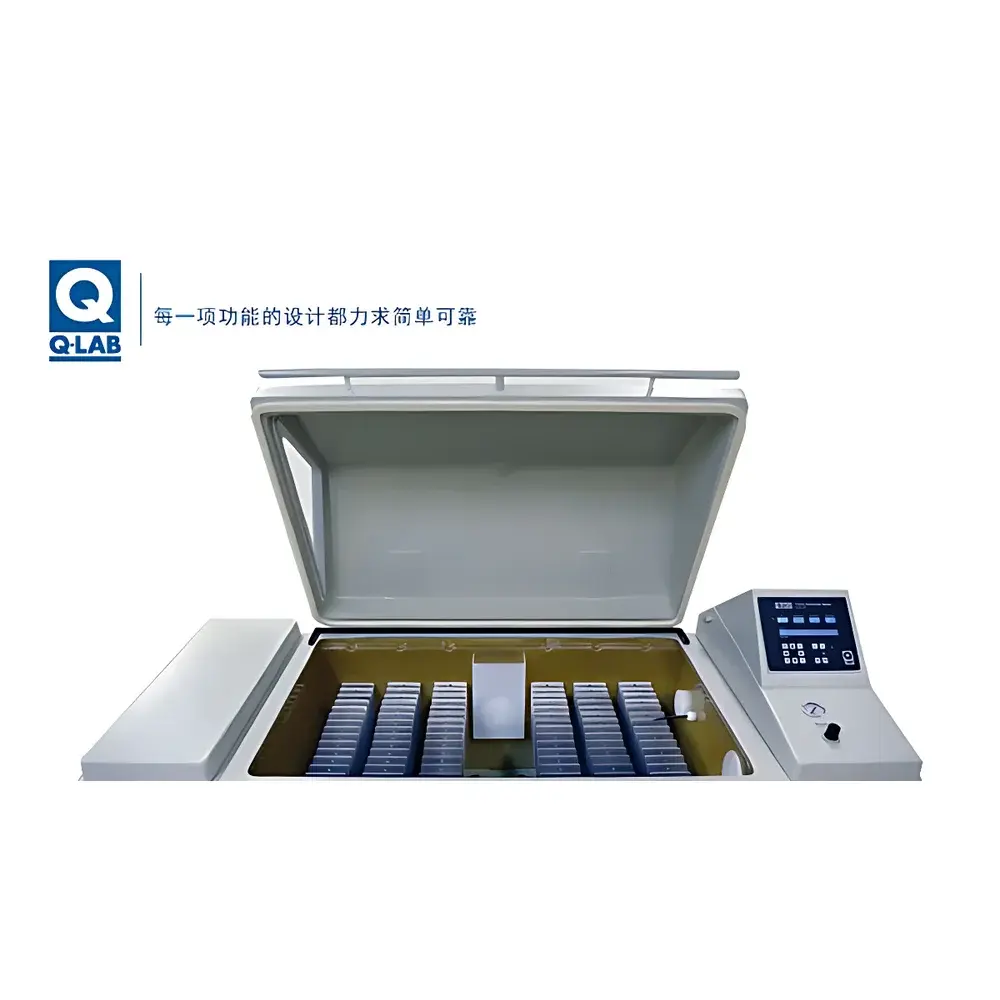
Q-Lab Q-FOG CRH Cyclic Corrosion Test Chamber
| Brand | Q-LAB |
|---|---|
| Origin | USA |
| Model | CRH |
| Compliance | ASTM B117, ISO 9227, GMW14872, SAE J2334, VW PV1210, Ford CETP, Renault D17 2025, Volvo VCS 1027, Chrysler MSJC307 |
| Humidity Control Range | 10–95% RH (programmable) |
| Temperature Range | Ambient +10°C to 50°C |
| Spray System | Air-saturated compressed air + corrosion solution (NaCl, CuCl₂, acetic acid, etc.) |
| Preconditioned Air System | Integrated air pre-conditioner for precise RH ramping |
| Programmable Spray Option | Yes |
| Controller | Microprocessor-based with dual 80-character LCD interface |
| Built-in Test Cycles | ASTM B117, Prohesion™, CCT-1/CCT-IV, GMW14872, SAE J2334, and custom multi-step cycles |
| Data Logging | Time-stamped cycle step tracking, event history, audit trail capability |
| Software Interface | Q-FOG® Control Software (optional PC connectivity) |
| Construction | Fiberglass-reinforced polymer (FRP) chamber body, corrosion-resistant stainless steel hardware |
| Safety Features | Over-temperature protection, low-level solution alarm, door interlock, leak detection |
Overview
The Q-Lab Q-FOG CRH Cyclic Corrosion Test Chamber is an advanced environmental test system engineered for high-fidelity simulation of real-world atmospheric corrosion mechanisms. Unlike conventional salt spray chambers operating solely under static ASTM B117 conditions, the CRH model implements true multi-phase cyclic exposure—integrating precisely controlled salt fog, drying, and humidity/condensation phases within a single chamber. Its core innovation lies in the integrated air pre-conditioning system, which enables dynamic, programmable relative humidity control from 10% to 95% RH independent of temperature, allowing accurate replication of dew formation, hygroscopic salt deliquescence, and electrochemical activity critical to automotive, aerospace, and infrastructure material degradation studies. Designed to meet stringent OEM and international regulatory requirements—including GMW14872, SAE J2334, ISO 16701, and VW PV1210—the CRH platform supports full compliance with GLP and GMP-aligned validation protocols when paired with Q-Lab’s optional 21 CFR Part 11-compliant software suite.
Key Features
- Triple-phase cycling capability: Salt spray, dry-off, and high-humidity/condensation stages—all executed sequentially or concurrently within one chamber
- Air pre-conditioning system enabling stable, repeatable RH control across wide temperature ranges without reliance on steam injection alone
- Programmable spray function with adjustable duration, frequency, and solution composition (e.g., neutral salt fog, acidic salt fog per ISO 9227)
- Microprocessor-based controller with dual-line LCD interface and intuitive keyboard navigation for cycle editing, execution, and diagnostics
- Built-in diagnostic cycle (Cycle I) for functional verification of all environmental subsystems—temperature, humidity, spray, airflow, and safety interlocks
- Fiberglass-reinforced polymer (FRP) chamber construction with stainless steel internal hardware, ensuring long-term resistance to chloride-induced degradation
- Comprehensive safety architecture: over-temperature cutoff, low-solution-level alarm, door interlock, and automatic leak detection
Sample Compatibility & Compliance
The Q-FOG CRH accommodates flat panels, coated components, fasteners, electronic enclosures, and assembled subassemblies up to standard chamber dimensions (e.g., CRH-1100: 1100 L internal volume). Sample racks are configurable for vertical or angled orientation to optimize salt deposition uniformity per ISO 9227 Annex A. The system complies with key corrosion testing standards including ASTM B117 (neutral salt spray), ASTM G85 Annex A5 (Prohesion™), ISO 9227, ISO 16701 (cyclic corrosion testing), and OEM-specific specifications such as Ford CETP 00.00-L-467, VW PV1210, and Renault D17 2025. All operational parameters—including temperature ramp rates, RH transition profiles, and spray onset timing—are traceable and auditable, supporting IQ/OQ/PQ validation in regulated environments.
Software & Data Management
While the CRH operates autonomously via its embedded microcontroller, optional Q-FOG® Control Software enables remote monitoring, cycle library management, and export of time-stamped event logs (CSV/Excel). When configured for 21 CFR Part 11 compliance, the software provides electronic signatures, role-based access control, and immutable audit trails for all parameter changes and cycle executions—essential for pharmaceutical, medical device, and automotive Tier 1 supplier quality systems. Data integrity is reinforced through redundant storage and timestamp synchronization with NTP servers. No cloud dependency: all logging and configuration reside locally unless explicitly enabled via secure LAN connection.
Applications
The CRH chamber serves as a primary tool in corrosion R&D labs, QC laboratories, and tiered supplier validation centers across automotive OEMs, defense contractors, and infrastructure materials developers. Typical use cases include evaluating paint adhesion under cyclic wet/dry stress, assessing galvanized steel passivation stability, qualifying aluminum alloy anodizing processes, validating sealant durability against chloride ingress, and benchmarking cathodic protection performance in coated steel systems. Its ability to reproduce condensation-driven corrosion kinetics makes it particularly valuable for studying underfilm corrosion, filiform propagation, and crevice corrosion initiation—phenomena poorly modeled by static salt fog alone.
FAQ
What distinguishes the CRH from the CCT model?
The CRH adds an integrated air pre-conditioning system that enables precise, independent RH control during drying and transition phases—whereas the CCT relies solely on steam injection for humidity and lacks fine-grained RH ramping capability.
Can the CRH perform ASTM B117 testing?
Yes—CRH fully supports ASTM B117, ISO 9227, and Prohesion™ protocols, with identical spray generation mechanics and chamber uniformity specifications.
Is third-party calibration documentation available?
Q-Lab provides factory calibration certificates traceable to NIST standards for temperature, humidity, and spray rate; on-site calibration services are available globally through authorized partners.
How is data integrity ensured during long-duration tests?
All cycle steps, setpoints, deviations, and alarms are logged with millisecond timestamps in non-volatile memory; optional software adds digital signature and change history tracking.
Does the CRH support custom test sequences beyond built-in cycles?
Yes—users may define up to 99 custom cycles with up to 99 steps each, specifying dwell times, target RH/temperature, spray activation, and airflow modes per step.



