
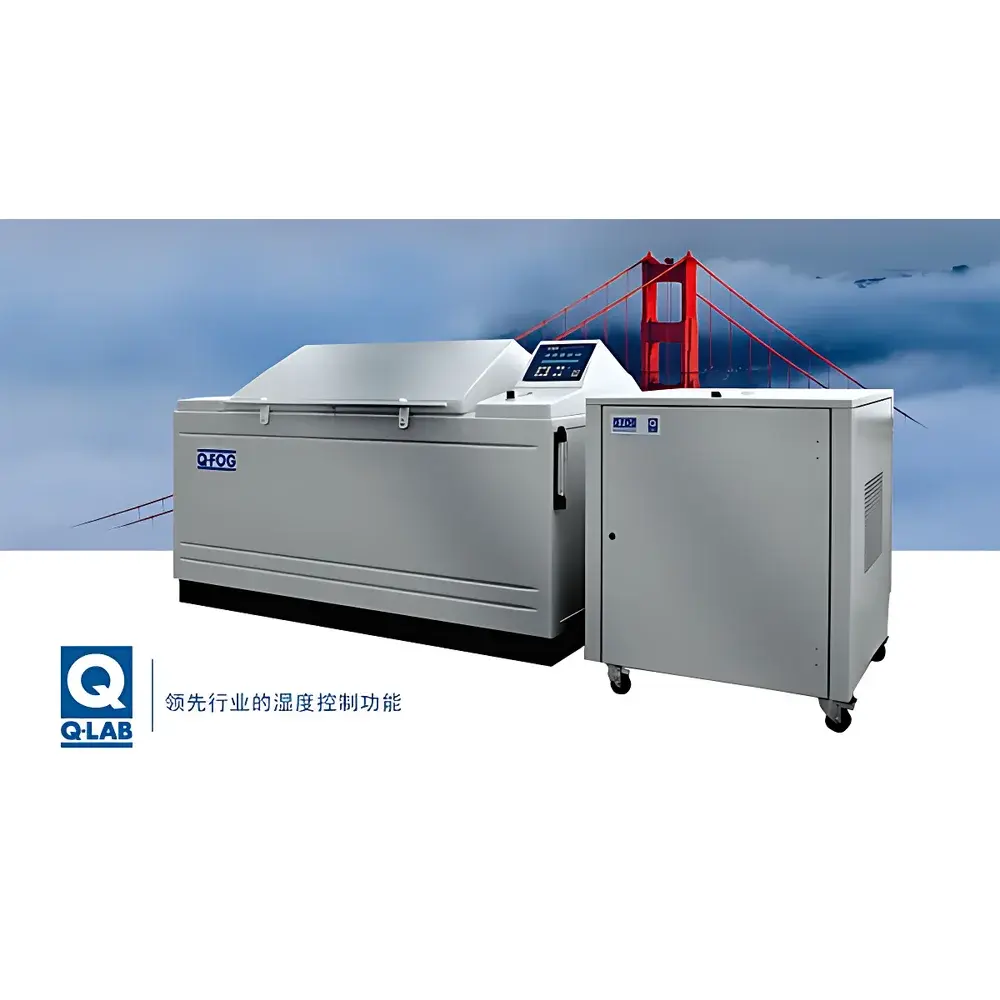
Q-Lab Q-FOG CRH Series Cyclic Corrosion Test Chamber
| Brand | Q-LAB |
|---|---|
| Origin | USA |
| Model | Q-FOG CRH |
| Chamber Capacity | 640 L (CRH600-HSC) / 1103 L (CRH1100-HSC) |
| Temperature Range | Ambient to 70 °C (operational range per test standard) |
| Relative Humidity Control | 30–95% RH (with air pre-conditioning system) |
| Salt Spray Deposition Rate | Adjustable via precision peristaltic pump and compressed air regulation |
| Spray Nozzle Type | Corrosion-resistant, self-cleaning atomizing nozzles |
| Optional Features | Integrated spray module (high-volume liquid delivery), programmable dry/wet/humidity/cycle sequences |
| Compliance | Designed to meet ASTM B117, ISO 9227, ISO 16701, GMW 14872, SAE J2334, Ford CETP, VW PV1210, Renault D17 2027, GB/T 10587, and other automotive & industrial cyclic corrosion standards |
Overview
The Q-Lab Q-FOG CRH Series is an advanced cyclic corrosion test chamber engineered for high-fidelity simulation of real-world atmospheric degradation mechanisms. Unlike conventional salt spray chambers operating solely under static saline fog conditions (e.g., ASTM B117), the CRH platform integrates three distinct exposure modes—salt fog, high-humidity conditioning, and optional water spray—within a single, tightly controlled environment. Its core innovation lies in the patented air pre-conditioning system, which enables precise, stable relative humidity control (30–95% RH) across temperature ranges from ambient to 70 °C. This capability supports multi-phase corrosion protocols where hygroscopic salt residues interact dynamically with moisture-driven electrochemical processes—a critical requirement for validating automotive coatings, galvanized substrates, and multi-layer metallic assemblies per GMW 14872, SAE J2334, and ISO 16701. The chamber’s robust stainless-steel construction, internal heating/cooling architecture, and integrated deionized water management system ensure thermal stability, rapid transition between test phases (<15 min typical for 25 °C ↔ 60 °C shifts), and long-term operational reliability under continuous duty cycles.
Key Features
- Triple-mode exposure control: programmable salt fog (ASTM B117-compliant), high-humidity conditioning (ISO 9227 Prohesion-compatible), and optional high-flow water spray (for accelerated wetting per Ford CETP or VW PV1210)
- Air pre-conditioning system with independent RH and temperature regulation—eliminates condensation artifacts and ensures uniform chamber-wide humidity distribution
- Self-cleaning, corrosion-resistant atomizing nozzles with adjustable deposition rate via variable-speed peristaltic pump and regulated compressed air supply
- Modular spray head assembly: spray module detaches without tools during fog-only cycles, preventing cross-contamination and nozzle clogging
- Integrated 120 L deionized water reservoir with particulate filtration, low-level alarm, and auto-refill interface (supports ≥7 days unattended operation)
- Intelligent microprocessor controller with full-cycle programming, real-time status monitoring, diagnostic logging, and scheduled maintenance alerts
- Ergonomic low-profile design with front-access hinged lid and internal LED lighting for visual inspection during operation
Sample Compatibility & Compliance
The Q-FOG CRH accommodates flat-panel specimens (e.g., Q-PANEL 75 mm × 150 mm test coupons) on standardized vertical-angle (15°) racks—eight racks (160 samples) in the CRH600-HSC model; ten racks (240 samples) in the CRH1100-HSC. For three-dimensional components—including wheel hubs, engine brackets, or chassis subassemblies—custom mounting options include 20 mm diameter suspension rods and full-height grating kits rated for up to 544 kg total load. All sample fixtures are constructed from non-reactive, corrosion-inert materials to prevent interference with electrochemical test outcomes. The system complies with GLP-aligned validation requirements: temperature and RH sensors are user-calibratable every six months using traceable reference instruments (e.g., NIST-traceable thermometer and saturated salt solution chamber), and firmware supports audit-ready calibration logs. Full compliance documentation—including test method alignment matrices (LF-8131), installation qualification (IQ) templates, and operational qualification (OQ) checklists—is available upon request for GMP-regulated environments.
Software & Data Management
The embedded Q-FOG controller runs deterministic real-time firmware supporting ISO/IEC 17025-aligned data integrity practices. All test parameters—including phase duration, setpoint tolerances (±0.5 °C, ±3% RH), spray timing, and fault events—are timestamped and stored internally with battery-backed memory retention. Exportable CSV logs include sensor readings at user-defined intervals (1–60 min), enabling traceability for FDA 21 CFR Part 11–compliant workflows when paired with Q-Lab’s optional Q-FOG Connect software (Windows-based, with electronic signature and role-based access controls). The controller features built-in self-diagnostics: predictive warnings for filter replacement, pump wear, or nozzle flow deviation; automatic shutdown on critical parameter excursions; and configurable alarm outputs for facility SCADA integration. No cloud dependency or external licensing is required—firmware updates are delivered via USB flash drive with cryptographic signature verification.
Applications
The Q-FOG CRH is deployed globally in Tier 1 automotive OEM laboratories, Tier 2 supplier QC labs, and independent testing service providers for accelerated corrosion validation of coated steel, aluminum alloys, zinc-nickel platings, and polymer-coated fasteners. Its ability to replicate field-relevant failure modes—such as crevice corrosion under dried salt crusts, blistering at coating defects during humidity cycling, and galvanic degradation at bimetallic interfaces—makes it indispensable for R&D of cathodic protection systems and eco-friendly pretreatment chemistries. Beyond automotive, it supports aerospace material qualification per SAE AMS 2700, marine hardware testing per ISO 12944, and infrastructure component evaluation per EN ISO 12944-6. The CRH’s programmable spray function enables development of proprietary corrosion-accelerated test methods aligned with internal durability targets—without reliance on third-party test houses.
FAQ
What deionized water specifications are required for CRH operation?
Q-Lab specifies resistivity ≥5 MΩ·cm (≤0.2 µS/cm conductivity) and silica content <10 ppb. Use of lower-purity water accelerates nozzle scaling and compromises RH stability.
Can the CRH perform ASTM B117-only tests?
Yes—the controller includes preloaded B117 mode with automated salt solution feed, temperature hold, and fog collection monitoring per standard requirements.
Is third-party certification available for temperature and RH uniformity mapping?
Q-Lab provides IQ/OQ documentation packages and partners with ISO/IEC 17025-accredited service providers for on-site thermal mapping (per IEC 60068-3-5) and humidity uniformity validation.
How often must the air pre-conditioning system be serviced?
The desiccant cartridge requires replacement every 12 months under continuous use; the humidification saturator tray should be cleaned quarterly to prevent mineral buildup.
Are spare nozzles and maintenance kits supplied with initial purchase?
Each CRH shipment includes the F-8064-K nozzle cleaning kit (1-year supply of acetic acid and eight replacement nozzles) and the F-9125-K preventive maintenance kit (filters, O-rings, calibration tools).



