
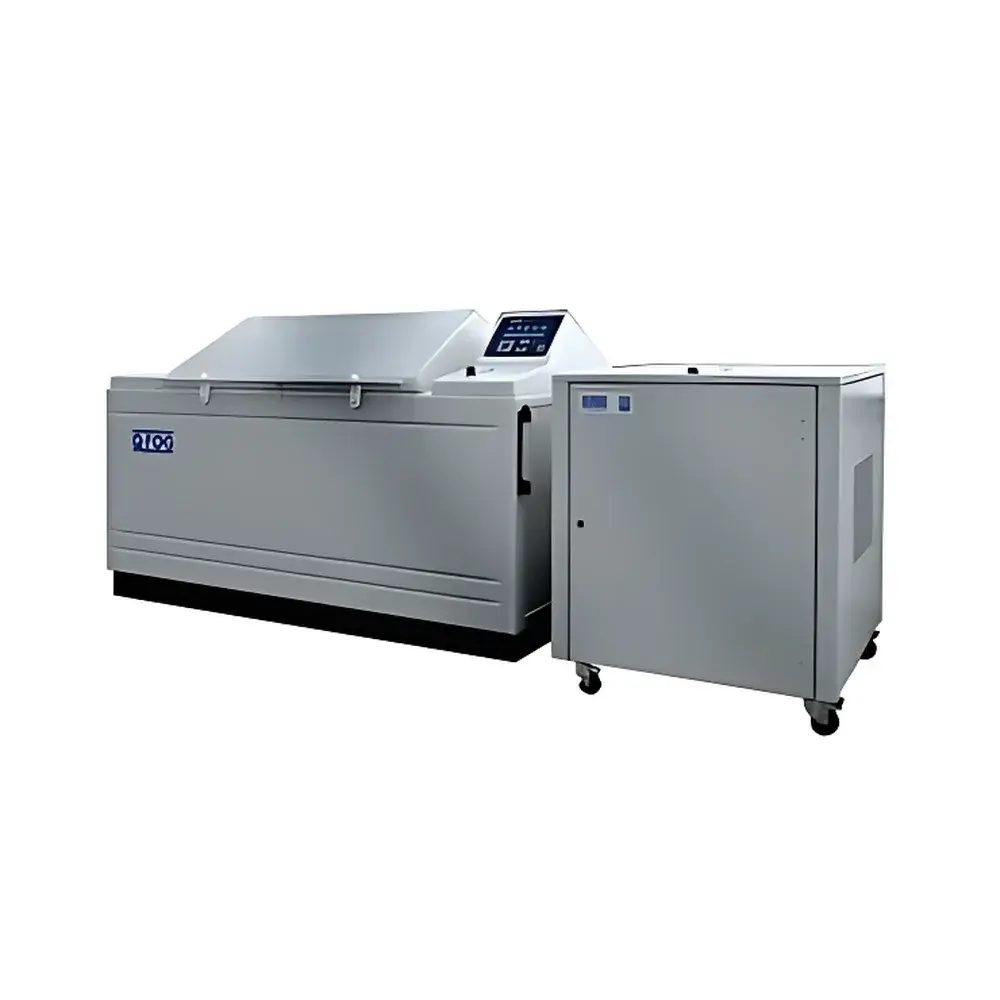
Q-LAB Q-FOG CRH1100 Salt Spray and Humidity Cycling Corrosion Test Chamber
| Brand | Q-LAB |
|---|---|
| Origin | USA |
| Model | Q-FOG CRH1100 |
| Chamber Capacity | 1103 L |
| Temperature Range | Ambient +10°C to 50°C (operational, adjustable per cycle phase) |
| Relative Humidity Control Range | 10% to 95% RH (±2% RH accuracy, typical) |
| Salt Fog Deposition Rate | 1.0–2.0 mL/80 cm²/h (adjustable via variable-speed peristaltic pump and regulated air pressure) |
| Spray Nozzle Type | Self-cleaning, corrosion-resistant ceramic nozzle array |
| Preconditioned Air System | Integrated dual-stage air pre-conditioning module for precise RH ramping and stabilization |
| Optional Features | Programmable rinse/spray module, internal LED lighting, viewing window, DI water requirement, built-in 120 L solution reservoir with level sensor and particulate filtration |
Overview
The Q-LAB Q-FOG CRH1100 is a fully programmable, high-fidelity cyclic corrosion test chamber engineered for laboratories requiring ISO 9227, ASTM B117, ASTM G85 Annex A5 (Prohesion), GMW 14872, SAE J2334, Ford CETP, VW PV1210, Renault D17 2027, and ISO 16701-compliant environmental simulation. Unlike conventional static salt spray chambers, the CRH1100 implements dynamic, multi-phase corrosion cycling—integrating controlled salt fog exposure, high-humidity condensation, low-humidity drying, and optional rinse phases within a single test sequence. Its core innovation lies in the integrated air pre-conditioning system, which enables precise, repeatable relative humidity (RH) control across all cycle segments—not merely during humidification, but also during temperature transitions and dry-out phases. This architecture replicates the thermodynamic and electrochemical drivers of real-world atmospheric corrosion more faithfully than fixed-setpoint chambers. The chamber operates exclusively with deionized water (≥1 MΩ·cm resistivity) to prevent mineral deposition and ensure long-term sensor stability and nozzle integrity.
Key Features
- Advanced RH control architecture: Dual-stage air pre-conditioning module with independent heating, cooling, and humidification paths ensures ±2% RH accuracy and programmable RH ramp rates (e.g., 10% RH/min to 95% RH/min)
- Variable salt fog delivery: Peristaltic pump with speed modulation and calibrated air pressure regulation enable independent control of deposition rate (1.0–2.0 mL/80 cm²/h) and spray distance—eliminating coupling between fog density and impact geometry
- Self-cleaning ceramic nozzle array: Prevents clogging from crystallized salts; requires no manual disassembly or ultrasonic cleaning during routine operation
- Programmable rinse module (optional): High-flow, large-droplet spray with user-defined on/off timing and flow-rate adjustment—designed specifically for automotive OEM specifications requiring aggressive surface washing between cycles
- Integrated 120 L solution reservoir: Equipped with particulate filter, liquid-level sensor, and audible/visual low-level alarm; supports unattended operation for ≥7 days under typical test profiles
- Thermal agility: Internal heater + high-CFM cooling/drying fan enables rapid transition between cycle phases (e.g., 50°C → 25°C in <12 min; 95% RH → 10% RH in <25 min), critical for simulating diurnal condensation/drying dynamics
- Ergonomic design: Low-profile access door, front-loading configuration, and internal LED lighting facilitate easy sample loading/unloading and real-time visual monitoring through the side-mounted tempered glass viewport
Sample Compatibility & Compliance
The Q-FOG CRH1100 accommodates up to 240 standard 75 mm × 150 mm test panels or equivalent irregularly shaped components (max. height: 450 mm). Rack configurations support vertical, angled, or stacked orientations per ASTM G85 and ISO 11997 requirements. All internal wetted surfaces are constructed from non-reactive polypropylene and fiberglass-reinforced polymer; stainless steel fasteners meet ASTM F519 specifications. The chamber complies with electrical safety standards IEC 61010-1 and UL 61010-1. For regulated environments, the controller supports audit-trail-enabled operation compliant with FDA 21 CFR Part 11 when paired with Q-LAB’s optional Q-FOG Connect software and network authentication. Calibration intervals follow Q-LAB’s recommended six-month schedule for temperature and RH sensors—traceable to NIST-certified references using portable calibration kits (LF-8131).
Software & Data Management
The embedded Q-FOG controller features a 7-inch color touchscreen interface with intuitive icon-based navigation. Users define multi-step cycles—including temperature, RH, fog duration, rinse timing, and dwell periods—via drag-and-drop sequencing or direct parameter entry. Each cycle stores full metadata: start time, operator ID, firmware version, and calibration status. Real-time graphs display chamber temperature, RH, and fog status; historical data exports to CSV or PDF via USB or Ethernet. Optional Q-FOG Connect software enables remote monitoring, centralized fleet management, automated report generation (including ISO/ASTM-compliant test certificates), and integration with LIMS platforms via RESTful API. All data logs include timestamps with millisecond resolution and are stored redundantly—on-device and optionally to network drives—to satisfy GLP/GMP documentation requirements.
Applications
The CRH1100 is deployed globally in automotive OEM validation labs (e.g., tier-1 suppliers performing GMW 14872 qualification), aerospace material screening (per ASTM D1654 for coated aluminum alloys), electronics corrosion resistance testing (IEC 60068-2-52), and infrastructure coating certification (ISO 12944 C5-M). Its ability to replicate coastal, industrial, and inland atmospheric degradation mechanisms makes it suitable for evaluating galvanized steel, zinc-nickel plating, e-coats, powder coatings, and polymer composites. Research institutions use its programmability to isolate individual corrosion accelerants—e.g., chloride ion ingress vs. cyclic hygrothermal stress—enabling mechanistic studies published in journals such as Corrosion Science and Electrochimica Acta.
FAQ
What deionized water specifications are required for stable CRH1100 operation?
Minimum resistivity of 1 MΩ·cm at 25°C; total organic carbon (TOC) <50 ppb recommended to prevent biofilm formation in reservoir and tubing.
Can the CRH1100 perform ASTM B117 without humidity control?
Yes—the controller allows disabling RH modulation to run pure salt fog mode while retaining all other precision controls (temperature, deposition rate, timer accuracy).
Is third-party calibration support available for the CRH1100?
Q-LAB maintains an international network of ISO/IEC 17025-accredited service partners who provide on-site sensor verification, system performance qualification (SPQ), and IQ/OQ documentation per GAMP 5 guidelines.
How does the air pre-conditioning system differ from standard humidification systems?
Standard chambers add moisture to ambient air; the CRH1100 conditions incoming air to precise dew point and temperature before injection—ensuring RH stability even during rapid thermal transients.
What maintenance intervals are recommended for the rinse module?
Nozzle inspection every 200 operational hours; full rinse-system flush with DI water after each test series involving organic contaminants or high-solids solutions.



