
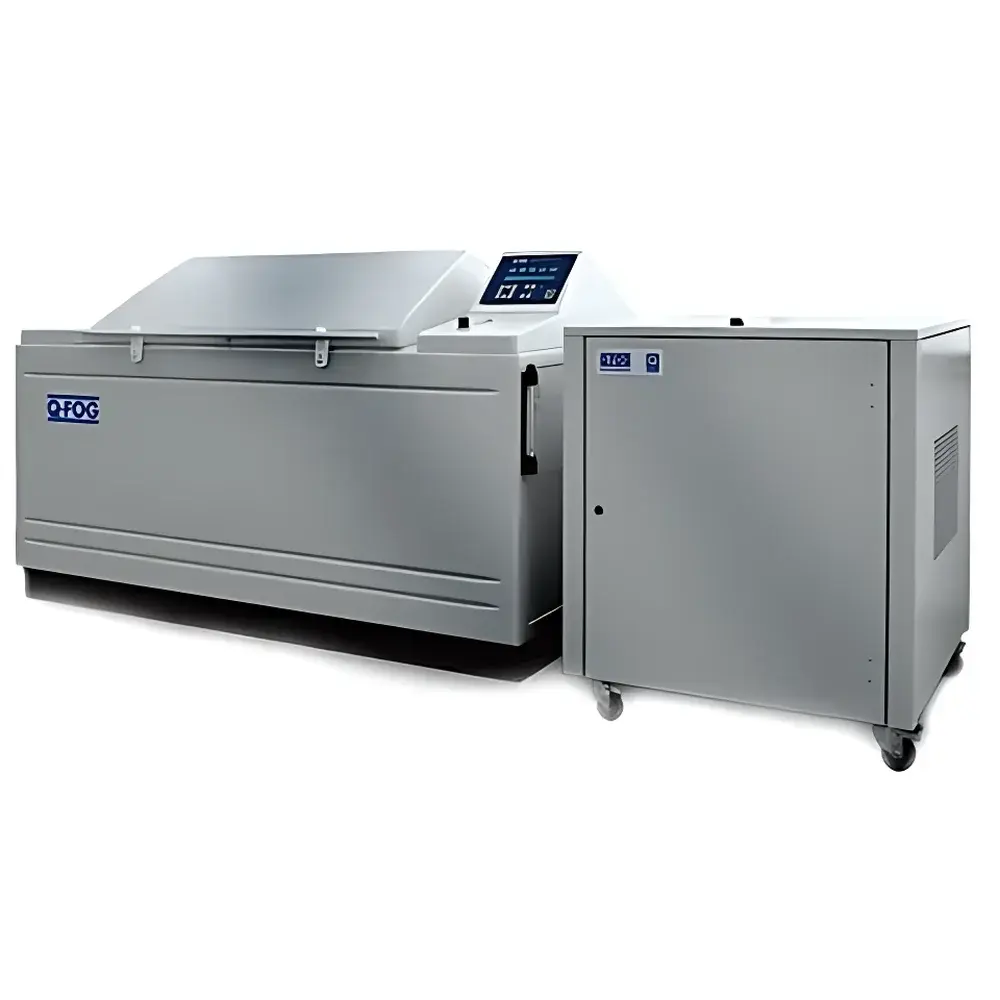
Q-Lab Q-FOG Cyclic Corrosion Test Chamber
| Brand | Q-Lab |
|---|---|
| Origin | USA |
| Model | Q-FOG |
| Spray Mode | Continuous Spray |
| Spray Rate | 1–5 L/h per 180 cm² |
| Nozzle Pressure | 0.7–1 kg/cm² |
| Fog Removal Method | Air-Compression Exhaust |
| Salt Fog Deposition Rate | 0.5–3 mL/h·80 cm² |
| Temperature Range | Ambient to 70 °C |
Overview
The Q-Lab Q-FOG Cyclic Corrosion Test Chamber is an engineered environmental test system designed to replicate and accelerate corrosion mechanisms encountered in real-world service conditions—particularly those involving alternating exposure to salt spray, high humidity, drying, and ambient storage phases. Unlike traditional continuous-salt-spray chambers operating under static ASTM B117 conditions, the Q-FOG platform implements programmable multi-phase cycles grounded in electrochemical corrosion science: chloride ion penetration, hygroscopic moisture absorption, oxygen diffusion, and electrolyte evaporation drive localized pitting, crevice corrosion, and coating delamination. Its architecture supports three core configurations—SSP (Salt Spray & Dry), CCT (Cyclic Corrosion with 95–100% RH), and CRH (Cyclic Corrosion with fully variable relative humidity control)—each calibrated to meet internationally recognized test standards including ISO 9227, ASTM G85 Annexes, GMW 14872, SAE J2334, and VW PV 1210. The chamber’s reinforced fiberglass-reinforced polymer (FRP) construction eliminates internal metallic components susceptible to corrosion, ensuring long-term dimensional stability and chemical inertness across decades of operation.
Key Features
- Corrosion-resistant FRP chamber body with no internal steel framing—eliminates galvanic coupling and structural degradation
- Variable-speed peristaltic pump for precise, repeatable salt fog deposition (0.5–3 mL/h·80 cm²), traceable to ISO 9227 calibration protocols
- Integrated air pre-conditioning module (CRH models) enabling programmable RH ramp rates from 10% to 95% at ±2% accuracy, critical for simulating condensation-driven interfacial corrosion
- Dual-zone heating: chamber heater + external air heater for independent control of temperature during dry and humid phases
- Programmable spray, soak, dry, and humidity phases with user-defined transition times—supports rapid thermal cycling (CRHR variant) down to ≤15-minute transitions per ISO 11997 and JASO M609
- Self-cleaning nozzle assembly (CRH/CRHR) mitigates crystallization-induced blockage using timed solution flush cycles
- Intuitive touchscreen controller with five language options (English, French, Spanish, German, Italian), built-in diagnostics, maintenance alerts, and automatic safety shutdown
- Compliance-ready audit trail: timestamped event logging, parameter change history, and alarm records aligned with GLP/GMP documentation requirements
Sample Compatibility & Compliance
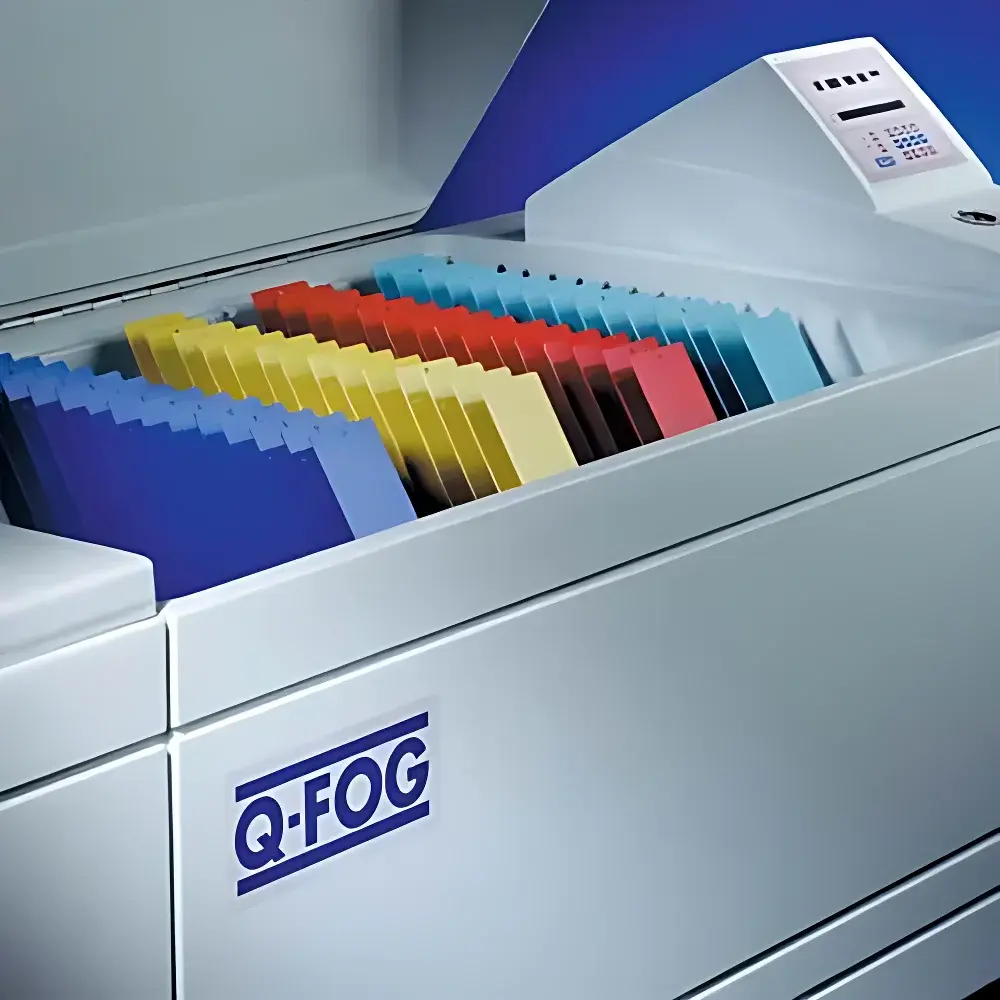
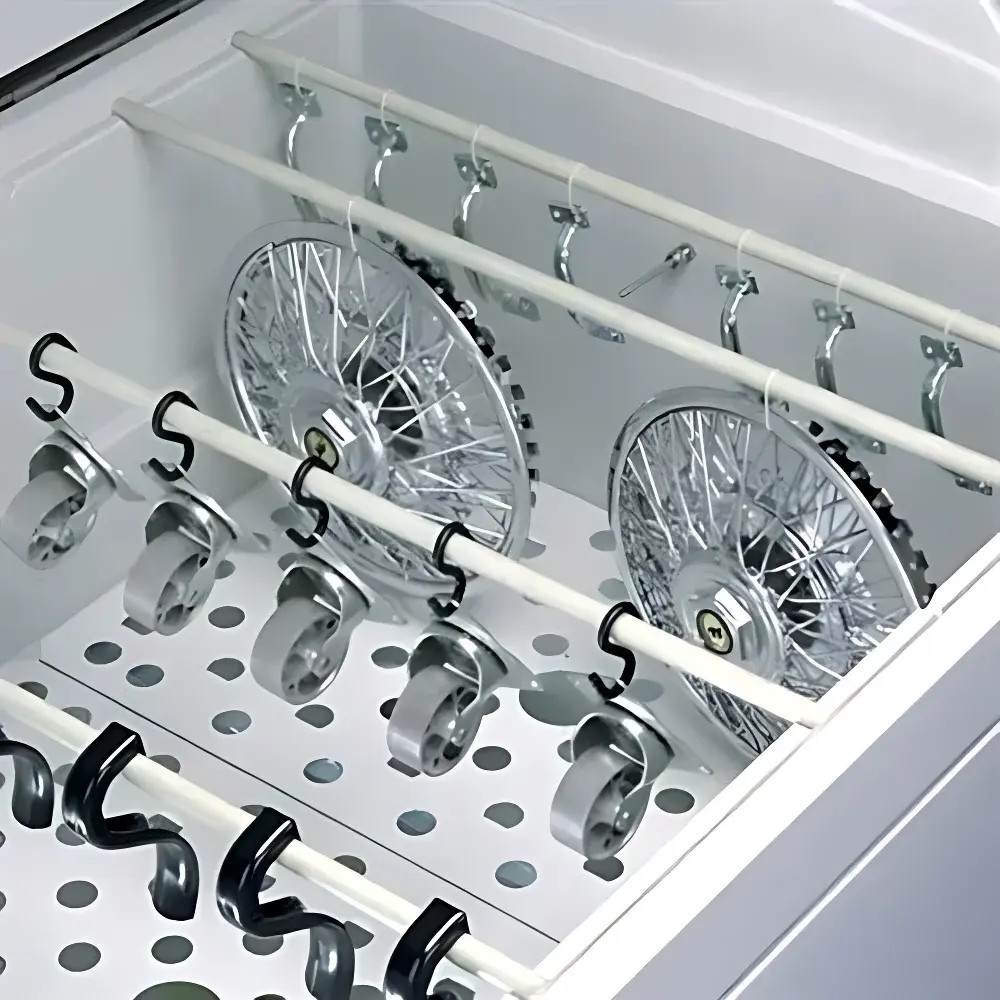
The Q-FOG accommodates diverse specimen geometries—from flat panels (up to 100 × 300 mm) and hanging parts to assembled subassemblies—with standardized mounting fixtures (test board racks, suspension rods, grid trays). All models require deionized water (≥50 kΩ·cm resistivity, <8 ppm TDS) for steam generation and fog humidification. The system meets stringent regulatory expectations: its software architecture supports 21 CFR Part 11-compliant electronic signatures when integrated with Q-Lab’s optional Q-Cloud™ data management suite; humidity and temperature sensors are NIST-traceable; and operational parameters remain within tolerance bands defined by ISO/IEC 17025-accredited laboratories. Validated test methods include automotive OEM specifications (Ford CETP, GMW, VW PV, Renault D17), aerospace standards (MIL-STD-810G, MIL-STD-202G), and international corrosion norms (IEC 60068-2-52, BS 3900 F4/F9, GB/T 10125).
Software & Data Management
Q-FOG controllers feature embedded firmware with non-volatile memory for storing up to 100 user-defined test programs, each supporting up to 99 sequential steps with independent setpoints for temperature, RH, spray duration, and airflow. Real-time monitoring includes graphical trend displays of chamber conditions, deviation alarms, and cycle progress indicators. Optional Q-Cloud™ cloud-based platform enables remote access, centralized fleet management, automated report generation (PDF/CSV), and secure role-based user permissions—fully compliant with FDA 21 CFR Part 11 Annex 11 and EU GMP Annex 11 requirements. Raw sensor data is logged at 1-second intervals with cryptographic hash integrity verification, supporting full auditability during regulatory inspections.
Applications
The Q-FOG is deployed across R&D, quality assurance, and certification labs for evaluating corrosion resistance of coated metals (e.g., Zn-Ni plating, electrophoretic primers), automotive exterior trim, aerospace fasteners, marine hardware, and infrastructure-grade protective coatings. Its multi-phase fidelity enables predictive lifetime modeling for cathodic disbondment in pipeline coatings, blistering kinetics in marine paints, and filiform corrosion propagation under thin organic films. In OEM validation workflows, it replaces months of field exposure with accelerated laboratory testing—reducing time-to-market while maintaining statistical correlation to real-world failure modes documented in ASTM D5894 and ISO 16701.
FAQ
What distinguishes Q-FOG CRH from CCT and SSP models?
The CRH adds fully programmable relative humidity control (10–95% RH) via an air pre-conditioning system, whereas CCT only maintains saturated humidity (95–100% RH) and SSP lacks humidity control entirely.
Is compressed air required—and what purity specifications apply?
Yes: clean, oil-free, desiccated air at 3–8 bar (40–120 psi) with ≤5 µm particulate filtration and coalescing moisture removal is mandatory for consistent fog generation.
Can the Q-FOG perform Prohesion testing?
Yes—SSP, CCT, and CRH models all support 1-hour salt spray / 1-hour dry cycling per ASTM G85 Annex 5, with precise temperature ramping between phases.
Does the system comply with GLP or GMP documentation requirements?
When used with Q-Cloud™ and configured for electronic signature capture, it satisfies ALCOA+ data integrity principles and supports full 21 CFR Part 11 compliance.
What water quality is required for reliable operation?
Deionized water with resistivity ≥50 kΩ·cm, total dissolved solids 200 µm is essential for steam generators and fog nozzles.



